
When buyers ask us about solid wood cat tree wholesale options, the question behind the question is almost always the same: is this actually worth the premium?
It is — but not for every buyer, not for every market, and not for every channel. This guide lays out the practical differences between solid wood and carpet cat trees from a wholesale buyer’s perspective: what you’re actually paying for, what your end customers will notice after six months of use, and how the two material choices position differently on Amazon, in pet specialty retail, and in branded DTC channels.
What “Solid Wood” and “Carpet” Actually Mean at the Factory Level
These two terms describe two completely different construction philosophies, not just surface materials.
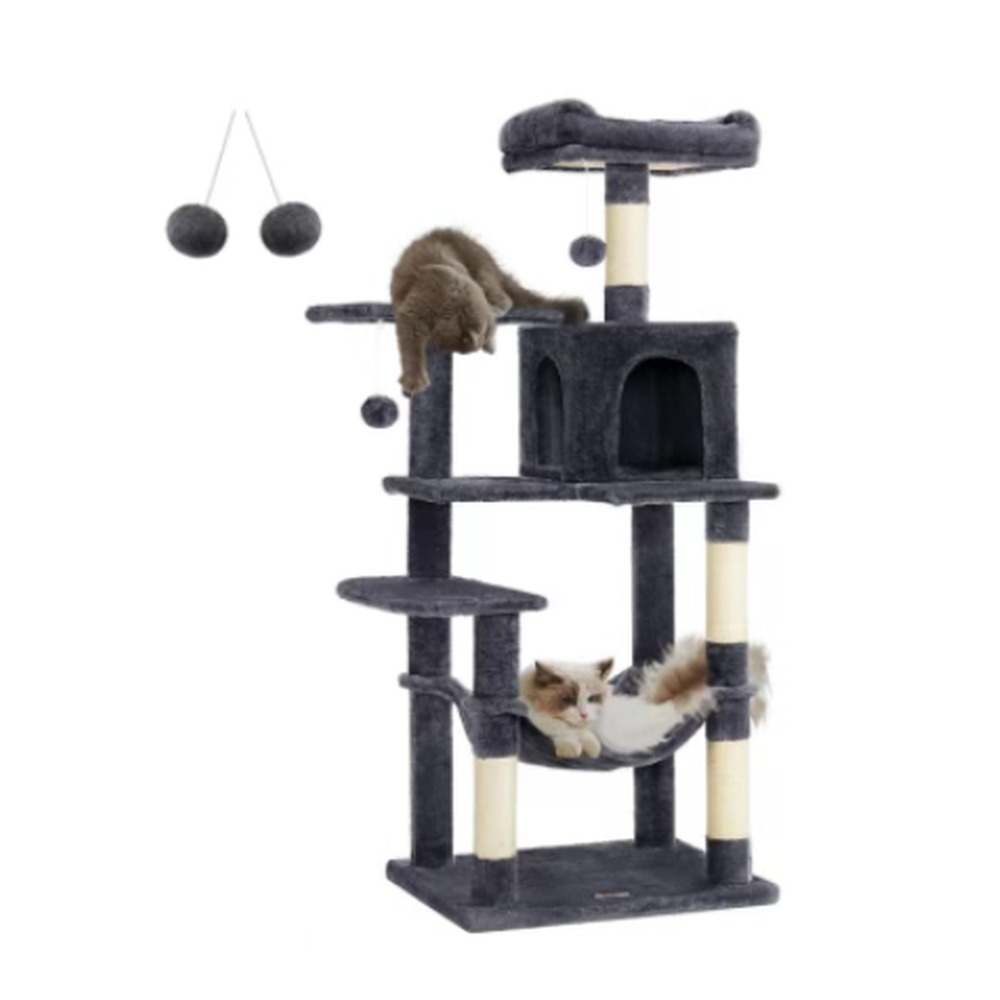
Carpet cat trees are almost universally built on particleboard or MDF cores — engineered wood panels pressed from wood fiber and adhesive. The carpet is wrapped and stapled over these panels, which is why the “wood” underneath rarely appears anywhere in the product listing. Sisal rope is added to scratching posts, fabric to platforms. The structure itself is the cheapest that works.
Solid wood cat trees use actual timber — typically pine, rubber wood, or beech — cut and machined into structural components. The visible surfaces may be painted, stained, or clear-coated, but the material underneath is real wood with grain, natural variation, and structural integrity that comes from fiber alignment, not adhesive chemistry.
This matters because it determines almost every downstream property: weight, durability, smell, cleanability, and how the product looks after a year of use.
Why Solid Wood Cat Tree Wholesale Buyers Are Different from Mass Market Buyers
The mass market for cat trees — Amazon basics, discount pet stores, supermarket pet aisles — runs on carpet and particleboard. These buyers compete on price and volume. Margins are thin, differentiation is minimal, and product life cycles are short.
Solid wood cat tree wholesale buyers are operating in a different category. Their customers are:
- Design-conscious cat owners who want furniture that doesn’t look out of place in a modern apartment
- Premium pet brand founders building a product line that justifies $150–$400 price points
- European and Scandinavian importers where environmental standards and material transparency matter to end consumers
- Amazon private label sellers targeting the mid-to-high end, where reviews mention durability and aesthetics, not just price
If your customer base is buying on price, solid wood will not work for you. If your customers are buying on quality, longevity, or aesthetics — or if you’re building a brand that can command real margin — solid wood is the product that holds the positioning.
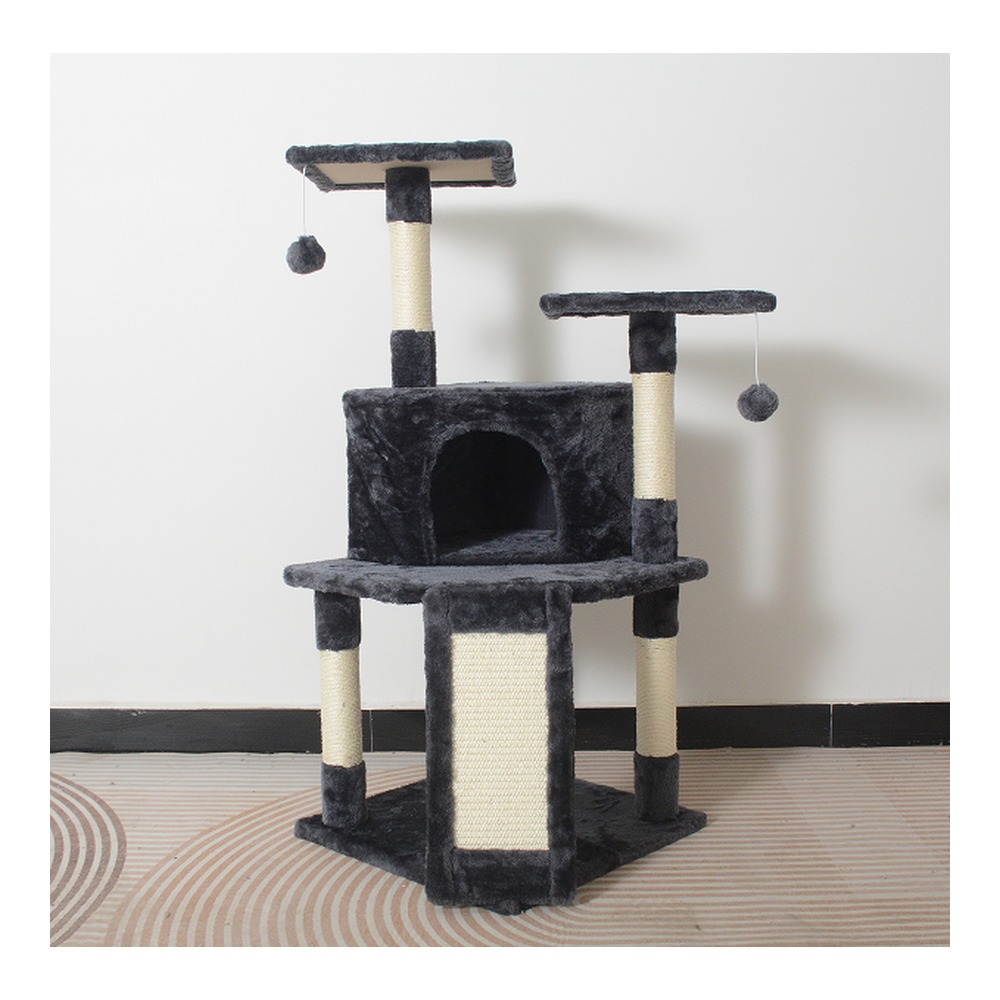
The Practical Differences: A Side-by-Side Comparison
| Factor | Solid Wood Cat Tree | Carpet Cat Tree |
|---|---|---|
| Core material | Real timber (pine / rubber wood / beech) | Particleboard / MDF |
| Surface | Paint, stain, or natural finish | Carpet fabric + sisal rope |
| Weight | Heavier (more stable for large cats) | Lighter (easier to ship, less stable) |
| Durability | 5–10+ years with normal use | 1–3 years before carpet frays/flattens |
| Cleanability | Wipe-down surfaces; no fabric to trap hair | Carpet traps hair, dander, odors |
| Smell (new product) | Neutral to light wood scent | Off-gassing from adhesive + synthetic carpet |
| Customization | High (size, color, finish, engraving) | Low (carpet color, size only) |
| Price point (retail) | $120–$400+ | $30–$150 |
| Typical buyer market | Premium pet, Scandinavian, design-focused | Mass market, value-focused |
The durability gap is the most important number for wholesale buyers making a brand decision. A carpet cat tree that looks fine in the product photo starts to show frayed edges and matted carpet by month four. A customer who paid $200 and is writing a review at month six is judging a different product than the one they bought. Solid wood ages neutrally — a scratched wooden post still looks intentional; a frayed carpet post just looks worn.
What Happens at 12 Months: The Real Durability Test
The most common end-customer complaint about carpet cat trees is not structural failure — it’s aesthetic failure. The carpet pills, the sisal unravels, the fabric platforms develop permanent indentations. None of these make the product non-functional, but all of them make the product look bad, and a product that looks bad generates negative reviews.
Solid wood does not have this problem. The surfaces that cats scratch — wooden posts, wooden platforms — develop character marks that don’t look like failure. The painted surfaces chip occasionally, but localized touch-up is straightforward. Most importantly, hair removal from wood is a wipe; hair removal from carpet is a task.
For Amazon sellers, this durability difference shows up directly in review scores at the 6-month and 12-month mark. Products that hold their appearance generate higher review averages and fewer returns. In a category where the Buy Box is competitive, that review differential compounds over time. According to the American Pet Products Association 2023–2024 industry report, U.S. pet industry spending exceeded $147 billion — and premium, durable product lines are capturing an increasing share of that spend.
Material and Safety Considerations for the European Market
European wholesale buyers face an additional consideration: material compliance. The EU’s REACH regulation restricts certain chemicals in products that come into prolonged contact with consumers — and while cat furniture isn’t regulated the same as children’s toys, importers selling into Germany, the Netherlands, and Scandinavia increasingly face retailer compliance questionnaires that ask about formaldehyde emissions, VOC content, and wood sourcing.
Particleboard and MDF cat trees often use urea-formaldehyde adhesive as the binding agent. The emission levels are typically below EU limits, but the subject line in the compliance questionnaire is uncomfortable. Solid wood doesn’t have this issue — there is no adhesive chemistry in the structural components. For buyers who want to understand EU chemical compliance requirements in full, the ECHA REACH regulation overview is the authoritative reference.
Our materials and certifications cover FSC-certified timber sourcing and CARB certification for formaldehyde compliance, which satisfies the most common retailer compliance requirements in North American and European markets.
When Solid Wood Cat Tree Wholesale Is Not the Right Fit
Being direct: there are buyers for whom carpet remains the right choice.
If you’re supplying a discount pet chain that stocks product below $60 retail, solid wood is not your material. The cost structure doesn’t work, and the customer isn’t asking for it.
If you’re testing a new Amazon listing with a small initial order to validate demand, a lower-cost carpet product lets you do that without the capital commitment of a solid wood order.
If your market is the gift-buying segment — people buying cat trees as birthday presents rather than considered purchases — carpet outsells wood because the visual in the listing reads as “cozy” in ways that a clean wooden product doesn’t.
The question is not which material is objectively better. The question is which material matches your customer’s buying criteria. We can supply both. We will tell you honestly when we think you’re mismatched.
What to Ask Your Supplier Before Ordering
Regardless of which direction you choose, wholesale buyers should ask these questions before placing a solid wood cat tree order:
What timber species is used, and where does it come from? “Solid wood” can mean anything from fast-growth pine to premium beech. The species determines grain appearance, hardness, and how the product responds to humidity changes during ocean shipping.
What is the finish and what are the VOC levels? A painted solid wood cat tree using a high-VOC paint is not a meaningful improvement over a low-emission MDF product for buyers with EU compliance requirements.
What are the MOQ and sample terms? Solid wood cat trees require more setup time at the factory than carpet products. Minimum order quantities and sampling lead times differ accordingly. See our small-batch OEM guide for what realistic quantities look like from a factory structured for solid wood production.
How is the product packaged for shipping? Wood is heavier than particleboard and more susceptible to corner damage if packaging isn’t designed for the material. This is particularly relevant for LCL shipments where cartons are handled more times than FCL.
Starting with Solid Wood Cat Tree Wholesale at SolidPetWood
Our cat tree product range runs from standard solid wood towers and condos to wall-mounted modular systems and outdoor-rated designs. All products are available for OEM customization — size, finish color, platform configuration, LOGO placement, and packaging — with lead times that reflect the actual complexity of solid wood production.
If you are comparing solid wood against carpet options for a new product line, we can send samples of both alongside a cost comparison. The right choice depends on your retail price point, your target customer, and your channel — and those specifics are more useful to us than a generic materials inquiry. Email shelly@solidpetwood.com with your intended retail price and primary sales channel, and we’ll tell you directly which direction makes sense for your situation.
For buyers sourcing from China for the first time, our OEM/ODM process page walks through how we handle sampling, specification approval, and production QC for first-time orders.
OEM/ODM Support
Need a custom cat tree production plan?
Send reference photos, target dimensions, material preferences, packaging needs, and market direction. We can review feasibility, sampling, MOQ, and export packaging before production. Request OEM QuoteRelated Product Lines
Explore wooden cat furniture we can manufacture.
Related Buyer Guides