
Your cat chews on the corner of her wooden house. Your dog licks the surface of his elevated bed. Your customer’s rabbit gnaws on every edge it can reach. Whatever finish is on that furniture ends up in the animal’s mouth.
Choosing a pet safe wood finish isn’t optional — it’s a product liability issue. The wrong coating can release volatile organic compounds (VOCs) during off-gassing, contain toxic pigments, or flake off into digestible chips. The right one protects the wood, looks good, and stays inert even when an animal chews on it.
Why Pet Safe Wood Finish Matters for Buyers
If you’re sourcing solid wood pet furniture from a manufacturer, the finish is one of the first things your customers will ask about. Pet owners are increasingly aware of chemical safety — and they check.
Common concerns:
- VOC off-gassing — fresh furniture releases volatile organic compounds that pets (with smaller lungs and faster breathing rates) are more sensitive to than humans
- Chewing and ingestion — cats and dogs chew wood surfaces; finish material enters the digestive system
- Skin contact — pets sleep on, rub against, and sit on finished surfaces for hours daily
- Allergic reactions — some finishes contain formaldehyde-based resins that trigger respiratory sensitivity
According to the U.S. Consumer Product Safety Commission (CPSC), furniture safety standards apply to pet products sold in the US market when they are marketed as “furniture.” This means your pet furniture finish must meet the same chemical safety expectations as human furniture.
Types of Pet Safe Wood Finish
Water-Based Polyurethane
Best all-around choice for commercial pet furniture.
Water-based polyurethane is the industry standard for pet safe wood finish in mass production. It forms a hard, clear protective layer that resists scratches, moisture, and pet saliva.
| Property | Water-Based Polyurethane |
|---|---|
| VOC content | Low (< 150 g/L) |
| Dry time | 2–4 hours between coats |
| Durability | High (scratch-resistant) |
| Food/pet safe after curing | Yes (fully cured = 21–30 days) |
| Cost | Low–medium |
| Appearance | Clear, slight sheen |
Key point: water-based polyurethane is pet safe after full curing — not immediately after application. The 21–30 day curing period is when VOCs fully off-gas. Manufacturers should apply the finish early enough in the production cycle that curing completes before shipping.
Natural Oil Finishes (Linseed, Tung, Hemp)
Premium option for high-end pet furniture brands.
Natural oils penetrate the wood rather than forming a surface film. They’re inherently non-toxic once cured and give wood a warm, natural appearance that appeals to the eco-conscious market segment.
| Property | Natural Oil Finish |
|---|---|
| VOC content | Very low to zero |
| Dry time | 24–72 hours per coat |
| Durability | Medium (needs reapplication over time) |
| Food/pet safe after curing | Yes |
| Cost | Medium–high |
| Appearance | Natural, matte, enhances grain |
Tung oil is the most durable natural option. Linseed oil (specifically boiled linseed oil) is the most common. Raw linseed oil takes days to dry and is not practical for production environments.
Trade-off: natural oil finishes are less scratch-resistant than polyurethane. For products that will be chewed heavily (rabbit furniture, cat scratching-related items), polyurethane is more practical.
Wax Finishes (Beeswax, Carnauba)
Good for decorative pieces, poor for heavy-use pet furniture.
Wax creates a soft, tactile surface that feels pleasant but offers minimal protection against moisture, scratches, and chewing. It’s fully non-toxic, making it technically the safest pet safe wood finish — but it doesn’t last.
| Property | Wax Finish |
|---|---|
| VOC content | Zero |
| Durability | Low (reapply every 3–6 months) |
| Pet safe | Yes (immediately) |
| Cost | Low |
| Appearance | Soft sheen, natural feel |
Wax is best suited for indoor decorative pet furniture where durability is secondary to aesthetics — think boutique cat shelves or display-grade pet houses.
Finishes to Avoid
Not every wood finish is safe for pet products. These should be excluded from your specifications:
| Finish Type | Why Avoid |
|---|---|
| Oil-based polyurethane | High VOC (350+ g/L), slow curing, toxic before fully cured |
| Lacquer (nitrocellulose) | Extremely high VOC, flammable, off-gasses for weeks |
| Shellac (with additives) | Some commercial shellac contains methanol |
| Stains with lead or chromium pigments | Toxic metals — illegal in many markets for pet products |
| Painted finishes with unknown composition | If the paint supplier can’t provide an MSDS, don’t use it |
How to Specify Pet Safe Wood Finish in Your OEM Order
When working with a pet furniture manufacturer, specify the finish clearly in your requirements document:
1. Name the finish type explicitly
Don’t write “safe finish” or “non-toxic coating.” Write:
- “Water-based polyurethane, VOC < 150 g/L, 2 coats”
- “Tung oil, food-grade, 3 coats with 48-hour dry time between coats”
2. Request the Material Safety Data Sheet (MSDS)
Every legitimate finish product has an MSDS. Ask your manufacturer to provide the MSDS for the exact finish they’ll use. This document lists:
- Chemical composition
- VOC content
- Health hazard classification
- Recommended protective equipment (tells you about toxicity)
3. Specify curing time before packaging
This is the step most buyers miss. A water-based polyurethane finish applied 3 days before shipping has NOT fully cured. The product arrives at your warehouse still off-gassing, and your customer smells chemicals when they open the box.
Specify: “Minimum 14 days between final coat application and packaging.” This doesn’t fully cure the finish (that takes 21–30 days), but it eliminates the worst of the initial off-gassing.
4. Match the finish to the product use case
| Product | Recommended Finish | Why |
|---|---|---|
| Cat house (enclosed) | Water-based polyurethane | Cats chew edges; needs durability |
| Elevated dog bed | Water-based polyurethane | Moisture resistance for drool/spills |
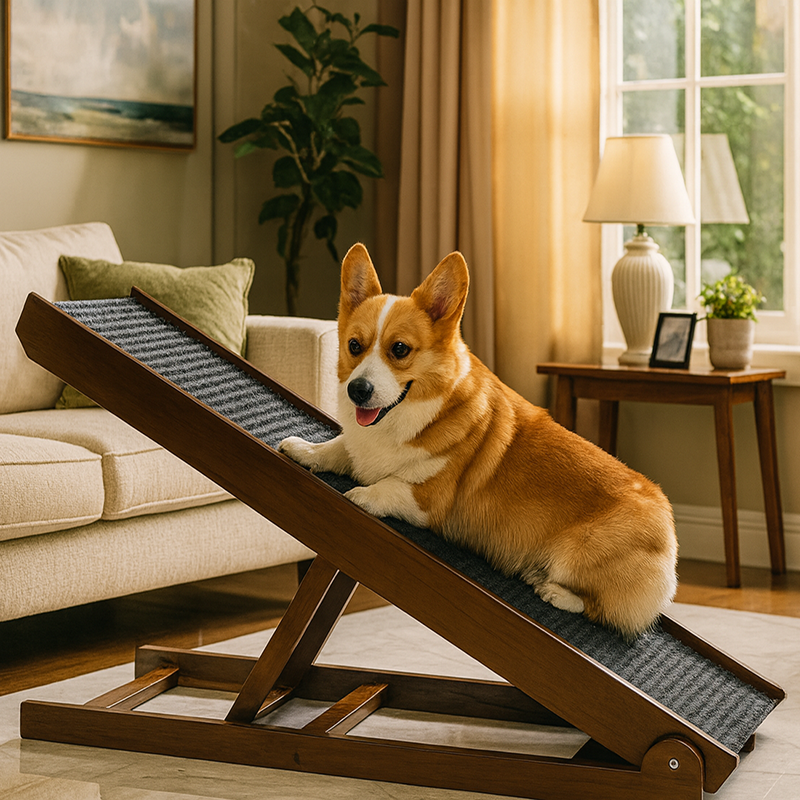
| Pet stairs | Water-based polyurethane | High wear from claws |
| Decorative cat shelf | Tung oil or wax | Aesthetic priority, lower wear |
| Rabbit hutch | Water-based polyurethane, extra coats | Rabbits chew aggressively |
| Custom designs | Discuss with manufacturer | Depends on expected use |
Certifications That Verify Pet Safe Wood Finish
Several third-party certifications help verify that a finish meets safety standards:
| Certification | What It Covers | Relevance |
|---|---|---|
| EN 71-3 (European toy safety) | Migration limits for 19 toxic elements | Widely used as pet product standard |
| ASTM F963 | US toy safety standard, surface coating requirements | Applicable to pet products marketed as “furniture” |
| GREENGUARD Gold | Low chemical emissions, stricter than standard GREENGUARD | Covers VOC off-gassing |
| FSC certification | Sustainable sourcing (not finish-specific) | Often paired with non-toxic finish requirements |
EN 71-3 is the most practical standard for pet furniture finishes. It tests for heavy metals and toxic substances that might migrate from the coating — exactly the scenario when a pet chews on finished wood. Ask your manufacturer if their finish materials comply with EN 71-3, and request the test report.
What Happens When You Get the Finish Wrong
Scenario 1: Customer complaints about smell. The product wasn’t cured long enough. Buyers leave 1-star reviews mentioning “chemical smell” and “worried about my pet.” Recovery: pull inventory, air out for 2 weeks, reship. Cost: shipping + storage + reputation damage.
Scenario 2: Finish peeling under pet use. Wrong finish type for the application — wax or thin oil finish on a product that gets chewed and scratched daily. The finish flakes off, exposing raw wood that absorbs moisture and stains. Customer returns the product.
Scenario 3: Regulatory action. A finish containing restricted substances (lead, chromium, excessive formaldehyde) triggers a product safety complaint. Depending on the market, this can result in recalls, fines, or import bans.
All three scenarios are preventable by specifying the right pet safe wood finish upfront and verifying compliance before production begins.
Ordering Pet Furniture with the Right Finish
Before placing your OEM order, request a finished sample to evaluate the actual finish quality — not just the wood and construction. Check for even coverage, smooth texture, absence of drips, and most importantly, smell. A properly cured sample should have no noticeable chemical odor.
Browse our product catalog to see finish options available across different product categories, or contact us to discuss finish specifications for your order.