A buyer once shipped us a competitor’s flat-pack cat tower: a void in the core sat exactly where the joint screw went in, and the slot edge had blown out.
Why Is Birch Plywood Used in Pet Furniture?
Birch plywood is used in pet furniture because its cross-grain plies make panels that are dimensionally stable, strong for their weight, and ideal for flat-pack construction. A void-free core holds screws and keeps laser-cut edges clean, CNC cutting holds tight slot-and-tab tolerances, and E0-grade panels keep formaldehyde emissions within the strictest commonly used limits.
Structurally, alternating grain balances internal stresses, so a panel stays flat where a solid board would cup. Commercially: flat-pack. Rectangular panels nest tightly, ship dense, and assemble with slot-and-tab joints that need no hardware bag. Our space-saving cat furniture guide covers why that flat-shipping math matters in small-space assortments.
What Birch Plywood Is (and Isn’t) for Pet Furniture Lines
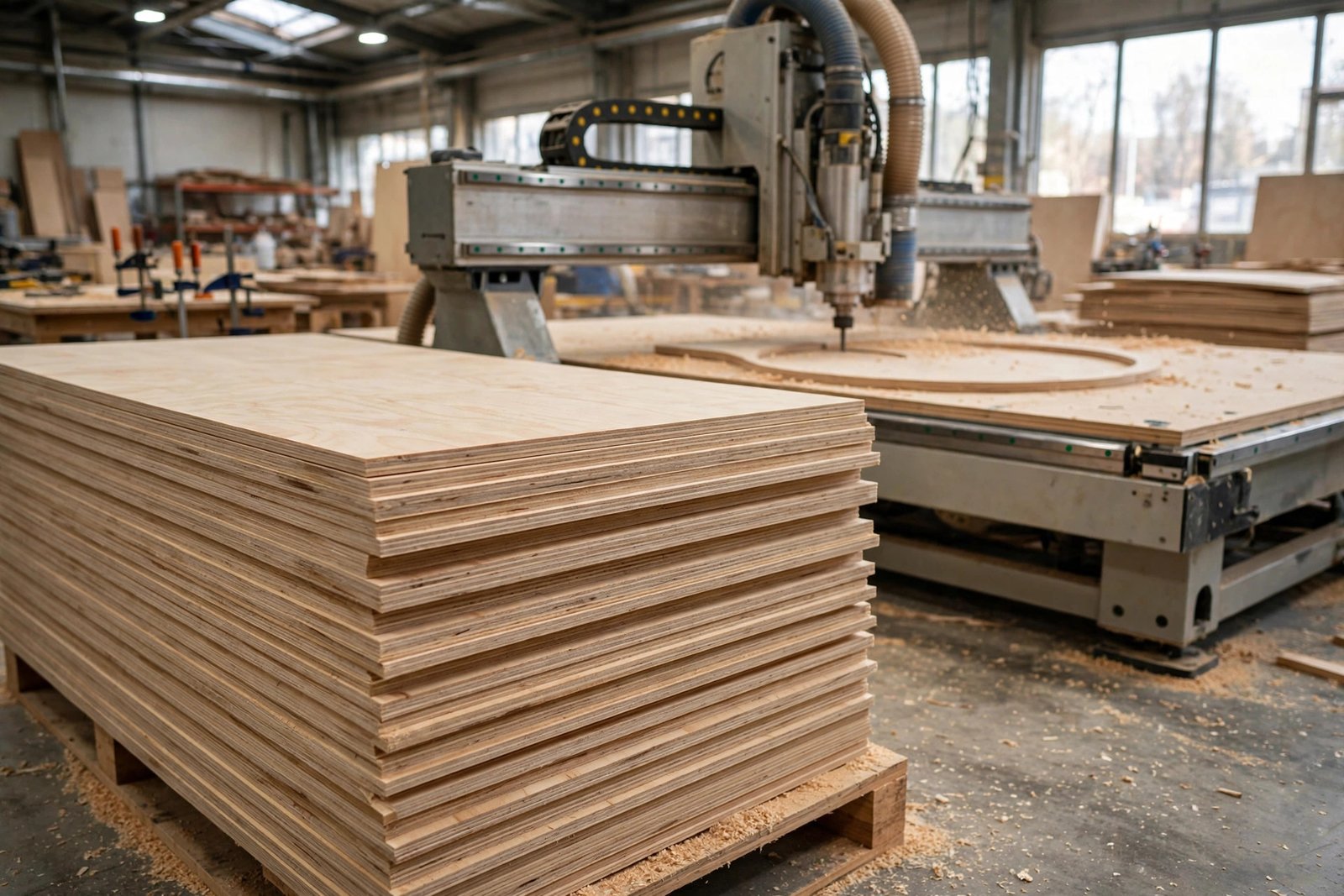
Birch plywood is a multi-ply panel: an odd number of thin birch veneers, each glued with its grain perpendicular to the next. That cross-grain construction is the whole point — strength in every direction, and resistance to cupping and splitting.
Two products share the name: true Baltic birch is all-birch multi-ply, while birch-faced plywood uses birch only on the faces, with a softer core of poplar or eucalyptus. “Baltic birch” is a trade convention for all-birch multi-ply grading, not a certified origin mark — buy the panel spec, not the nickname.
Why a Void-Free Core Decides Edge Quality and Screw-Holding
A void-free core means no missing or overlapping patches inside the panel — every ply continuous. Voids destroy the two things flat-pack pet furniture depends on: edge appearance and fastener grip. A slot cut through a void crumbles instead of cutting clean; a joint screw landing in a void spins without biting, and that joint loosens under a jumping cat.
All-birch construction earns its reputation here: dense veneers throughout leave nowhere for large voids to hide, and screw-holding approaches solid wood. That is why we trust good 18mm Baltic birch for structural joints under repeated dynamic load — with incoming QC. Cut a strip from each panel lot and read the cross-section; reject sheets with gaps or delamination.
E0 Grade and Formaldehyde Emission: What to Actually Ask For
E0 and E1 are commonly used panel emission labels indicating progressively stricter formaldehyde emission levels, with E0 the tighter of the two. They are trade labels, not universal certifications, and different markets test to different methods — chamber tests and desiccator tests do not produce interchangeable numbers.
So ask for the test report, not the word “E0” on an invoice — and check the test method, whether it is per batch, and whether the supplier is named. A report you cannot trace to a lab and a batch is marketing copy. Emissions are only part of the picture: a panel can carry an E0 label and still fail as pet furniture if its core has voids or its glue line opens in humidity. Background: Composite Panel Association.
The CNC Cutting Advantage: Nesting and Flat-Pack Tolerances
CNC cutting earns its place through nesting efficiency and repeatable tolerances. Nesting — how parts are arranged on the sheet — turns would-be offcut waste into sellable parts, and rectangular flat-pack components nest far better than irregular solid-wood cuts.
The second advantage decides whether flat-pack works at all. Slot-and-tab joints need clearance held around 0.1 to 0.2 millimeters: tight enough to seat with a firm press, loose enough to assemble without a mallet. A CNC router holds that window sheet after sheet; a hand-routed slot never does. We run flat-pack programs with dedicated feeds for birch multi-ply, because dull feeds tear the cross-grain plies and blow out slot shoulders.
Panel Thickness Decisions: 9mm, 12mm, 15mm, 18mm
Panel stiffness rises roughly with the cube of thickness, so small changes buy large structural gains. Four thicknesses cover nearly every part: 9mm for back panels and non-structural dividers, 12mm for light platforms with short spans, 15mm for standard platforms, and 18mm for load-bearing platforms or long spans.
Span matters as much as thickness — a 15mm platform spanning 300mm behaves very differently from the same panel spanning 600mm. When our engineering team prototypes a panel-intensive design, the first check is deflection under a simulated landing load at the actual span. Anything that visibly bows gets a thicker panel or an added rib before tooling.
Edges: Edge Banding vs. Exposing the Ply Line
Every cut exposes the layered cross-section, and the edge needs a decision. Edge banding — ABS, PVC, or real-wood veneer strip — seals the plies for a clean furniture face: the right call for furniture channels where a solid-wood look is expected, and it protects the edge from moisture wicking.
Alternatively, sand the exposed ply line smooth, seal it with water-based coating, and let the stripes become a feature — a look many modern brands choose. The trade-off: an exposed edge shows every void and patch, so it demands void-free panels, and unsealed end grain wicks moisture.
Moisture Resistance: Saying Plainly Where Birch Plywood Fails
The honest limit: interior-grade birch plywood is not a wet-environment material. Edges swell in standing water, and repeated wetting and drying opens glue lines. A cat tree next to a frequently mopped floor or a cattery that hoses down runs will defeat interior plywood — say so on the listing rather than after the review.
Moisture-resistant glue (the “MR” designation) improves tolerance to humidity swings, not immersion. Dimensional stability under normal indoor humidity is genuinely a plywood strength — the cross-grain plies at work — but humidity tolerance and water tolerance are different claims. Solid wood posts have their own moisture story, covered in our kiln-dried wood for cat furniture guide.
When Solid Wood Is the Honest Answer
Plywood is not the answer to every part. Vertical posts that take clawing and chewing at close range, perches where a cat’s full weight lands on a small footprint, and any premium-positioned line justify solid wood: claws dig through a panel face and eventually reach a glue line, while solid stock wears evenly and refinishes cleanly.
Our position is a split — birch plywood where flat panels serve the design, solid wood where claws, chewing, and dynamic load concentrate. That split also builds line architecture: a flat-pack value line and a premium hardwood line can share a brand and a catalog, aimed at different channels. Full species comparison: our best wood for cat tree guide.
من مصنعنا: Watch our CNC router cut precision flat-pack parts for wooden cat furniture.
الأسئلة الشائعة
Why is birch plywood used in pet furniture instead of regular plywood?
All-birch multi-ply gives a dense, void-free core that holds screws, machines cleanly on CNC, and stays dimensionally stable. Mixed-core commodity plywood has voids that flat-pack joints cannot rely on.
Is E0-grade birch plywood safe for pets?
E0 is a commonly used label for the strictest formaldehyde emission tier in panel boards. Ask your panel supplier for the test report per batch — method, lab, lot. Core quality matters equally.
What panel thickness should cat tree platforms use?
12mm suits light platforms with short spans, 15mm covers standard platforms, 18mm is for load-bearing parts or long spans. Prototype the actual span first.
Can flat-pack joints really hold without hardware?
Yes, when slot-and-tab clearance is held around 0.1–0.2mm, a window CNC cutting maintains consistently. Dull tooling or inconsistent panels widen that window, and the joint won’t stay seated.
Laser cutting or CNC cutting for birch plywood parts?
CNC cutting is the primary process for structural parts: no heat-affected edge, excellent slot tolerances. Laser cutting suits thin panels and decorative detail but chars thick stock.
Developing a flat-pack pet furniture line? Send your drawings to our engineering team — we will review the panel spec, joint design, and edge treatment, and advise where each material wins. Flat-pack cartons go through a drop sequence along إجراءات اختبار ISTA lines before we sign off. Talk to our engineering team.
دعم OEM/ODM
هل تحتاج إلى خطة إنتاج مخصصة لشجرة القطط؟
أرسل صورًا مرجعية، وأبعاد مستهدفة، وتفضيلات المواد، واحتياجات التعبئة والتغليف، واتجاه السوق. يمكننا مراجعة الجدوى، وأخذ العينات، والحد الأدنى لكمية الطلب، وتعبئة التصدير قبل الإنتاج. طلب عرض أسعار OEMخطوط الإنتاج ذات الصلة
استكشف أثاث القطط الخشبي الذي يمكننا تصنيعه.
أدلة المشترين ذات الصلة