
Sooner or later, every cat furniture factory gets the video: a tall tower rocking on its base like a metronome each time the cat lands on the top perch. That wobble is exactly what cat tree stability testing methods exist to catch before the tower leaves the factory — the gap between “looks solid in the showroom” and “stays solid in a living room” is where most failures are born.
Why Cat Tree Stability Testing Methods Belong on Your RFQ Checklist
Most RFQs ask about materials, dimensions, and finish — almost none ask how the factory tests stability. Yet a tower’s failure mode is rarely a broken board; it’s the structure tipping, swaying, or loosening at the joints over months of daily landings. Ask which tests run, what the pass/fail criteria are, and whether the report covers the exact SKU you’re buying.
What Does “Stable” Actually Mean Before Testing Begins?
A stable cat tree keeps every joint tight and its base planted when a cat launches, lands, and changes direction at speed — the load is dynamic and off-center, never a neat static weight mid-platform. Stability belongs to the whole assembly: base footprint, column placement, joint rigidity, and center of gravity, judged only by tests that reproduce those forces.
Static load ratings alone don’t define it. A platform can hold dead weight and still fail at home — failure looks like the tower walking across the floor over weeks, or a joint opening a millimeter at a time. That’s why we ask three questions separately: will it tip, will it sway, will it hold.
The Tip-Over Test: Recreating the Worst Five Seconds of a Cat’s Day
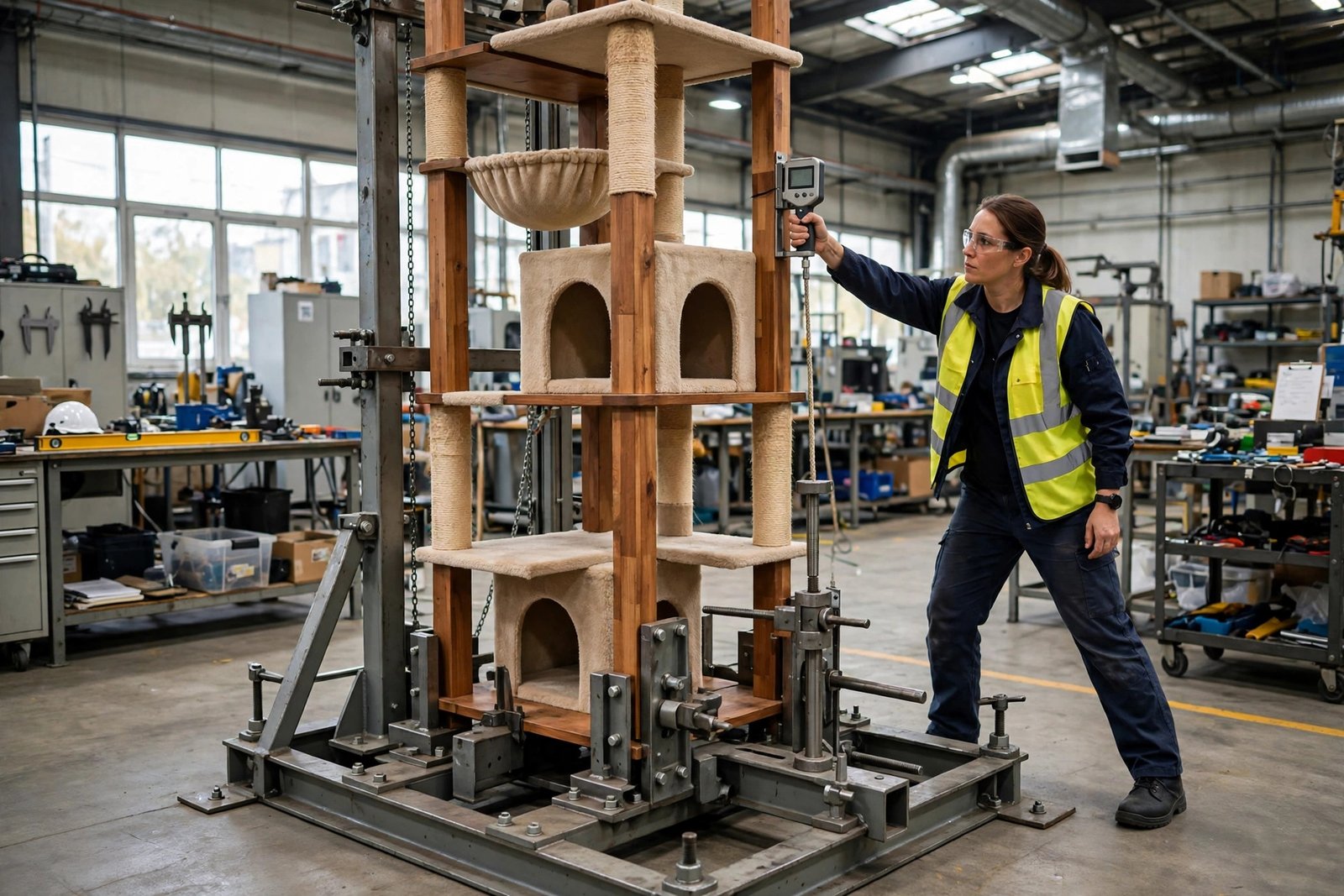
The tip-over test asks how much horizontal force at the top perch it takes before the base lifts, and whether the design clears a defined safety margin above what a real cat produces mid-leap. We run it on the fully assembled unit — every shelf and scratcher attached — because a bare frame says nothing about the finished product’s center of gravity.
The tower goes on a level concrete floor, assembled exactly per our instruction sheet, and a strap at top-perch height applies a measured horizontal pull, increasing gradually. The pass line: the opposite base edge must not lift under the target pull, and nothing may shift, crack, or loosen. The safety margin lives in the gap between target pull and real-cat force — kept there on purpose, because living-room floors are never as level as our concrete.
The Wobble Test: Reading Sway Like a Joinery X-Ray
The wobble test exposes what static tests hide: looseness developing in the joints. We shove the tower at mid-height with a firm, rhythmic push — a cat braking hard on a platform edge — and watch the recovery. A sound structure settles in one or two clean oscillations; a compromised one keeps swaying.
In solid-wood construction, wobble almost never comes from the wood — it comes from the connection: a dowel joint a fraction loose, a threaded insert not fully seated. Our well-built cat tree anatomy guide shows how each joint carries load; the wobble test verifies the theory survived production. When a sample sways too long, we open the joint instead of adding ballast.
We also test after simulated aging: assemble, disassemble, and reassemble several times — the way a customer moving house does — then test again. A joint that passes once but loosens on the third reassembly is a design problem, not a QC problem.
Load Testing: Proof-Testing Every Surface Past the Point of Comfort
Load capacity testing asks the simplest question the hard way: gradually, off-center, and past comfort. Our test jig loads each platform, perch, and condo floor individually, starting centered then moving toward the edge — because cats sprawl across corners and hang half off the edge, they don’t sit in the middle of platforms.
We run to overload, watching for the failure mode, not just the failure point: a gradual deflection the customer would notice, or a sudden joint release nobody sees coming. A useful report records load, position, duration, and deflection in millimeters — not adjectives.
Multi-Cat Households: The Scenario That Breaks Optimistic Designs
Single-cat testing is the industry’s favorite fiction: real failures usually involve the second cat — one launching while another is sprawled on the top perch, combined dynamic load hitting a structure already leaning into the jump. Our worst case assumes two cats moving in opposite directions.
So the tip-over pull runs with the top perch pre-loaded, and the wobble test runs with weight on the upper platforms — never on an empty tower, because empty-tower testing flatters every design. A tall tower, anything near two meters, gets the full multi-cat protocol: height multiplies every force in the structure, and a design that can’t pass loaded doesn’t ship.
How to Read a Factory’s Stability Test Report
First, the criteria must be numeric and pre-defined: pull force, lift thresholds, deflection limits, assembly cycles. “No visible damage” is an opinion, not a criterion. Second, the report must name the exact SKU and configuration tested — a report for the 120 cm tower does not cover the 180 cm version. Third, the failures must be recorded, not just the passes: a report showing design iterations and what changed proves the testing steered the design.
Red flags: a lone “passed” stamp with no numbers; a report dated before the current design revision; testing the base model while you’re ordering the tall one. For context, the closest formal standard is منطق ASTM F2057 — written for clothing storage units, not cat trees, but its logic of graded pull forces is what serious factories borrow.
من مصنعنا: See how a well-built cat tree’s joints carry load — a walkthrough of the structure behind every stable tower.
The Honest Limits of Cat Tree Stability Testing
No rig reproduces a living room. Our tests run on level concrete; your customer’s floor might slope, sit on thick carpet, or have a rug under half the base — all of which move the tipping point. We test the documented assembly; a customer who improvises has left the tested configuration. And no rig reproduces years of a large cat using the same launch perch daily — our repeat-assembly and sustained-load checks approximate it, but “approximate” is the honest word.
ال CPSC tip-over information center is worth a read for how tip-overs actually happen in homes — it keeps everyone’s expectations honest, including ours. Testing validates the structure, not the placement: a tested tower that the customer moves away from the wall, or places where a cat launches onto it from a bookshelf, is operating outside every tested scenario.
If you’re comparing factories, the question isn’t “did you test it” — everyone says yes. Ask which three tests, what the numeric criteria were, which SKU the report covers, and whether you can see the failures. Browse our solid-wood cat trees, then talk to our engineering team.
الأسئلة الشائعة
What are the main cat tree stability testing methods?
Tip-over testing (horizontal pull at the top, checking base lift), wobble testing (rhythmic push revealing joint looseness), and load capacity testing (gradual, off-center loading of every weight-bearing surface, often past rated capacity).
What is the tip-over test for a cat tree?
The fully assembled tower sits on a level surface while a measured horizontal force pulls outward at the top perch. The pass line: the opposite base edge must not lift under the target pull, and nothing may shift, crack, or loosen.
How is load capacity tested?
Each platform, perch, and condo floor is loaded in stages — centered first, then toward the edge — and held while deflection is measured in millimeters. Good reports record load, position, duration, and recovery.
Why test with multiple cats in mind?
Real failures usually involve the second cat: one launching while another is already on the top perch. Testing pre-loaded, with forces in opposing directions, catches the combined dynamic loads that empty-tower testing flatters away.
دعم OEM/ODM
هل تحتاج إلى خطة إنتاج مخصصة لشجرة القطط؟
أرسل صورًا مرجعية، وأبعاد مستهدفة، وتفضيلات المواد، واحتياجات التعبئة والتغليف، واتجاه السوق. يمكننا مراجعة الجدوى، وأخذ العينات، والحد الأدنى لكمية الطلب، وتعبئة التصدير قبل الإنتاج. طلب عرض أسعار OEMخطوط الإنتاج ذات الصلة
استكشف أثاث القطط الخشبي الذي يمكننا تصنيعه.
أدلة المشترين ذات الصلة