
A German buyer once toured a “factory” for four hours, approved the supplier, and placed the biggest order — with a trading company renting an office across town from the workshop. The brochure was glossy; the real production floor was someone else’s. How to audit a pet furniture factory is not box-ticking; it is making sure the floor you stand on builds your product.
How to Audit a Pet Furniture Factory: The 12-Point Checklist
A proper factory audit walks twelve stations: the woodworking shop, kiln-drying facility, finishing line, raw-material storage, capacity planning, assembly, in-line checks, finished-goods warehouse, worker welfare, compliance documents, 5S, and corrective-action discipline. Each exposes what brochures hide; the red-flags list tells you when to leave early.
Bring a notebook, a moisture meter, and the willingness to open cartons.
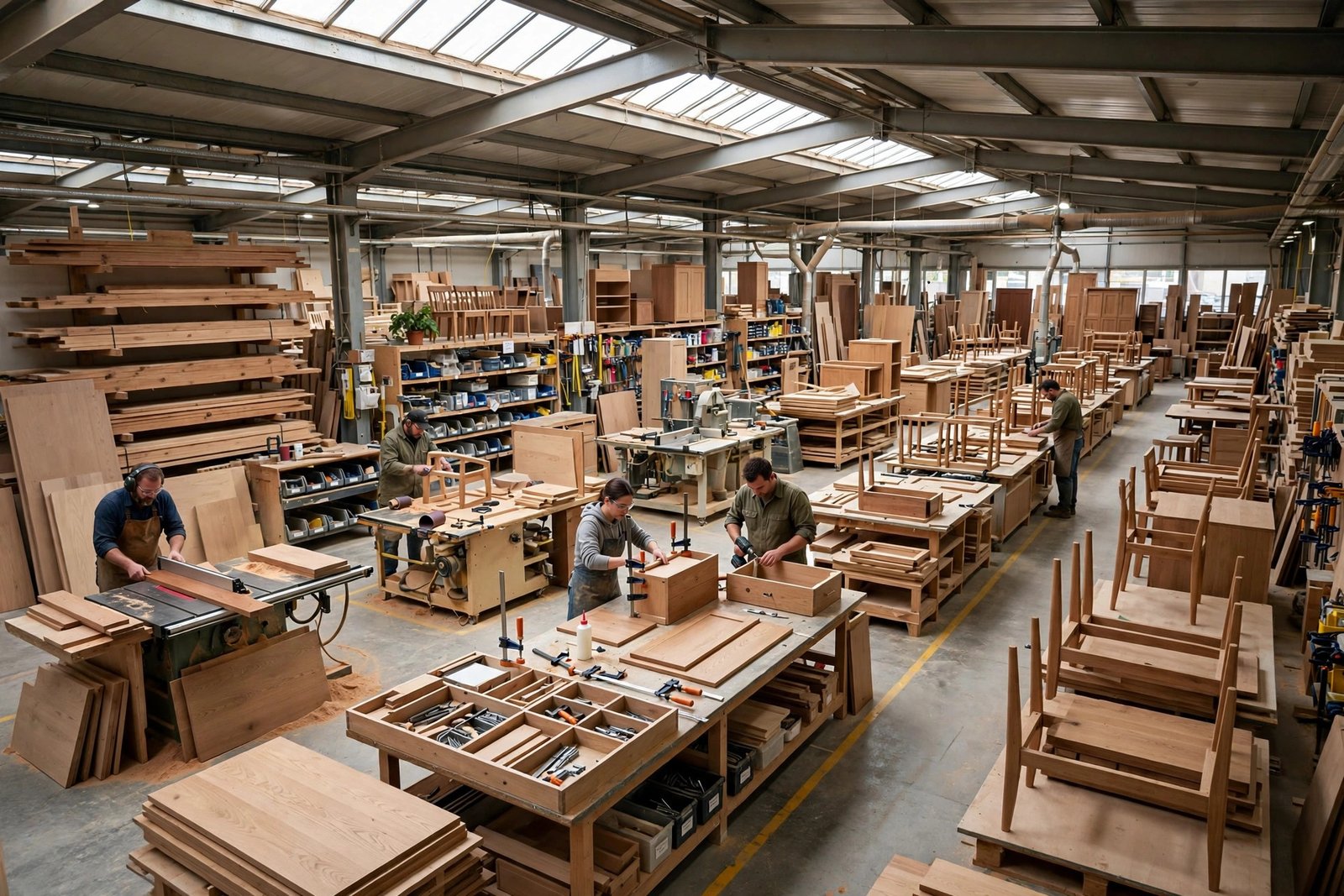
1. Woodworking Shop: Machines, Dust Extraction, and Tooling
Does the woodworking shop match the catalogue? Expect a panel saw, thickness planer, CNC routers, a boring machine for dowel holes, and sanding stations. Tall scratching towers with no long-bed planer or CNC means complex parts are outsourced where you cannot see. Dust extraction is the tell: ducted hoods and a clean floor mean sharp tooling; drifting sawdust means dull blades.
2. Kiln-Drying Facility: The Hidden Quality Gate
What is the kiln-drying facility controlling? Wood moisture. Lumber that ships too wet warps, cracks, or shrinks in the customer’s home — the most common structural failure in wooden pet furniture. Judge the batch moisture logs, not the chamber size: a credible facility logs pin-meter readings before wood enters production.
Worst supplier visit we ever made: boards leaning against a sunny wall, presented as a kiln.
3. Finishing Line: Pet-Safe Coatings and Ventilation
The finishing line is where pet safety becomes chemistry. Ask which coatings run on it — water-based is the baseline — and ask for data sheets plus third-party reports on formaldehyde and VOC. The spray booth should be enclosed with exhaust filtration — not a shop corner with a fan in the window. Parts should cure in a ventilated rack before packing; furniture packed wet arrives smelling of solvent.
4. Raw-Material Storage and Incoming Inspection
Good factories inspect lumber before it earns floor space. Look for a covered, ventilated store with species and grade markings, boards palletized off the ground. Ask how incoming boards are checked: warp grading, moisture content on arrival, segregation of suspect batches — and the rejection record. A factory that never rejects is not inspecting; it is receiving. Our best wood for cat trees guide explains why species honesty starts here.
5. Production Capacity: Reading the Floor, Not the Brochure
Brochure capacity is a wish; on the floor it is arithmetic. Count the workstations, then count how many are actually running — not staged for your visit. Ask how mixed orders are sequenced: separate lines or one line with changeovers, and where your run waits behind someone else’s. Look for a planning board of open orders against machine hours. No visible schedule means promises are made from memory.
6. Assembly and Hardware: Where Wobble Is Born
Cat furniture lives or dies at the joints. Watch assembly: dowels drilled to jig, screws driven with depth-set drivers, inserts seated square. Pick up a finished unit and give it a firm lateral push — hidden wobble shows itself. Ask where hardware comes from and whether it is inspected on arrival — the reason we photograph every hardware batch. Failure modes are catalogued in our sourcing mistakes guide.
7. In-Line Quality Checkpoints, Not Just Final Inspection
A final inspection at the packing table catches what the process already ruined. Real quality control runs in-line: cutting for dimensions, sanding for surface, finishing for coverage and cure, assembly for stability. Ask for the inspection records and the sampling plan — ISO 9001 documentation describes exactly this. Then ask: “Show me the last batch that failed.”
8. Finished-Goods Warehouse and Packing Discipline
The warehouse is where good furniture goes to die if storage is careless. Check stacking: heavy cartons crush light ones. Check humidity: solid-wood goods stored damp reabsorb moisture and warp — the kiln’s work, undone. Watch packing: corner protection, part separation, hardware bags sealed and labeled per SKU. Open one carton at random and count against the packing list; its discipline predicts the container’s.
9. Worker Welfare and Safety: Compliance You Can See
Worker welfare is not charity; it is a stability indicator. Look for the facts: masks in the sanding area, ear protection near planers, charged extinguishers, clear aisles, machine guards in place. Ask about working hours and wage cycles, and whether the factory holds social compliance certification — amfori BSCI is the common one. Talk to a worker if allowed; coached answers sound coached.
10. Documentation: Certificates, Test Reports, Traceability
Ask for the paper behind the claims: business license, certifications, recent third-party test reports, and traceability records. Check the dates — an expired certificate is a confession. Then ask for a test report from a batch you name, not the framed one. The framed report is marketing; the one they find in five minutes is a system. Our guide to choosing a solid-wood manufacturer covers documentation’s role in the supplier decision.
11. 5S Housekeeping: The Cheapest Signal on the Floor
5S — sort, set in order, shine, standardize, sustain — is free and reveals everything. Where tools have shadow boards, materials have labeled locations, and aisles are painted, people follow procedures when nobody is watching. Where offcuts pile against machines and nobody knows where the sandpaper lives, your order gets lost in the chaos. Ten minutes of walking tells you what the certificate wall cannot.
12. Corrective Action Plan Discipline: The Audit After the Audit
The last point is a question: when something went wrong last time, what changed? Ask for one real corrective action plan — the complaint, the root cause, the fix, and proof the fix held. A serious factory shows a closed loop with evidence; a weak one shows an apology. This predicts your future better than any certificate: every supplier fails eventually — the question is whether they learn.
Red Flags: When to End the Factory Audit Early
When should you end a factory audit early? When you find an office with no production floor, workers scattering as you arrive, no moisture meter near the lumber, a finish room sharing air with packing, or nobody who can show a failed batch. Any one of these ends the day.
Your time is better spent on the next candidate. For sourcing traps beyond the audit itself, see our pet furniture quality inspection guide.
The Limitation No Checklist Fixes: Remote Audits and What They Miss
One honest limitation: a video-call audit cannot replace standing on the floor. Cameras show only what they are pointed at — never the damp corner or the crushed cartons. Remote audits work for re-qualifying a known supplier or verifying a corrective-action fix, but for a first-time partner, nothing replaces choosing your own route across the floor. And even a perfect audit is a snapshot: spring’s approved floor may not build your autumn shipment. Pair it with in-line inspections on early orders.
Aus unserer Fabrik: Take a look inside our factory and see how solid-wood cat furniture is made.
FAQ
How long should a pet furniture factory audit take?
A full day: four to six hours on the floor plus document review.
Should I hire a third-party auditor or go myself?
Go yourself for a first-time supplier. Third-party auditors suit follow-up visits.
What is the single most important checkpoint?
Moisture control — check the kiln-drying batch logs and verify with your own pin meter.
How do I verify production capacity claims?
Count running workstations and check the schedule against machine hours.
Can a remote video audit replace an on-site factory audit?
For re-qualifying, yes. For a first-time partner, no.
Start With a Factory That Expects the Audit
A factory worth auditing has the logs ready before you ask — moisture records, inspection sheets, a corrective action plan with a closed loop. If you are evaluating solid-wood pet furniture suppliers, bring this checklist through Angebot anfordern and tell us which twelve points you want to see first. Prefer email? Use our Kontaktseite.
OEM/ODM-Unterstützung
Benötigen Sie einen kundenspezifischen Produktionsplan für Kratzbäume?
Senden Sie Referenzfotos, Zielabmessungen, Materialpräferenzen, Verpackungsanforderungen und Marktausrichtung. Wir können Machbarkeit, Muster, MOQ und Exportverpackungen vor der Produktion prüfen. OEM-Angebot anfordernVerwandte Produktlinien
Entdecken Sie Holzmöbel für Katzen, die wir herstellen können.
Verwandte Einkaufsführer