A brand buyer once rejected an entire production run over a logo the size of a thumbnail. Technically perfect — crisp, centered, the right brown. The problem was placement: the inside wall of a condo, where a cat’s claws would cross it daily. Two months later, half the logos looked chewed. Logo engraving methods for wooden furniture are not a decoration decision; they are a durability decision wearing a branding costume.
Logo Engraving Methods for Wooden Furniture: The Four Options, Ranked by Durability
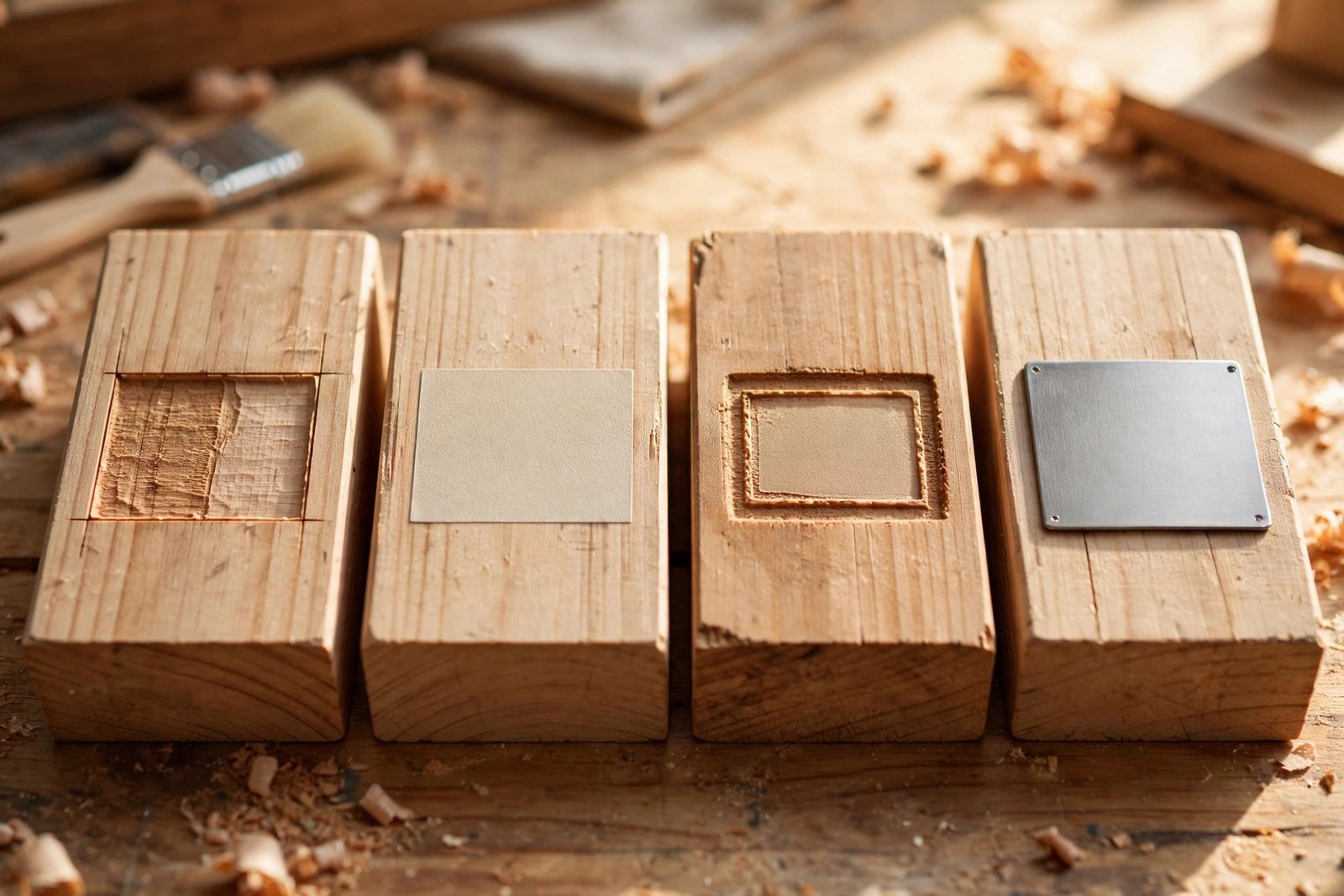
What are the logo engraving methods for wooden furniture? Four dominate private-label production: laser engraving (burned into the wood, most durable), branding iron (pressed heat mark, rustic feel, variable depth), silk-screen printing (ink on the surface, full color, wears fastest), and metal nameplate (attached tag, survives everything, adds a part). For cat furniture — scratched, chewed, and leaned on daily — the ranking above is also the recommendation order.
Laser Engraving: Precision That Exposes the Wood’s Honesty
Laser engraving burns the design into the wood with a focused beam, removing a thin layer of fiber to leave a permanent, tactile mark — no ink, no added material, nothing to peel. On our floor it is the default for solid-wood cat furniture, and the method that most exposes a factory’s honesty about materials.
Contrast is the whole game. A laser mark on light pine reads dark and crisp; the same file on dark walnut barely whispers. We keep a sample board of every species we engrave, because buyers choose colors on screens and wood answers in its own palette. Oily species resist the burn and produce a weak, uneven mark; we say this before the order, not after the sample.
Fine detail has a floor. Lines thinner than about 0.3 mm fill in on softwood as the char spreads through open grain; end grain bleeds worse than face grain. Wikipedia’s laser engraving overview documents the process physics; the shop-floor translation is that wood is not paper, and the file must be built for fiber.
Silk-Screen Printing: Color the Engraving Can’t Do
When the brand needs full color — a green leaf, a gradient paw — engraving is out and silk-screen printing is in. A mesh screen deposits ink through the design’s open areas onto the wood. Fast, color-faithful, and premium on a retail shelf.
The limitation is surface adhesion on a product that lives a hard life. Screen ink sits on top of the wood, and cats are, professionally speaking, abrasion machines. On a side panel touched at unboxing, screen print holds up well. On a scratching surface or perch edge, it wears — sometimes within weeks in a multi-cat home. Place screen-printed marks on low-contact zones: the mark’s life depends on its zip code.
Ink chemistry matters for the pet category. We run water-based inks for pet furniture marks, accept the shorter wear life versus solvent inks, and place the mark accordingly. If your private-label program needs color, our private label guide covers how the mark choice fits the broader brand rollout.
Branding Iron: The Oldest Method and Its Limits
A branding iron is a heated metal die pressed into the wood, scorching the design in. The oldest method on this list and, on the right product, the most charming — the mark has depth, a hand-made read, and a permanence ink cannot match. For rustic and farmhouse-positioned lines it is often the first choice.
The honest limitation is consistency. Depth varies with wood density: the iron sinks deeper into soft pine than hard oak, and across one panel the mark can read strong in one spot and faint in another. That becomes batch-to-batch variation strict brand guidelines do not tolerate. We standardize press time and temperature per species and reject panels outside the mark window — but a branding iron will never match a laser for repeatability. Artwork for it should be bold, simple, and forgiving: thick lines, no fine text. It is a folk instrument, and it plays folk songs.
Metal Nameplates: When the Logo Has to Survive Everything
When the mark must outlast the product, the answer is a metal nameplate — a stamped, etched, or laser-marked tag in brass, aluminum, or stainless, pinned, screwed, or glued on. It survives scratching, moisture, sunlight, and cleaning chemicals, and reads as hardware, not decoration.
The trade-offs are real. A nameplate is a separate part: separate supplier, separate inventory, separate assembly step. Pins work loose on softwood over time; screws need pilot holes and add labor; adhesive fails where it gets wet. We size the plate to the mounting surface and spec the fastener to the species — brass pins hold in hardwood but walk out of soft pine within a year, and our warranty returns prove it. Our custom options page maps where nameplates fit among other customization choices.
Artwork Resolution: The File the Factory Actually Needs
Every method on this list fails the same way when the artwork is wrong. The factory needs a vector file — AI, EPS, or SVG — with the logo converted to outlines, at the exact physical size of the mark. A 2000-pixel PNG from the brand deck is a suggestion, not a production file.
The rules differ by method. Laser wants outlines with minimum 0.3 mm line weight and no overlapping paths. Silk-screen wants spot colors, not CMYK builds, because each color is a separate screen. Branding iron wants your boldest mark. Nameplate wants a mechanical drawing with hole positions. The wrong file type means the factory redraws your logo — or stalls the schedule.
Durability Reality Check: Rub, Moisture, and Sunlight
We run every new mark through three informal tests before approval: fifty rub passes with a coarse cloth, three damp-dry moisture cycles, and a week in the sunlit window of our sample room. Not lab certifications — third-party labs handle the formal protocols — but they catch the obvious failures before they become shipments.
The results follow the ranking in the first section. Laser passes all three on face grain. Screen print passes sunlight, survives moisture, and degrades on rub — which is exactly why placement matters. Branding irons pass everything but vary in appearance.
The limitation buyers should internalize: no mark is permanent on a product designed to be slowly destroyed by animals. The goal is a mark that outlasts the warranty story, not the furniture. Choose the method whose failure mode you can live with — fading ink, varying depth, or a plate with screws — because every method has one.
Desde nuestra fábrica: See CNC machining in action on solid-wood cat furniture in our factory.
Preguntas frecuentes
Which logo method is most durable on solid-wood cat furniture?
Laser engraving, then metal nameplate. Laser burns into the wood fiber with nothing to peel; nameplates survive everything but add a part and an assembly step.
Can my full-color logo be engraved into wood?
No — engraving is monochrome. Full-color marks need silk-screen printing, which trades durability for color, so keep the mark on low-contact surfaces away from scratching zones.
Why does my logo look different on different wood species?
Contrast and char behavior vary by species. Light woods give dark, crisp laser marks; dark or oily woods give weak ones. Ask for a species sample board before approving.
What artwork file should I send the factory?
A vector file (AI, EPS, or SVG) with text converted to outlines, at the exact physical size of the mark. Minimum 0.3 mm line weight for laser; spot colors for silk-screen; bold simplified art for branding iron.
Will a screen-printed logo survive cat scratching?
On a scratching surface, no. Screen print belongs on side panels and other low-contact zones. For high-contact areas, choose laser engraving or a nameplate.
Does the finish affect the logo mark?
Yes. Screen ink grips sealed, sanded surfaces far better than raw grain, and marks go on after the final finish coat unless the factory specifies otherwise. Our guía de acabados seguros para mascotas covers the coating options.
Put Your Mark Where It Will Last
A logo is the smallest part of the product and the most permanent statement on it. Send your artwork and the intended surface through Solicitar presupuesto — we will recommend the method, the placement, and the file adjustments before the first mark is made.
Soporte OEM/ODM
¿Necesita un plan de producción de árboles para gatos personalizado?
Envíe fotos de referencia, dimensiones objetivo, preferencias de materiales, necesidades de embalaje y dirección de mercado. Podemos revisar la viabilidad, el muestreo, el MOQ y el embalaje de exportación antes de la producción. Solicitar cotización OEMLíneas de productos relacionadas
Explore muebles para gatos de madera que podemos fabricar.
Guías de Compra Relacionadas