A buyer once sent us three competitor samples and one question: all three claimed “solid wood,” but one wobbled, one dented under a fingernail, one smelled of chemicals. The difference was never the marketing word — it was the species, the drying, and the joinery. This guide scores common species the way a factory does, so you can judge the best wood for a cat tree before committing to a line.
What Is the Best Wood for a Cat Tree?
There is no single best wood for a cat tree — the right species depends on the product tier. For value lines, kiln-dried pine works when the structure compensates for its softness; for mid-range, rubberwood offers the best strength-to-cost ratio; for premium, oak or walnut justify their price through hardness and finish. In every tier, kiln-dried stock at 8–12% moisture content matters more than the species name on the label.
Species gets the marketing attention, but most field failures trace back to moisture, not species: boards that shrank after cutting, joints that opened in dry warehouses. A well-dried pine tower outlasts a poorly dried oak one — keep that hierarchy in mind below.
How Factories Score Wood Species for Cat Trees
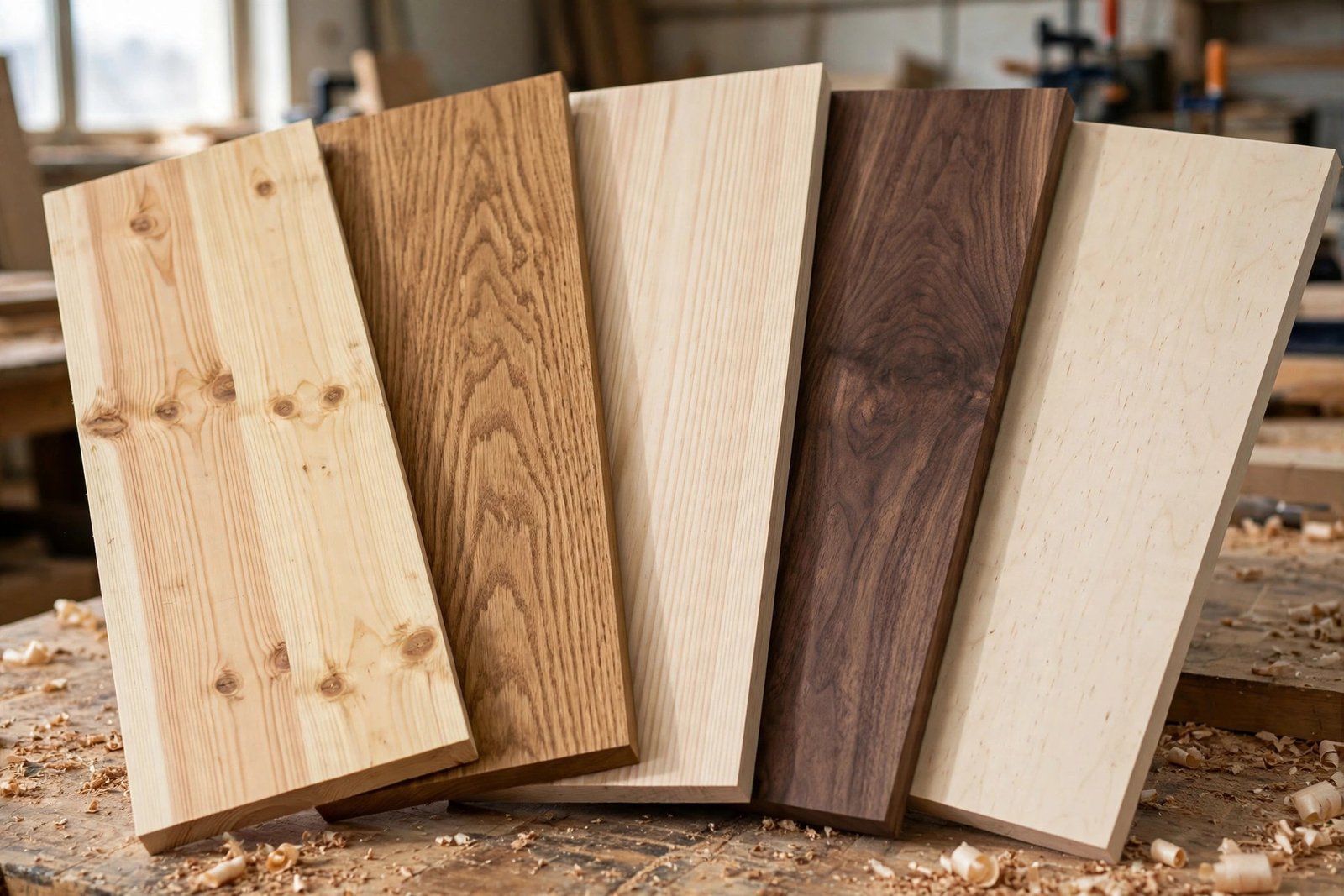
When our engineering team evaluates a species for a new line, we score hardness (Janka rating), workability, dimensional stability, and cost per CBM at our gate. No species wins all four:
| Espèce | Janka hardness (lbf) | Workability | Stability | Relative cost |
|---|---|---|---|---|
| Eastern white pine | ~380 | Excellent | Good (if kiln-dried) | Faible |
| Bois de caoutchouc | ~960 | Très bon | Bon | Low–mid |
| Yellow birch | ~1,260 | Bon | Très bon | Mid |
| Red oak | ~1,290 | Bon | Bon | Mid–high |
| Black walnut | ~1,010 | Excellent | Très bon | Élevé |
Janka figures are published reference values (see the Wood Database), not our lab data. They measure dent resistance — directly relevant because cat claws are a daily dent test. Hardness alone never decides: a very hard species that moves with humidity can be worse than a softer, stable one.
Pine for Cat Trees: Cheap, Workable, and Honest About Its Limits
Pine dominates the value tier: it machines beautifully, takes water-based coating evenly, and keeps finished weight shippable. Its ~380 lbf Janka rating means claws will leave marks — physics, not a defect, and honest suppliers say so upfront.
Where pine fails is when factories treat it like hardwood. Screwing a perch post directly into pine end-grain lets threads back out under a jumping cat; we use threaded inserts or through-bolts on every pine load joint. Pine also demands real kiln-drying: at 16% moisture it shrinks toward indoor equilibrium and opens every joint you trusted. Our gate meters every pine bundle; out-of-band stock never reaches the saw. More: kiln-dried wood for cat furniture.
Pine’s cost advantage is real, but it buys a design obligation — thicker sections, better hardware, honest finishing. Factories skipping those steps are why “pine cat tree” has a mixed reputation.
Oak and Hardwood Cat Trees: When the Premium Pays Off
Oak earns its premium position through hardness and grain. At ~1,290 lbf Janka, red oak resists claw denting visibly better than pine, and its open grain takes stain with furniture-grade depth buyers can feel. For home-decor channels, that surface quality is the product as much as the structure.
The honest caveat: weight. A tall oak tower ships heavier, which flows straight into carton specs and freight math — model that before falling in love with the species. Oak also punishes dull tooling; tear-out on cross-grain cuts is the classic symptom of a shop running hardwood on softwood feeds. Ask what changes on a supplier’s line when they switch species — the specific answer tells you whether they actually run hardwood. We run oak on dedicated CNC programs with adjusted feeds, and every oak batch gets the same moisture metering as pine. Our luxury wooden cat furniture line shows where oak belongs in a tiered assortment.
Rubberwood: The Plantation Hardwood Buyers Overlook
Rubberwood (Hevea brasiliensis) is the quiet workhorse of mid-range wooden furniture: a true hardwood at ~960 lbf Janka, plantation-grown, priced well below oak. For cat trees it hits a sweet spot — hard enough to resist daily claw wear, light enough to keep shipping sane, straight-grained enough to finish cleanly.
Its supply story matters to Western buyers: rubberwood comes from rubber plantations at the end of their latex cycle, a credible sustainable-forestry narrative without old-growth hardwood pricing. FSC-certified rubberwood exists for brands needing chain-of-custody paperwork (FSC). Full story: our rubberwood cat furniture guide.
One processing note: rubberwood is typically finger-jointed from shorter boards — standard, structurally sound practice, but it means the factory’s finger-joint QC matters more than for solid-sawn oak. Ask how joints are tested, not just whether the wood is “solid.”
Birch and Engineered Panels: Where Plywood Fits in Cat Trees
Birch plywood belongs in the conversation honestly: void-free multi-ply birch machines beautifully on CNC, holds hardware well, and suits flat-pack designs where large flat components ship better as panels. E0-grade birch keeps formaldehyde emissions within the strictest limits.
Our position is structural: solid wood for load-bearing posts and perches where claws and chewing concentrate, quality plywood where flat panels serve the design. We don’t accept mystery-core plywood with voids that swallow screws — every panel lot gets a cut-sample check at incoming. Full comparison: our solid wood vs MDF guide.
Moisture Content: The Spec That Outranks Species
If you take one number from this guide, take this: 8–12% moisture content at cutting. Below 8%, wood turns brittle and starves glue joints; above 12%, it moves after machining and opens joints in the customer’s home. We meter every incoming bundle and reject out-of-band stock regardless of species or supplier.
Kiln-drying is not a checkbox — the certificate should state final moisture content, not just “kiln-dried.” When a supplier can’t produce that number, you are buying hope. Our factory tour shows the metering station where this happens.
What Wood Choice Can’t Fix: Honest Limitations
Two limits deserve honesty. First, no species compensates for bad joinery: the hardest oak still fails when a perch is screwed into end-grain without inserts. Species is the starting point; engineering decides. Second, wood is natural — grain variation and color drift between boards are inherent, and any factory promising zero variation is promising something nature doesn’t deliver. What a professional factory promises instead is bounded consistency: moisture within a published band, documented grading, a finish spec you can hold us to.
voir notre atelier où les meubles pour chats en bois massif sont usinés et assemblés. Watch our kiln-drying and joinery line — the two factory steps that decide whether a wooden cat tree survives years of clawing.
FAQ
What is the best wood for a cat tree overall?
For most buyers, kiln-dried rubberwood offers the best balance of hardness, workability, and cost. Pine suits value lines with proper hardware; oak and walnut suit premium lines where finish quality justifies the price.
Is pine strong enough for a large cat tree?
Yes, with conditions: kiln-dried to 8–12%, thicker sections to compensate for softness, and threaded inserts or through-bolts instead of screws into end-grain. Design the structure for pine, not just build from it.
What is Janka hardness and why does it matter for cat trees?
The Janka test measures the force needed to dent wood, in pounds-force (lbf). Cat claws constantly press into surfaces, so higher Janka numbers predict better dent resistance: pine ~380 lbf, oak ~1,290 lbf.
Does rubberwood count as real solid wood?
Yes. Rubberwood (Hevea brasiliensis) is a true hardwood from plantation-grown trees. It is commonly finger-jointed from shorter boards, which is standard, structurally sound practice when joint QC is enforced.
Is plywood acceptable in a wooden cat tree?
Void-free birch plywood works for flat panels in flat-pack designs, at E0 formaldehyde grade. Keep solid wood for load-bearing posts and perches; avoid mystery-core panels with voids.
What moisture content should cat tree lumber be?
8–12% at the time of cutting. Ask suppliers for the actual metered number on the kiln certificate, not just the words “kiln-dried.”
Ready to specify the right species for your line? Demander un devis — tell us your target tier and we’ll recommend the species, structure, and finish to fit.
Support OEM/ODM
Besoin d'un plan de production personnalisé pour un arbre à chat ?
Envoyez des photos de référence, les dimensions cibles, les préférences de matériaux, les besoins en emballage et la direction du marché. Nous pouvons examiner la faisabilité, l'échantillonnage, les MOQ et l'emballage d'exportation avant la production. Demander un devis OEMLignes de produits associées
Explorez les meubles pour chats en bois que nous pouvons fabriquer.
Guides d'achat associés