
A buyer sent us a video: her fourteen-year-old cat circled a beautiful tall condo, then slept beside it. Flawless product, wrong user. Senior cat furniture fails most often not through breakage but abandonment — the cat simply stops using it.
How Senior Cats Use Furniture Differently
Senior cat furniture serves an animal with reduced jump height, stiffer joints, weaker grip, and often declining vision. Where a young cat launches, a senior cat climbs — one deliberate step at a time — and any gap requiring a jump is a barrier. The design brief inverts the normal priorities: accessibility first, then stability under slow heavy loading, then comfort. Height is a liability, not a feature.
Arthritis changes the load case: a senior cat thumps down with full weight and limited shock absorption, so platforms see higher-than-expected peak forces. We prototype senior layouts low first, adding height only where a ramp or step makes it reachable — a senior line the cat won’t climb is scrap wood. A cheap factory shrinks a standard condo and calls it senior-friendly; a specialized manufacturer starts from the arthritic cat.
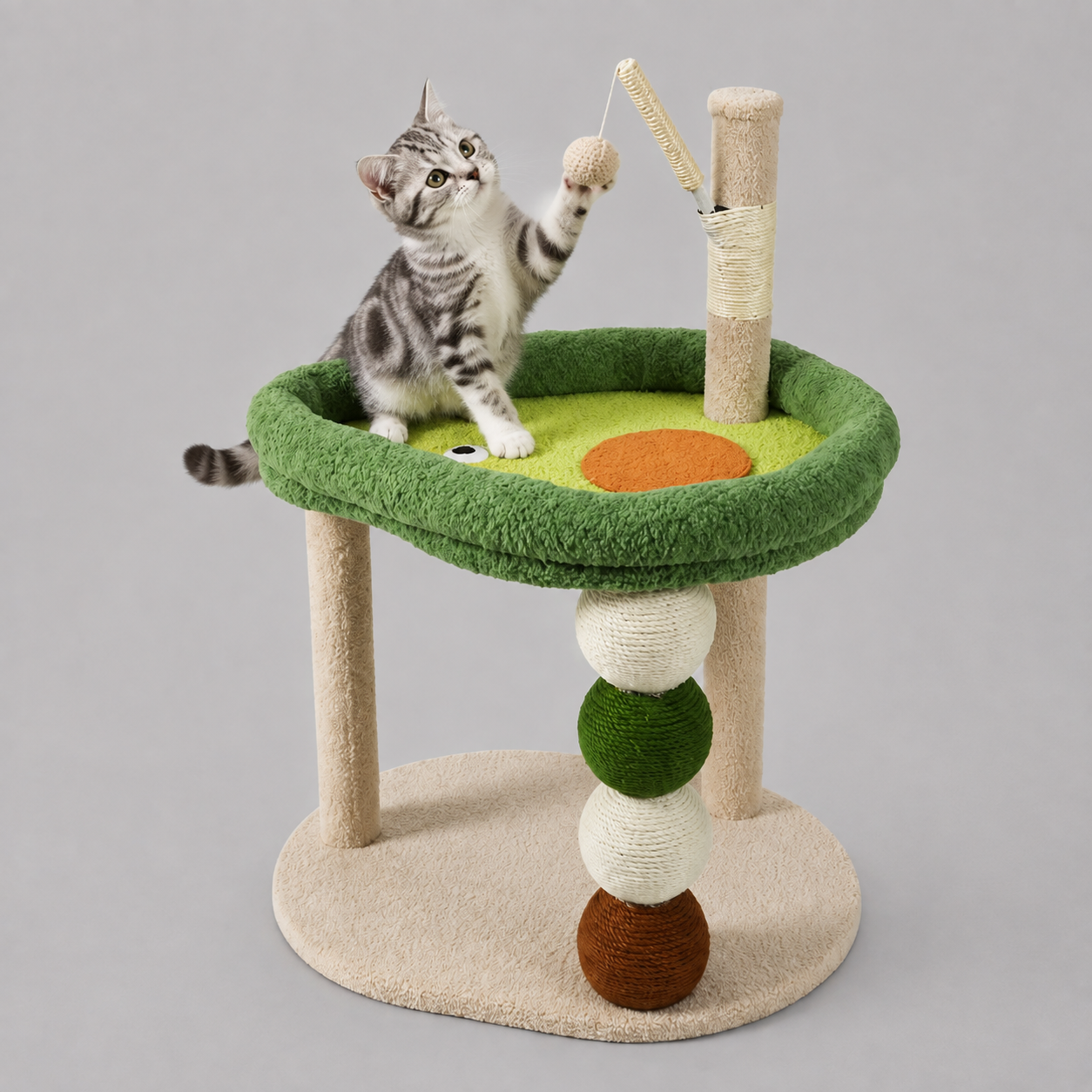
Low-Entry Senior Cat Furniture Design: Doorways, Ramps, and Step Heights
Good senior cat furniture eliminates every jump between rest areas. Condo doorways sit at floor level or behind a maximum 8–10 cm lip — low enough to step over without lifting the body. Where elevation changes are unavoidable, ramps replace leaps, and intermediate steps break the climb into increments a stiff cat manages.
| Dimension | Starting specification | Pourquoi |
|---|---|---|
| Condo doorway lip | ≤ 8–10 cm | Step over, never lift over |
| Step riser | 10–12 cm | One leg-lift per step, not a jump |
| Step tread depth | ≥ 20 cm | Fits all four paws, room to turn |
| Platform safety lip | 3–4 cm | Stops the dozing senior sliding off at 3 a.m. |
| Ramp angle | 20–25° from horizontal | Walkable without crouching into a jump |
Every dimension must pass one test: can a twelve-year-old with arthritis use this half-asleep at 3 a.m.?
Ramp Angles and the Trade-Offs Nobody Lists
Ramp angle is the most argued-over number in senior cat furniture, and the honest answer is: it depends on the cat. As a starting rule we prototype ramps at 20–25 degrees from horizontal: shallow enough for arthritic cats to walk up without crouching, steep enough to keep the footprint reasonable. Below 20 degrees the ramp works beautifully but consumes alarming floor — a 40 cm rise needs over a meter of run.
Surface matters as much as angle: shallow transverse grooves or an inset sisal runner, matte finish for grip, plus 5–6 cm side rails against sideways slips. Prototype with genuinely old cats — our workshop borrows seniors, because a ramp a three-year-old trots up may defeat the fourteen-year-old it was built for. That borrowed-cat test has killed more ramp designs than any lab instrument.
Anti-Slip Surfaces That Outlast Claws
Anti-slip treatment on senior cat furniture must survive the same claws that destroy it on kitten products, while working for weaker paws. Stick-on pads peel, foam grips shred, and glossy finishes betray.
| Méthode | Claw durability | Grip for weak paws | Verdict |
|---|---|---|---|
| Routed grooves in the wood | High — it is the wood | Bon | Permanent; our default |
| Inset sisal or carpet runner | Moderate; replaceable | Excellent | Best grip; plan for replacement |
| Matte textured water-based coating | Modéré | Good micro-grip | Fine on treads; never gloss |
| Stick-on pads | Low — peel under claws | Inconsistent | Not specified |
A textured water-based finish keeps VOC and formaldehyde profiles clean — consistent with E0/E1 grades and Conformité au titre VI de la TSCA de l'EPA expectations — and provides the micro-texture paws need. High-build glossy coatings look premium in photos and skate under paws in practice; we cap gloss levels on all senior-line treads and ramps. At IPQC we check coating adhesion with a cross-hatch test — a flaking textured finish becomes smooth patches exactly where grip matters most. Our guide des finitions de bois sans danger pour les animaux de compagnie details the full specification.
Senior Cat Furniture Stability: Slow, Heavy Landings
Senior cats rarely tip furniture dramatically — they defeat it slowly, leaning full weight against one side while hauling themselves up. Stability testing should therefore emphasize sustained off-center loading over impact: we apply a lateral lean load at platform height for extended durations, checking for joint creep and gradual base lift.
Low overall height is the category’s structural gift: a 60–80 cm senior line is inherently more stable than a 180 cm tower, freeing budget for what seniors need — wider platforms, stronger step brackets, better grip. We still run the full protocol: tip-over checks per ASTM F2057 principles adapted to low furniture, fatigue cycling on step brackets, and pre-shipment inspection under an AQL plan. In kiln-dried wood at 8–12% moisture content, with bolt-through joinery at every load-bearing node, a senior unit should feel immovable when an owner leans on it — they do.
The Limitation: Accessibility Costs Floor Space
The boundary to understand: accessible senior cat furniture consumes more floor area than standard equivalents. Low angles need long ramps, generous treads need deep platforms, and step sequences need horizontal run — a senior-friendly two-level unit can easily occupy twice the footprint of a standard tower reaching the same height. There is no engineering trick around geometry.
Senior lines suit houses better than studios — merchandise them near orthopedic beds, not the compact-living section. We advise against compressing a senior design to hit a smaller carton: shortening the ramp to save freight reintroduces the jump the product existed to eliminate. When floor space is truly constrained, a wall-mounted step sequence borrows vertical wall instead — see our custom design options for how the two combine.
voir notre atelier où les meubles pour chats en bois massif sont usinés et assemblés. Nous sommes un fabricant spécialisé de meubles pour animaux de compagnie en bois massif, et les lignes pour chatons reçoivent leur propre cahier des charges d'ingénierie dans notre atelier — jamais un dossier adulte réduit.
How Solid Pet Wood Builds Senior Cat Furniture
We’re a specialized solid wood pet furniture manufacturer; senior lines get the most conservative engineering in our catalogue — the user is the most fragile.
rédige le cahier des charges d'une page pour chatons avec vous : plage de poids cible, hauteur maximale de la plateforme, rayon de bord arrondi, spécifications du tissu et des coutures, chimie de la finition, et test d'impact latéral que le prototype doit réussir. Un véritable partenaire de conception remet en question vos chiffres plutôt que d'acquiescer — les nôtres le font. adapts platform heights, ramp angles, and doorway clearances to your market’s senior-cat profile, validating on genuinely old test cats, not young stand-ins. arrondit tous les bords accessibles sur la CNC, fraise et bouche chaque fixation, encapsule toute la mousse, et teste la résistance des coutures de rembourrage à l'IPQC. cuts every tread and ramp to the low-entry specification, caps gloss on all senior surfaces, and runs cross-hatch adhesion checks at IPQC. effectue des tests de fatigue par impact latéral sur chaque prototype de chaton avant l'outillage ; tout changement structurel déclenche un nouveau cycle de test via un ordre de modification d'ingénierie (ECO). tests senior prototypes with sustained off-center lean loads, cycles step brackets through fatigue, and folds field feedback into future runs via an engineering change order (ECO) process. See our protocoles de test de durabilité.
Trust is the currency of the senior category: published dimensions, stated test methodology, documented finish chemistry. When your senior-line brief is ready, pour un examen d'ingénierie avant l'outillage. for an engineering review.
FAQ
What makes furniture “senior-friendly” for cats?
Three things: no jumps between rest areas (low doorways, ramps, shallow steps), grip on every surface a paw touches, and stability under slow heavy leaning — height is a liability, not a feature.
What ramp angle works for arthritic cats?
We prototype at 20–25 degrees from horizontal — shallow enough to walk without crouching, steep enough to keep the footprint sane. Below 20 degrees the ramp works but consumes a lot of floor. The ramp surface matters equally: grooves or sisal runners plus a matte grippy finish, with side rails against sideways slips.
How should stability be tested for senior cat furniture?
Emphasize sustained off-center loading — a lateral lean at platform height held over time — since seniors defeat furniture by leaning, not leaping. We combine this with tip-over checks per ASTM F2057 principles, fatigue cycling on step brackets, and AQL-governed pre-shipment inspection.
Are water-based finishes grippy enough for senior paws?
A matte, finely textured water-based coating provides good micro-grip and keeps formaldehyde and VOC within E0/E1 and EPA TSCA Title VI expectations. High-gloss finishes should be avoided on treads and ramps regardless of how they photograph — for lasting grip, combine the coating with routed grooves or replaceable sisal runners.
Can we develop a private-label senior cat furniture line?
Yes. Senior lines adapt well to private label: platform heights, ramp angles, doorway clearances, and finishes tune to your market while the validated low-entry structure stays constant. Structural changes trigger new prototype iteration and stability testing.
Support OEM/ODM
Besoin d'un plan de production personnalisé pour un arbre à chat ?
Envoyez des photos de référence, les dimensions cibles, les préférences de matériaux, les besoins en emballage et la direction du marché. Nous pouvons examiner la faisabilité, l'échantillonnage, les MOQ et l'emballage d'exportation avant la production. Demander un devis OEMLignes de produits associées
Explorez les meubles pour chats en bois que nous pouvons fabriquer.
Guides d'achat associés