
A Berlin retail buyer told us his best-selling cat tree was also his most returned — a 180 cm tower that dominated studio apartments and wobbled on uneven floors. He replaced it with three compact SKUs and watched returns fall while revenue per square meter doubled. That’s the commercial logic of space saving cat furniture: apartment dwellers don’t buy smaller versions of suburban products; they buy a different category with different engineering priorities.
Why Apartment Dwellers Buy Cat Furniture Differently
Space saving cat furniture succeeds when it treats floor area as the scarcest resource in the home. Apartment buyers evaluate products by what they displace and punish anything that wobbles or blocks walkways — prioritize footprint efficiency, visual lightness, and stability on real apartment floors over raw height.
The engineering brief flips: a suburban tower buys stability with a wide heavy base, while a compact unit earns it through geometry — lower center of gravity, wider stance relative to height, tighter joints.
Three Space-Saving Formats Worth Stocking
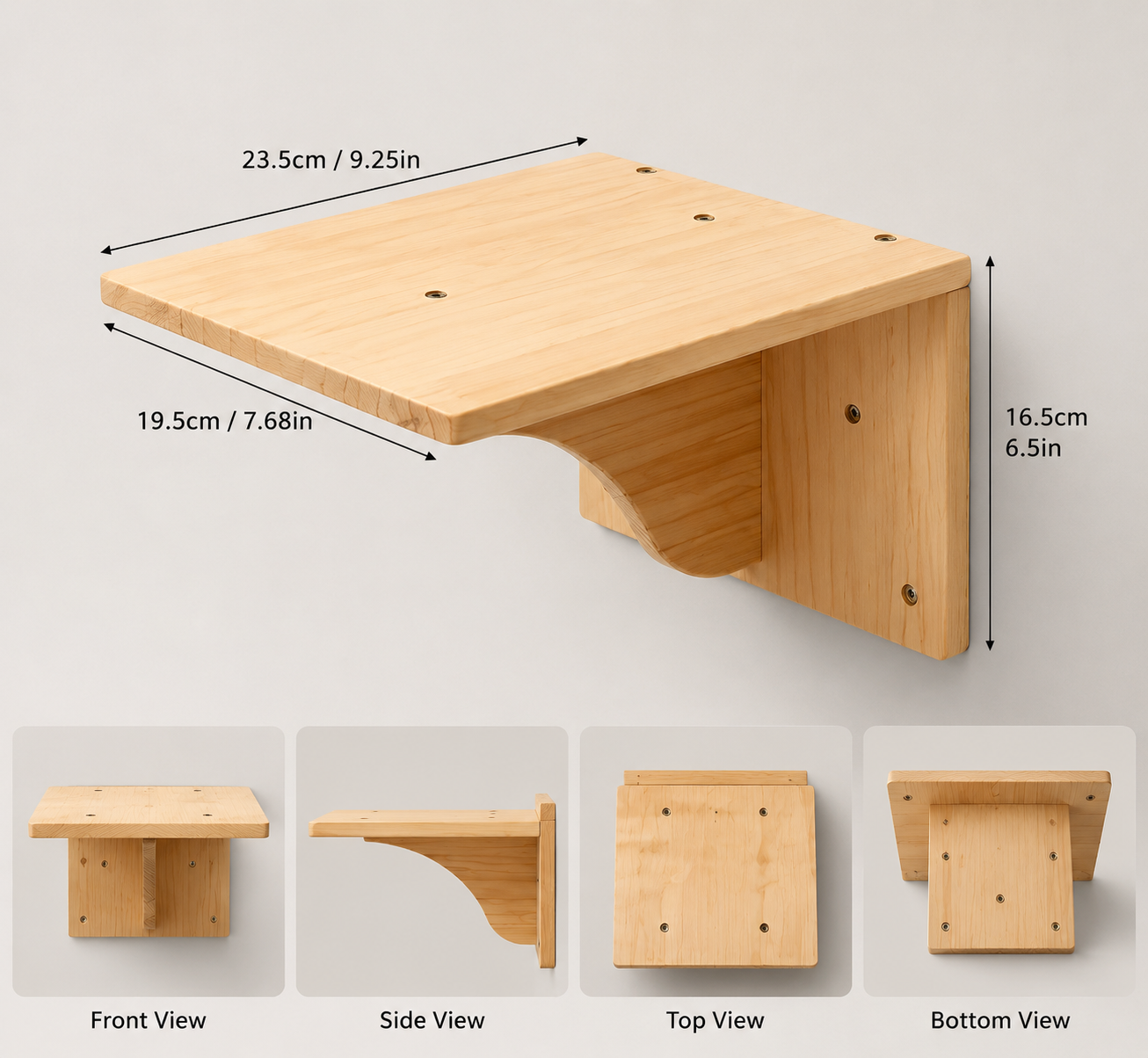
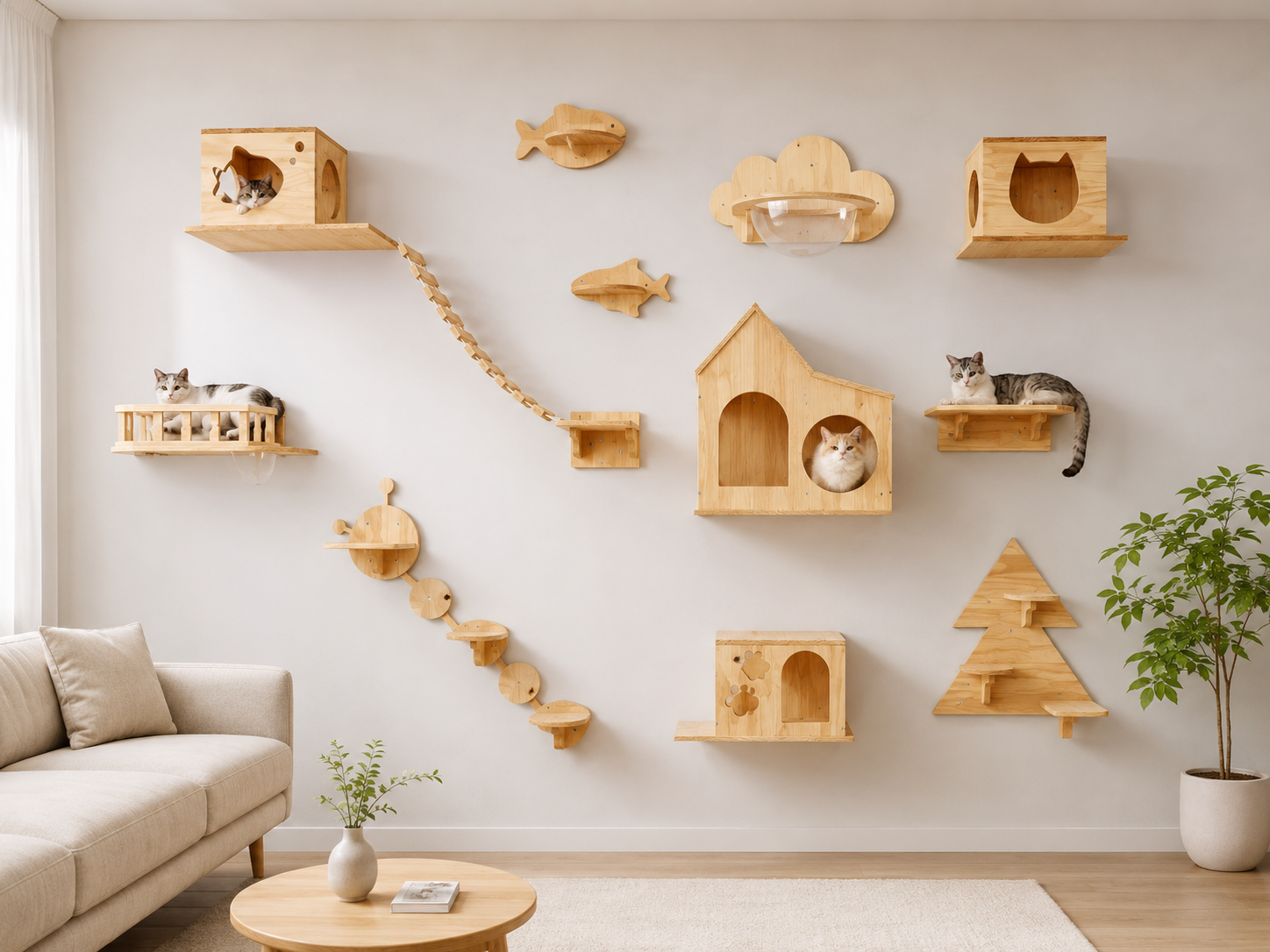
Retailers need three formats, not twenty SKUs: wall-mounted components consuming zero floor area, vertical tension designs gripping floor-to-ceiling without drilling, and compact freestanding pieces under roughly a quarter square meter. Together they cover renters who cannot drill, owners who will not drill, and everyone in between.
| Formater | Floor Footprint | Install Requirement | Engineering Focus |
|---|---|---|---|
| Wall-mounted | Zéro | Anchors into wall or stud | Bracket design + anchor matching |
| Floor-to-ceiling tension | Pole base only | No drilling; needs a flat ceiling | Tensioner holding force + pole stiffness |
| Compact freestanding | Under ~0.25 m² | Aucune | Base-to-height ratio + joint upgrades |
Each format has a distinct return profile: wall-mounted units ship flat and pack densely but depend on the customer’s wall and installation skill; tension designs demand tight manufacturing tolerances. Compact freestanding pieces are the easiest sell and the hardest to engineer.
Wall-Mounted: Engineering Vertical Real Estate
Wall-mounted pieces are the purest form of the category: zero floor footprint. The engineering challenge moves entirely to the mounting system and the plank. A wall perch for a 6 kg cat must handle dynamic landing loads through two or three anchor points — bracket design and included anchors matter more than wood species.
We specify anchors by wall type — toggle bolts for drywall, sleeve anchors for masonry — and CNC-machine mounting plates for consistent hole spacing. On our line, mounting plates are machined in the same batch as their planks, so hole spacing never drifts between runs; IPQC verifies the pairing before packing. Planks are kiln-dried to 8–12% moisture content so they never cup or twist after installation, with a full round-over on edges since wall pieces sit at face height. For the broader trade-offs, see our wall-mounted vs freestanding comparison.
Floor-to-Ceiling Tension Designs: Space Saving Without Drilling
Tension designs are the renter’s answer to the space problem: a central pole wedges between floor and ceiling via a screw-jack tensioner, converting unused vertical air into climbing territory without a single wall anchor. The format lives or dies on the tensioner’s holding force and the pole’s resistance to bowing.
The tensioner must hold through seasonal ceiling movement — a pole tensioned in humid August can loosen by dry January. We fatigue-test every tensioner design through thousands of cycles on a rig that simulates seasonal movement, and specify wide-range tensioners with locking collars. The pole should be solid or thick-walled; a thin hollow pole bows visibly under side-platform launches. Platforms clamp with through-bolts, not friction collars alone — see our floor-to-ceiling cat tree overview. Poles that fail the straightness check on the jig fixture go back to milling, not forward to packing.
Compact Freestanding: What Gets Cut and What Must Stay
Shrinking a freestanding tree means deciding what the cat will not miss. Height can drop — apartment cats use the first 120 cm far more than the top 60. What must never be cut is base stability: a compact tree needs a proportionally wider base, or a weighted low platform doubling as a lounge.
| Tree Height | Base Strategy | Stability Verification |
|---|---|---|
| Under 90 cm | Proportionally wider base | Tip-test with off-center loads, ASTM F2057 logic |
| 90–120 cm | Wider base + bolt-through joints | Tip-test + joint torque checks |
| Over 120 cm | Weighted low platform doubling as lounge | Full tip-over + fatigue sequence |
Our in-house design team prototypes compact variants at three base ratios, tip-testing each with off-center loads per ASTM F2057 principles and keeping the winner. A cheap factory shrinks the base and keeps the screws; a specialized manufacturer widens the base proportionally and upgrades to bolt-through connections at every structural node. A water-based matte coating keeps the piece visually quiet, E0/E1 grades keep emissions within Conformité au titre VI de la TSCA de l'EPA expectations, and cartons are validated with an ISTA 3A drop test sequence plus FBA size tier checks.
The Trade-Off: Smaller Footprint, Tighter Tolerances
The honest limitation: compactness concentrates every manufacturing flaw.
| Composant | Why Compactness Tightens Tolerance | Our Check |
|---|---|---|
| Tension pole | Thin hollow poles bow under side loads | Straightness checked on a jig fixture |
| Compact joints | A 2 mm misalignment shows at eye level | Bolt-through connections at structural nodes |
| Wall planks | Cupping telegraphs at face height | Kiln-dried to 8–12% MC; full round-over edges |
Logistics tighten too: compact pieces still need full ISTA-grade protection, and the protection eats a larger share of the carton dimension. Expect more installation questions per unit sold — wall-mounted and tension formats shift assembly confidence onto the customer. We counter with tool-free tensioners, single-page visual instructions, and QR-linked videos — documentation is part of the product here, not an afterthought.
voir notre atelier où les meubles pour chats en bois massif sont usinés et assemblés. see our workshop where compact solid-wood cat furniture is machined and assembled.
How Solid Pet Wood Engineers Space-Saving Cat Furniture
Our in-house design team develops each format against its own structural brief: wall-mounted pieces validated on bracket and anchor engineering, tension designs proven through fatigue cycling, compact units prototyped at multiple base ratios and tip-tested per ASTM F2057 principles. Production carries that discipline through CNC-machined mounting plates, jig-fixture straightness checks, and AQL inspection tuned to each format’s risk points.
This isn’t marketing — it’s the direct math of the apartment: every centimeter removed from the base must be compensated structurally, or the returns will find it. We prove the compensation on the test rig before your assortment ships.
FAQ
What defines space saving cat furniture versus a regular small cat tree?
It’s designed around the apartment’s scarcest resource — floor area — not just a shorter tower: zero-footprint wall-mounted pieces, floor-to-ceiling tension designs, and compact freestanding units under ~0.25 m², each engineered for stability without wide suburban bases.
Are wall-mounted pieces safe for renters who cannot drill into studs?
They’re safe when matched to the wall: toggle bolts for drywall, sleeve anchors for masonry, into studs where the design requires it. Some walls can’t carry the load — state minimum wall requirements in the listing. Tension poles exist for renters who can’t drill at all.
How do tension pole cat trees stay stable without wall anchors?
A screw-jack or spring tensioner wedges the pole between floor and ceiling; platforms bolt to the pole. Stability depends on the tensioner’s holding force through seasonal movement and pole stiffness under asymmetric load. We fatigue-test the mechanism and specify locking collars.
What should retailers check before stocking compact cat furniture?
Check base-to-height ratio, joint construction (bolt-through beats screws), moisture content (8–12% kiln-dried), finish quality at close range, and carton dimensions vs parcel/FBA needs. Ask for tip-test and drop-test summaries, not just photos.
Can we develop a private-label space-saving line with matching finishes?
Yes — a shared finish and hardware language across all three formats is how strong assortments are built. Private-label work covers dimensions, finishes, and packaging while validated structures stay constant; new concepts go through prototype iteration first.
Space saving cat furniture is an OEM/ODM sweet spot: one lumber stream, one finishing line, one hardware family, multiple listings. Our private label and white label programs adapt dimensions, finishes, and packaging while validated structures stay constant. See our shipping pet furniture from China guide; send your assortment plan through our pour un examen d'ingénierie avant l'outillage. page for an engineering review.
Support OEM/ODM
Besoin d'un plan de production personnalisé pour un arbre à chat ?
Envoyez des photos de référence, les dimensions cibles, les préférences de matériaux, les besoins en emballage et la direction du marché. Nous pouvons examiner la faisabilité, l'échantillonnage, les MOQ et l'emballage d'exportation avant la production. Demander un devis OEMLignes de produits associées
Explorez les meubles pour chats en bois que nous pouvons fabriquer.
Guides d'achat associés