
A cat tree that collapses after three months of use doesn’t just generate a return — it generates a 1-star review that stays on your product listing forever. For B2B buyers sourcing pet furniture from OEM manufacturers, pet furniture durability testing at the factory level is the only way to verify that your products will survive real-world use before thousands of units ship to your warehouse.
This guide explains what pet furniture durability testing covers, which tests matter most for different product categories, and how to specify testing requirements in your manufacturing agreement so the factory actually does them.
What Is Pet Furniture Durability Testing?
Pet furniture durability testing is a series of mechanical tests that simulate months or years of real-world use in a compressed timeframe. The goal is to identify structural weak points — joints that loosen, platforms that sag, coatings that crack — before products leave the factory rather than after they reach the end consumer.
Unlike quality inspection which checks a finished batch for defects, durability testing is done on samples during or before mass production. It answers a different question: inspection asks “did the factory build it correctly?” while durability testing asks “will the design and materials hold up over time?”
Professional pet furniture durability testing typically covers four areas:
- Static load testing — Can the product support the rated weight without deformation?
- Dynamic/cyclic load testing — Does it survive repeated use (jumping on, climbing, scratching)?
- Stability testing — Does it resist tipping under normal use conditions?
- Environmental aging — Do materials and finishes degrade under humidity, temperature, or UV exposure?
Pet Furniture Durability Testing Standards and Methods
There is no single universal standard for pet furniture durability testing. Most factories and buyers adapt methods from general furniture testing standards (BIFMA, EN, ASTM) to pet furniture applications. Below are the key tests and how they apply to pet products.
Static Load Test
| Parameter | Method | Pass Criteria |
|---|---|---|
| Platform/shelf load | Place weight = rated capacity × 1.5 on each platform for 24 hours | No cracking, permanent deformation < 2 mm, no joint separation |
| Hanging/hammock load | Suspend rated weight from hammock or hanging bed for 48 hours | No fabric tear, frame deflection < 5 mm, no fastener pullout |
| Wall-mount load | Mount unit per instructions, apply 1.5× rated load for 24 hours | No wall anchor failure, bracket bending < 1 mm |
Why 1.5× and not 1.0×? Because a 6 kg cat doesn’t gently place itself on a platform — it jumps. The impact force of a cat jumping from 1 meter height is approximately 2–3× its body weight. The 1.5× safety factor on a static test is a minimum, not an aggressive target.
Cyclic (Fatigue) Load Test
Static tests prove the product is strong enough. Cyclic tests prove it stays strong enough after repeated use.
| Product Type | Test Method | Cycles | Pass Criteria |
|---|---|---|---|
| Cat tree platform | 75% of rated load, applied and released | 5,000 cycles | No visible joint loosening, cracking, or deformation |
| Hinged door (litter box furniture) | Open/close door through full range | 10,000 cycles | Hinge functional, no sagging > 3 mm, latch engages |
| Foldable/collapsible furniture | Fold and unfold completely | 2,000 cycles | Mechanism functional, no play > 2 mm at joints |
| Scratching post wrap (sisal) | Mechanical scratching simulator, 2 kg force | 3,000 cycles | < 20% fiber displacement, core material not exposed |
Most factories don’t have dedicated pet furniture fatigue testing rigs. They adapt general furniture testing equipment. If your factory claims they do cyclic testing, ask them to show you the equipment and a test report with cycle counts, loads, and pass/fail results. A verbal “we tested it” is not pet furniture durability testing.
Stability / Anti-Tip Test
Tall cat trees and multi-level structures are the highest-risk products for tipping. A tipping cat tree is a safety hazard and a product liability issue.
Standard test method (adapted from ASTM F2057 for furniture tip-over):
- Place the product on a flat, hard surface
- Apply a horizontal force of 23 kg (50 lbs) at the highest usable platform
- The product must not tip over
For cat trees specifically:
- Test with all sisal posts, platforms, and accessories installed (heaviest configuration)
- If the product has a base weight or anchor option, test both with and without it
- Record the tipping angle — products that resist tipping beyond 15° from vertical are considered stable
Environmental Aging Test
Solid wood and pet-safe finishes behave differently after exposure to humidity, temperature swings, and UV light.
| Test | Condition | Duration | What It Reveals |
|---|---|---|---|
| Humidity cycling | 30°C / 85% RH → 20°C / 40% RH, alternating 12-hour cycles | 14 days (28 cycles) | Wood warping, joint gaps, finish cracking, hardware corrosion |
| UV exposure | UV-A 340 nm lamp, 60°C panel temperature | 200 hours | Finish yellowing, color fading, coating chalking |
| Moisture resistance | Place wet cloth on surface for 24 hours | 24 hours | White rings, swelling, delamination |
Environmental testing is especially important for products made with MDF or engineered wood. Solid wood handles humidity better than MDF, but both degrade if the finish is inadequate. If your factory uses MDF for internal panels, make sure those panels have CARB-compliant adhesives and sealed edges.
Which Tests Matter Most by Product Category?
Not every product needs every test. Focus your pet furniture durability testing requirements on the failure modes most likely to cause customer complaints or safety issues:
| Product | Critical Tests | Why |
|---|---|---|
| Cat trees / cat towers | Stability + cyclic load on platforms | Tipping risk; joints loosen from jumping impacts |
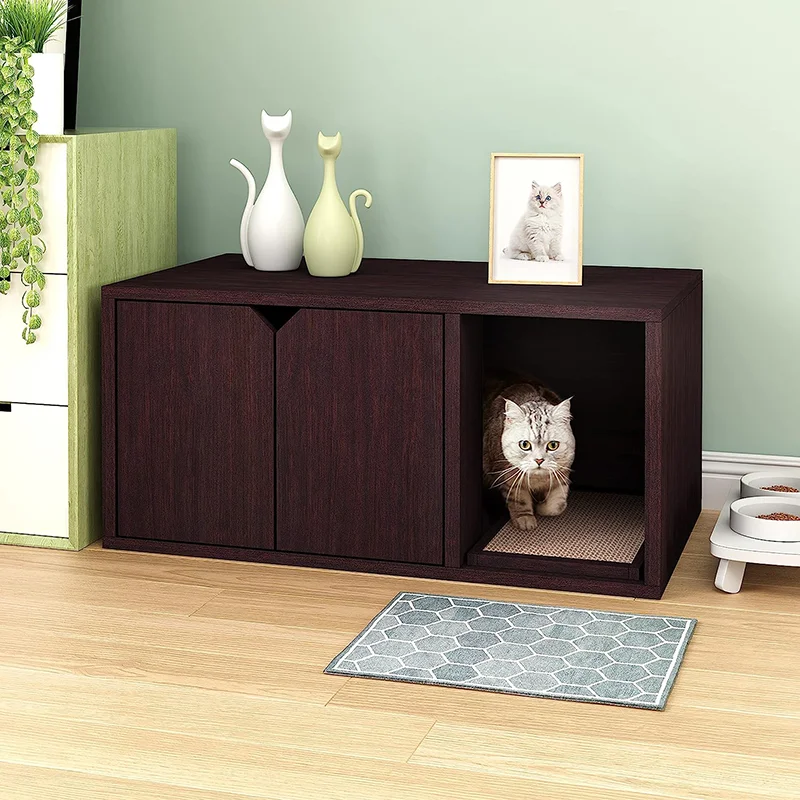
| Litter box furniture | Hinge cycling + moisture resistance | Door used daily; interior exposed to moisture and ammonia |
| Dog beds / elevated cots | Static load (large breeds) + fabric tear | 40+ kg dogs; fabric/mesh is the weak point |
| Pet stairs | Static + cyclic load on steps | Repeated stepping; small footprint increases stress per step |
| Wall-mounted shelves | Wall anchor pull-out + static load | Mounting failure = falling product + injury risk |
| Outdoor cat houses | Full environmental suite (UV + humidity + rain) | Year-round weather exposure |
How to Specify Durability Testing in Your OEM Agreement
Adding “must pass durability testing” to your purchase order means nothing without specifics. Here’s what to include in your OEM manufacturing agreement:
1. Define Test Methods and Pass Criteria Before Sampling
Include a durability testing specification document as an attachment to your purchase agreement. At minimum, specify:
- Which tests are required (static, cyclic, stability, environmental)
- Load values and cycle counts for each test
- Pass/fail criteria with measurable thresholds (not “acceptable quality”)
- Sample size: typically 3 units from pre-production run
2. Test at the Pre-Production Stage, Not After Mass Production
Durability testing on finished goods is too late — if the design fails, you’ve already paid for tooling and production. Test during the sample phase so design changes are still possible and affordable.
Recommended testing timeline:
| Stage | Test | Purpose |
|---|---|---|
| First sample | Static load + stability | Verify basic structural design |
| Pre-production sample | Full durability suite (all 4 test types) | Final design validation before mass production |
| Mass production (per batch) | Static load spot-check on AQL sample | Confirm production consistency |
3. Require Photographic Evidence and Test Reports
Every test should produce a written report including:
- Test date, sample ID, and lot number
- Test method, equipment used, parameters applied
- Results with measurements (not just “pass/fail”)
- Photos of the test setup and any failures observed
If a factory refuses to provide test reports, that’s a red flag. Factories that actually do pet furniture durability testing are proud of the results and will share them readily — it’s a competitive advantage.
When Third-Party Testing Is Worth the Cost
Factory self-testing is adequate for most B2B orders. But consider independent third-party testing (SGS, Bureau Veritas, Intertek, or TÜV) when:
- First order with a new factory — Verify the factory’s own test results independently
- High-value orders (> $50,000) — The cost of third-party testing ($500–$2,000 per product) is insignificant compared to the cost of a failed shipment
- Products for regulated markets — If selling into the EU, children’s furniture safety standards (EN 71 for items marketed for children’s pets) may apply depending on how the product is classified
- Products with identified safety risk — Tall cat trees, wall-mounted units, or any product rated for large dogs (> 30 kg)
According to ASTM International, furniture testing standards provide the framework, but application to pet furniture requires buyer-specified adaptations since no dedicated pet furniture durability standard currently exists.
The Consumer Product Safety Commission (CPSC) provides guidance on furniture stability requirements that are directly applicable to heavy or tall pet furniture products.
OEM/ODM Support
Need a custom cat tree production plan?
Send reference photos, target dimensions, material preferences, packaging needs, and market direction. We can review feasibility, sampling, MOQ, and export packaging before production. Request OEM QuoteRelated Product Lines
Explore wooden cat furniture we can manufacture.
Related Buyer Guides