
A buyer once sent us a photo of a competitor’s “walnut” cat tower and asked why ours would cost more. The photo told the story: pale streaks across every platform, a washed-out gray cast, edges that looked nothing like the rendering. It was walnut bought the way a spreadsheet buys walnut — heavy on sapwood, no color sorting, finished in a hurry. We quoted the honest version instead, and his walnut line became the highest-margin family in his catalog. Walnut cat furniture is less a material choice than a positioning decision.
Why Does Walnut Cat Furniture Command the Premium Tier?
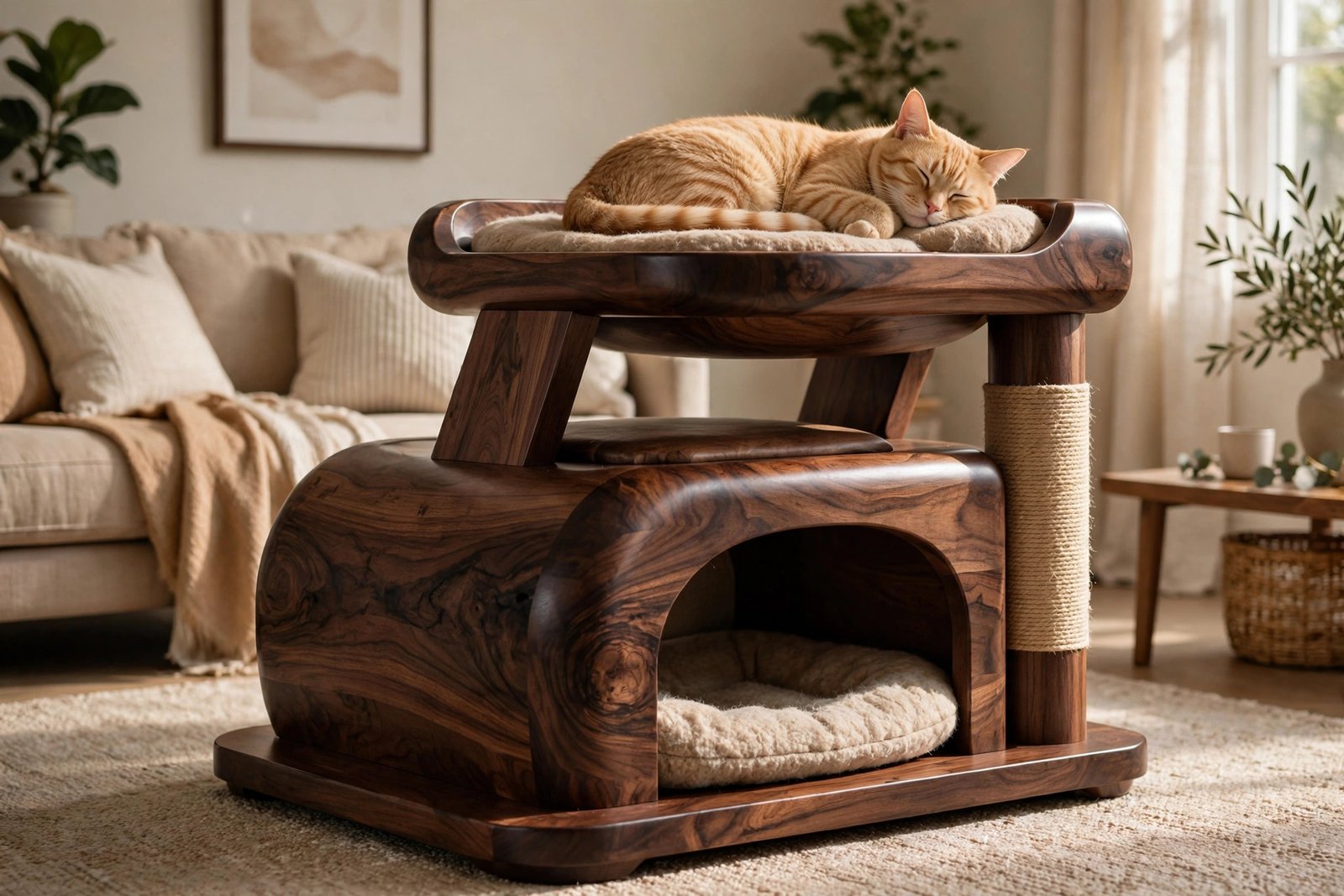
Walnut cat furniture commands the premium tier because black walnut offers a color and grain character no other commercial hardwood matches at scale: deep chocolate-brown heartwood, calm straight grain, an instant designer-segment read. The premium is not about hardness — at roughly 1,010 lbf Janka, walnut is softer than red oak.
That distinction drives the whole brief. Walnut earns its keep on visible surfaces — platforms, condo faces, shelving — where the eye lands, and earns nothing hidden inside a structure. Our best wood for cat tree scorecard puts walnut’s numbers beside every alternative: you are buying looks and stability, not hardness.
Black Walnut vs. “Walnut”: Read the Spec Sheet
Black walnut is Juglans nigra, the North American hardwood behind virtually all premium walnut furniture. But “walnut” on a spec sheet can mean several things at very different prices: European walnut (Juglans regia), lighter and rarer, or “walnut-stained” poplar and rubberwood — pale woods wearing a brown finish.
A stained line can be an honest value product, but the buyer should know which is being quoted. Ask for the botanical name, not the marketing name; species background is published at the Wood Database. If a “walnut” quote lands near an oak-line price, it is almost certainly stained something-else — and the stain will tell on it within a year as edges wear back to pale wood.
Heartwood vs. Sapwood: The Color-Matching Problem
Every walnut tree grows two woods: chocolate-brown heartwood that everyone pays for, and a pale creamy sapwood band near the bark. Left unsorted, a panel shows both — the pale streaks from our opening story. Structurally fine, but on a premium line every customer reads it as a defect.
The trade has two answers. First, steaming: most commercial walnut is steamed after sawing, which darkens sapwood and evens out color — the standard product, not a compromise, though heavy sapwood still shows through. Second, selection: specify heartwood-only grades and sort panels at the factory so adjacent parts match. That sorting happens before cutting, never after assembly — because after assembly the mismatch is a rework, and walnut rework is priced in walnut.
Finishing Walnut: Oil Depth vs. Water-Based Speed
Walnut is the species that makes finishers look good. Hardwax oil is the classic choice: it hardens in the fiber and leaves the grain readable under a soft sheen — half the selling proposition on a designer line. Water-based finishes bring faster cure times and simpler paperwork, but read slightly flatter than oil.
Our production answer splits by channel: oil where the retail story is craftsmanship and touch, water-based where throughput and paperwork rule. Either way, walnut’s open pores telegraph through thin finishes, so pore-filling or multi-coat build belongs in the spec. And one caution for every brief: walnut lightens with UV exposure, drifting chocolate toward honey-brown over the years — slow, even, attractive, but never promise buyers an unchanging color.
Working Properties: Stability, Machining, and Shop Dust
Walnut is cooperative in the shop: it machines cleanly, glues reliably, and holds detail without tear-out. Stability is genuinely good — walnut moves less with humidity swings than oak, which matters for wide platforms. Kiln-dried to 8–12 percent, walnut panels stay flat where fussier species cup.
The hardness caveat stands: at ~1,010 lbf Janka, walnut dents more easily than oak, so put walnut where eyes go and sisal wrap or harder species where claws go. A walnut scratching post is a contradiction; a walnut-faced condo with sisal-wrapped posts is the correct architecture. One frank line on shop hygiene: walnut sanding dust is a known sensitizer, so professional shops run extraction and respirators at sanding stations — a factory-hygiene matter, not a product-safety one. Finished walnut furniture in the home carries no such concern.
Where Walnut Cat Furniture Wins — and Where It Doesn’t
Walnut cat furniture wins on visible, touchable surfaces for the designer segment: condo faces, wide lounge platforms, shelving walls — anything the listing photo leads with. It wins on stability for wide flat parts, and on the mid-century palette where warm brown wood is the design language.
It does not win on hardness — claws will mark it. It does not win in wet environments. And it does not win on price-sensitive lines: walnut lumber costs a multiple of oak, and that multiple must be recovered at retail. The most expensive walnut mistake is not the lumber price but designing for the wrong customer — confirming the channel before the species is the whole game.
Positioning a Walnut Line: Channel First, Species Second
Positioning starts with honesty about what the premium buys: color depth, grain character, stability, designer read — not indestructibility. Copy should name the specifics a premium buyer verifies: North American black walnut, heartwood-selected, oil-finished. Lead with hero pieces where walnut covers the most visible surface per dollar of lumber.
Keep finish options narrow: natural oil and perhaps one darker tone, because walnut’s proposition is its own color. That restraint keeps the catalog photographable as one material family — exactly what designer-segment buyers shop for. Industry background: National Hardwood Lumber Association.
Da nossa fábrica: A short look at solid wood cat furniture coming together in our factory — the same color-sorting discipline we apply to walnut lines.
FAQ
Is black walnut the same as the “walnut” on cheap furniture?
Not necessarily. True black walnut is Juglans nigra. Much “walnut” furniture is walnut-stained poplar or rubberwood — honest at a value price, but the stain wears and pale wood shows through at edges within a year or two.
Is walnut hard enough for cat furniture?
At ~1,010 lbf Janka it is softer than oak. Design for it: walnut on visible surfaces, sisal wrap or harder species where claws land. It is a look-and-stability material, not an abrasion material.
Why does walnut furniture change color over time?
Walnut lightens with UV exposure, drifting chocolate toward honey-brown over the years. Slow, even, natural — not a defect. Never promise buyers an unchanging color.
What is the difference between steamed and unsteamed walnut?
Steaming darkens pale sapwood and evens out color; it is the industry standard. But it narrows the range rather than erasing it — premium lines still specify heartwood-selected grades plus factory color sorting.
Is walnut dust dangerous?
Walnut sanding dust is a known sensitizer, so professional shops use extraction and respirators at sanding stations. A factory-hygiene matter; finished walnut furniture in the home carries no such concern.
Considering a walnut line? Tell us the target retail channel first — designer-segment means heartwood selection, color sorting, and oil finishes; anything else means we will point you at the species that actually earns the margin. Talk to our engineering team.
Suporte OEM/ODM
Precisa de um plano de produção personalizado de árvore para gatos?
Envie fotos de referência, dimensões alvo, preferências de material, necessidades de embalagem e direção de mercado. Podemos revisar a viabilidade, amostragem, MOQ e embalagem de exportação antes da produção. Solicitar Cotação OEMLinhas de Produtos Relacionadas
Explore móveis de madeira para gatos que podemos fabricar.
Guias do Comprador Relacionados