
A UK retail buyer once rejected a shipment of our upholstered pet beds over a single missing sentence — the foam supplier’s declaration named the test result but not the test method. The foam had passed the lab; the paperwork hadn’t. In the British market, the report is the product, and the report is only as good as its weakest sentence.
BS 5852 Flammability Testing for Pet Beds: What Buyers Actually Need
BS 5852 flammability testing for pet beds means the filling materials and fabric covers have passed the British ignition tests for smouldering and flaming sources — the same methods the 1988 UK furniture fire regulations demand for household furniture. A pet bed sits legally outside those regulations, but British retailers treat a passing lab report as the price of entry.
Start with the distinction most pet-product articles skip: BS 5852:2006 is a test method, not a law. Part 1 describes how to test upholstered composites against smouldering ignition sources; Part 2 describes the flaming sources. The law is the 1988 Regulations, which say which furniture must pass and what labels it must carry. Confusing the two is how factories end up buying “BS 5852 certified foam” — a phrase no standard defines and no lab can certify.
The 1988 Regulations in One Paragraph: What the Law Covers
The Furniture and Furnishings (Fire) (Safety) Regulations 1988 require upholstered furniture for private domestic use — sofas, beds, mattresses, cushions — to pass ignitability tests, enforced by trading standards. A 2025 amendment removed certain baby and child products from scope and simplified labelling.
A pet bed is not furniture for human domestic use, so it falls outside these UK regulations’ legal scope — nobody can fine you under the 1988 Regulations for an untested dog bed. But the overarching General Product Safety Regulations 2005 still apply to consumer products sold in the UK, and every serious British buyer writes a flammability requirement into the purchase contract. The law doesn’t demand the test; the market does.
What BS 5852 Testing Actually Tests: Fillings, Covers, Ignition Sources
BS 5852 testing attacks a pet bed’s foam filling, fibre filling, and fabric cover with defined ignition sources — a smouldering cigarette equivalent (Source 0) and match-flame equivalents (Sources 1 and 2). The standard asks whether materials ignite under these repeatable attacks.
When we developed our first upholstered cat bed for a UK client, we assumed the solid-wood frame was the compliance story. The lab told us the opposite: the pine frame was never the question — the foam filling and the fabric cover were. That is the mental model to keep: the wood is structure, but the flammability story lives entirely in the soft goods.
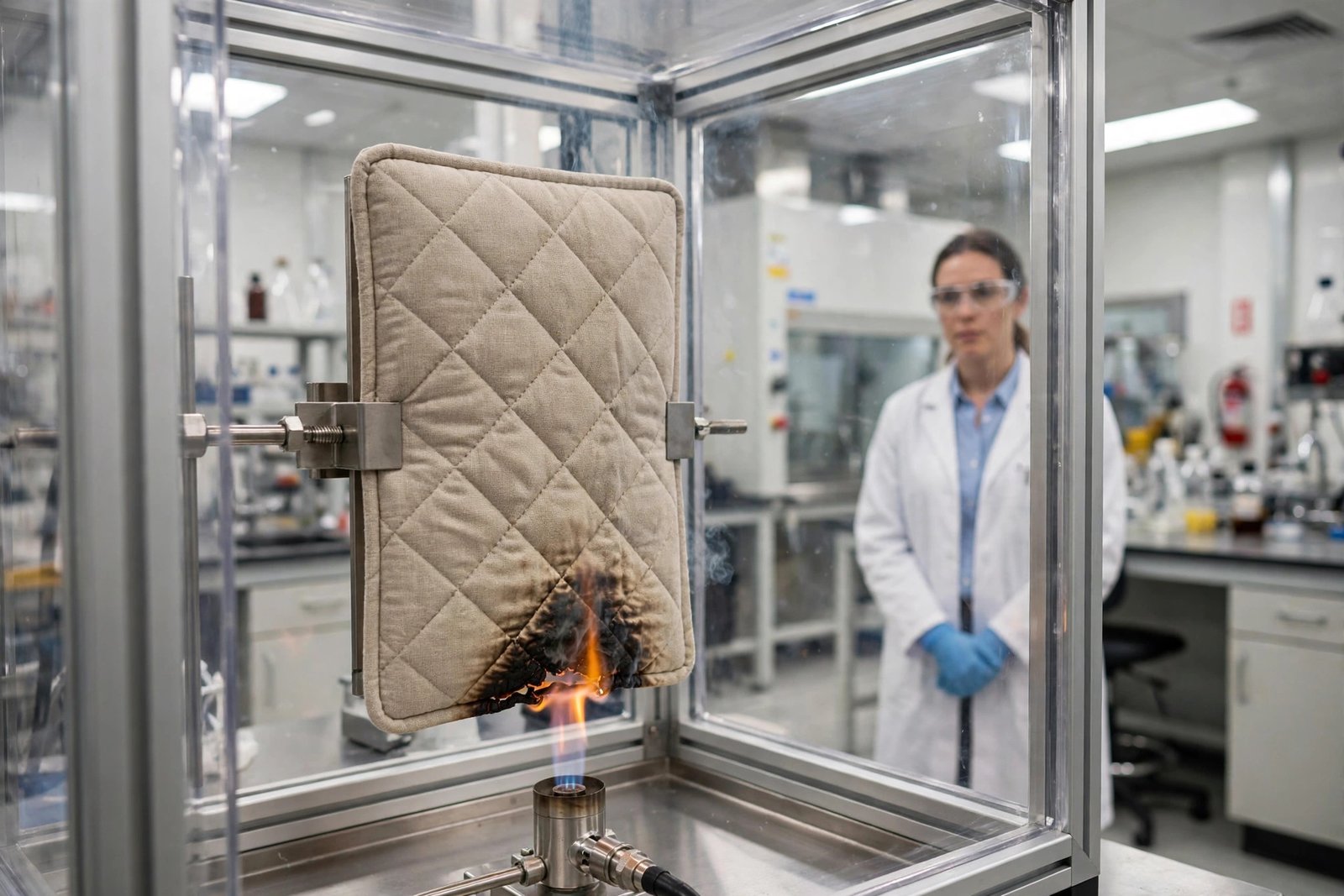
Filling materials are tested under Schedule 1 of the regulations: samples of foam or fibre face smouldering and flaming ignition, and must not ignite. Covers are tested as composites — the fabric laid over a standard test foam — because a cover’s real-world behaviour depends on what sits beneath it. This composite principle is where most “compliant” claims quietly fall apart.
Schedules 1, 3 and 4/5: How to Read a Fire Test Report Like a Buyer
A proper report reads like an engineering document, not a certificate. Look for four things: the sample description (does it name your foam density, your cover fabric, your construction?), the ignition sources applied (Source 0 smouldering, Source 1 or 2 flaming), the verdict per schedule, and the lab’s accreditation. A report on foam alone proves the foam — it says nothing about your bed.
Schedule 3 is the industry’s favourite workaround, and buyers should understand it: it tests an interliner — a fire-barrier fabric placed between filling and cover — so that a decorative cover which fails on its own can pass as part of the construction. Schedules 4 and 5 test the cover composite itself. None of these is “better”; they are different engineering routes to the same outcome, and the report must say which route was taken. Red flags: a report whose sample description doesn’t match your bill of materials, a test date older than the current foam formulation, or a lab with no accreditation named on the report.
The Supplier Declaration: Paperwork That Matters More Than the Logo
For in-scope furniture, the 1988 Regulations place the duty on the supplier: hold technical documentation proving compliance, and supply only furniture that meets it. Pet beds inherit none of this duty by law — so smart buyers impose it by contract, and smart factories volunteer it before being asked.
What the declaration should contain: the exact construction (foam type and density, cover fabric and weight, interliner if used), the test standard with year (BS 5852:2006), the schedules tested, the lab name, and the report number and date. One declaration per SKU, refreshed whenever a material or supplier changes. Our OEM process guide covers how we document material specs per SKU on our production line — the same discipline applies to soft goods.
Flame Retardants: The Trade-Off Nobody Puts in the Brochure
The brochures omit this: the regulations do not mandate flame-retardant chemicals — they mandate ignition performance. Most conventional foam passes because it is chemically treated; treatment is the means, not the requirement. The means has baggage: the government’s 2016 consultation flagged health and environmental concerns around certain flame retardants, particularly brominated compounds breaking down into harmful constituents.
For pet products this matters more than for sofas, because animals chew, knead, and sleep with their faces buried in the filling. FR-free constructions that pass do exist — inherently resistant fibres, interliner barriers under Schedule 3 — but they change cost and hand-feel. A buyer demanding both “no flame retardants” and “lowest price” is asking for two things that pull in opposite directions; the honest factory says so before sampling.
From our factory: A look inside how our wood furniture factory operates — from material selection to production.
The Honest Limits of Fire Testing on Pet Beds
Three limits, stated plainly. First, a passing report describes the tested construction — one foam, one fabric, one build. Change the foam supplier, drop the cover weight, or switch the FR treatment, and you are holding a report about a different product. Second, BS 5852 measures ignition resistance under defined sources; it does not make anything fireproof. A passing bed still burns in a developed fire, and no test changes that. Third, testing beyond the law’s scope is a market choice, which means the bar is whatever you and the buyer agree in writing — borrowing a furniture regulation “by vibes” without naming schedules, sources, and report numbers is how disputes start.
Supplying the UK market? Don’t ask whether a pet bed “is BS 5852.” Ask which schedules, which ignition sources, and which report number — then keep that declaration with the SKU. Talk to our team about UK-ready constructions.
FAQ
Does BS 5852 legally apply to pet beds in the UK?
No. The Furniture and Furnishings (Fire) (Safety) Regulations 1988 cover upholstered furniture intended for private domestic use by people — a pet bed falls outside that legal scope. British buyers demand the testing anyway as a contractual and marketplace requirement.
What is the difference between Schedule 1 and Schedule 4/5 tests?
Schedule 1 tests the filling materials (foam, fibre) against smouldering and flaming ignition. Schedules 4 and 5 test the cover fabric as a composite over standard foam — because a cover’s real behaviour depends on what lies beneath it.
Can a pet bed pass BS 5852 without flame-retardant chemicals?
Yes, in principle: the standard tests ignition performance, not chemistry. FR-free routes exist — inherently resistant fibres or a Schedule 3 interliner barrier — but they change cost and feel, so the trade-off should be agreed with the buyer upfront.
What paperwork should a UK buyer request from the factory?
A supplier declaration per SKU naming the exact construction, the test standard (BS 5852:2006), the schedules tested, the lab, and the report number and date — plus the underlying lab report. Refresh it whenever a material or supplier changes.
Does one foam test report cover all my pet bed SKUs?
Only if every SKU uses the identical foam, cover, and construction the report describes. A report on foam alone does not certify a finished bed, and a report on one construction does not transfer to another.
OEM/ODM Support
Need a custom cat tree production plan?
Send reference photos, target dimensions, material preferences, packaging needs, and market direction. We can review feasibility, sampling, MOQ, and export packaging before production. Request OEM QuoteRelated Product Lines
Explore wooden cat furniture we can manufacture.
Related Buyer Guides