A buyer once asked us for the “non-toxic certificate” for the finish on a cat tree. We sent the VOC report, the heavy-metals migration report, and a two-paragraph explanation of why the single certificate he asked for doesn’t exist. That gap — between what buyers ask for and what proves a finish safe — is what non-toxic wood finish certification for pet furniture really means: not one stamp, but a route through specific tests, each answering a different question.
Non-Toxic Wood Finish Certification for Pet Furniture: What Buyers Actually Need
No single “non-toxic finish certificate” exists in the furniture world — not from any government, not from any test lab. What exists is a set of third-party certification tests, each proving one thing: VOC emissions, heavy-metals migration, formaldehyde release. The buyer’s job isn’t collecting stamps; it’s matching the tests to the risk, because a cat chewing a perch edge faces a different hazard than a cat sleeping on a finished platform.
The same principle governs the paperwork. A VOC report answers the room-air question and says nothing about chewing; a migration report answers the chewing question and says nothing about the room. The wrong report for your risk is the most expensive compliance — lab fees spent proving nothing.
What Counts as “Non-Toxic” on a Wood Finish?
“Non-toxic” on a wood finish means the cured coating doesn’t release harmful substances in real use — no hazardous VOCs off-gassing into the room, no heavy metals migrating when chewed or licked. Note “cured”: nearly every coating is hazardous wet and safe dry, so the certificate-worthy question is always about the finished film.
That distinction is where most confusion lives. A water-based finish sounds safe and a solvent-based one sounds dangerous, but the test that matters measures the cured film, not the can. We’ve seen water-based coatings fail heavy-metals migration — the pigment, not the carrier, was the problem. The carrier is marketing; the cured film is chemistry.
The Three Finish Routes: Water-Based, Hardwax Oil, UV-Cured
Pet furniture factories work with three finish families, each with a different certification route: water-based coatings (low VOC by design, tested for emissions and migration), hardwax oils (natural oils and waxes, tested for migration and sensitizers), and UV-cured coatings (instant-cure finishes, tested for residual monomers). The route differs because the chemistry — and therefore the risk — differs.
Water-based is our default for cat trees. Our P1 guide compared the craft of water-based vs UV coating — drying, hardness, production rhythm — and this article is the other half: the certification route. Water-based coatings certify well on VOC because the carrier evaporates as water, but they still need the full heavy-metals migration panel: pigments and driers don’t care what carried them. Hardwax oil is the mirror image: a beautiful natural narrative, but “natural” never meant “inert” — its path runs through sensitizer screening and migration testing.
UV-cured finishes are the factory favorite for throughput — cured in seconds under lamps — and their certification question is different again: did the cure complete? Under-cured UV film leaves residual monomers, and the test for that is specific. Each route ends at the same place — a lab report on the cured film — but they start from different risks.
The Certification Path: Which Tests, Which Labs, What the Report Proves
The certification path runs: define the risk, pick the test standards, send cured-finish samples to an accredited test lab, and read the report against limits — then repeat whenever the formulation changes. The step buyers skip is the first: without naming the risk (chewing? off-gassing? skin contact?), the lab can’t pick the right test.
Sample submission matters more than people think: the lab needs the finish as the customer receives it — cured, on the actual wood, at production film thickness. We send kiln-dried pine panels finished on our own line, not drawdowns on glass or a can of liquid coating, because the report must describe the furniture, not the raw material. File every report against the exact formulation and supplier batch — a “new and improved” formula resets the clock. Testing lead time runs several weeks for a full panel, so submit samples the moment a formulation is shortlisted, not when the production run is scheduled.
EN 71-3 and CPSIA: Borrowed Toy Standards That Pet Buyers Trust
Pet furniture has no dedicated finish-safety standard, so serious buyers borrow from toys: EN 71-3 (migration of certain elements — the lab simulates stomach acid and measures what leaches out) and the CPSIA framework (lead content limits, including 90 ppm on lead in surface coatings). A teething toddler and a chewing cat share the same exposure route: mouth on finished wood.
The migration test is the one to understand: EN 71-3 measures how much migrates out under simulated gastric conditions — the right question for a chewable surface. A pigment can contain an element and still pass, if the cured film locks it in. The CPSC’s business education pages explain the American side — written for children’s products, but the logic transfers to anything a pet puts in its mouth.
A third borrowed standard is food-contact: some buyers want food-contact-safe finishes on feeding-adjacent surfaces, evaluated under FDA’s food-contact substances framework. Overkill for a scratching post, reasonable for a raised feeder tray — matching the standard to the exposure is the whole game.
VOC and Heavy-Metals Testing: How to Read the Numbers
Two test families, two questions. VOC testing asks what the finish puts into the air — chamber-tested, reported as emission rates over time, and the number that matters is the cured product’s. Heavy-metals testing asks what comes out when chewed, licked, or handled — migration testing, element by element. Reading the report: the sample must be cured finish on wood at production thickness; the method and limits must be named, not just “pass”; the date must match the formulation — an old report on a reformulated finish is decoration. Red flags: a report on liquid coating; “non-toxic” in a lab letterhead presented as certification — labs test, they don’t certify; a blank limits column.
The Honest Limits of Non-Toxic Wood Finish Certification
Three limits, stated plainly. First, every report describes the finish as tested — one wood species, one film thickness, one formulation batch. Change any of them and you’re holding a report about a different product. Second, migration testing simulates conditions; it doesn’t reproduce one cat’s chewing habits over five years. Third, “non-toxic” is not a finish property the way hardness is — it’s a verdict about a specific exposure under a specific standard. A finish can clear every migration standard and still be wrong if it can’t survive claws — safety and durability are separate tests.
Specifying a finish for a pet line? The useful question isn’t “is it non-toxic” but “which tests, on the cured film, against which limits.” Send us your finish spec — we’ll map the route. Talk to our engineering team.
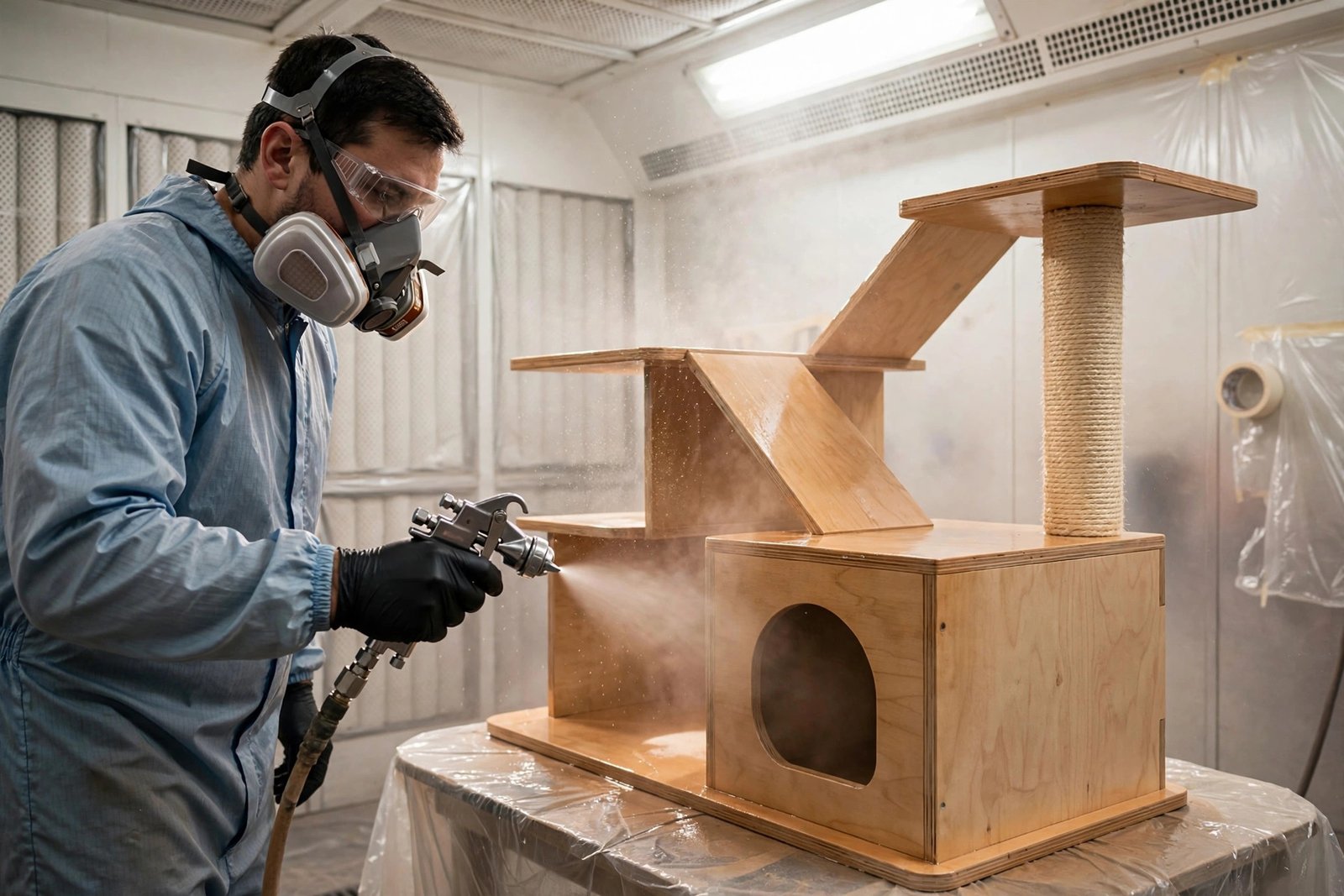
From our factory: See how water-based and UV-cured finishes are applied on solid wood cat furniture in our workshop.
FAQ
Is there a single non-toxic certificate for wood finishes?
No. “Non-toxic” is proven through a route of third-party tests — VOC emissions, heavy-metals migration, formaldehyde release — each answering one risk. Any single stamp claiming to cover everything deserves skepticism.
How does certification differ between water-based and UV-cured finishes?
The risks differ, so the routes differ: water-based coatings certify on VOC testing plus the heavy-metals migration panel; UV-cured finishes add cure completeness — residual monomers in under-cured film. Both end at a lab report on the cured film.
What is EN 71-3 migration testing?
A lab simulates stomach-acid conditions and measures which elements migrate out of the finish. Borrowed from toys, it fits pet furniture because a chewing cat and a teething toddler share the same exposure route.
How do I read a finish test report?
Three checks: the sample is cured film on wood at production thickness (not liquid in a can), the method and limits are named rather than a bare “pass,” and the report date matches the current formulation. Labs test — they don’t certify “non-toxicity.”
OEM/ODM Support
Need a custom cat tree production plan?
Send reference photos, target dimensions, material preferences, packaging needs, and market direction. We can review feasibility, sampling, MOQ, and export packaging before production. Request OEM QuoteRelated Product Lines
Explore wooden cat furniture we can manufacture.
Related Buyer Guides