
Walk through our workshop on a Tuesday morning: fresh-cut pine, the CNC router shaping a platform, the spray booth hissing next door. A cat tree looks simple on a retail page. Inside the factory it is a choreography of lumber science, machining precision, finishing chemistry, and packaging engineering — each stage able to ruin the stages after it.
Lumber Intake: Moisture Control Before Anything Else
Every board entering a serious cat tree factory goes through moisture verification before it touches a saw. Kiln-dried lumber should read 8–12% moisture content on the meter; wetter stock gets stickered and rested, never cut. Skipping this step is how platforms warp and joints open six months after delivery.
| Meter reading | What it means | Factory action |
|---|---|---|
| Below 8% | Over-dried — brittle, starves glue joints | Set aside for reconditioning or reject |
| 8–12% | Kiln-dried and stable | Release to cutting |
| Above 12% | Will shrink and move after assembly | Sticker, rest, re-check — never cut wet |
Our routine is deliberately boring: every batch is meter-checked in several places, and readings go on the receiving record with the supplier lot. High-reading boards are stickered — stacked with spacers for airflow — and rechecked days later. Touring buyers should ask to see the moisture meter and the receiving log. If either is missing, the factory is building on hope.
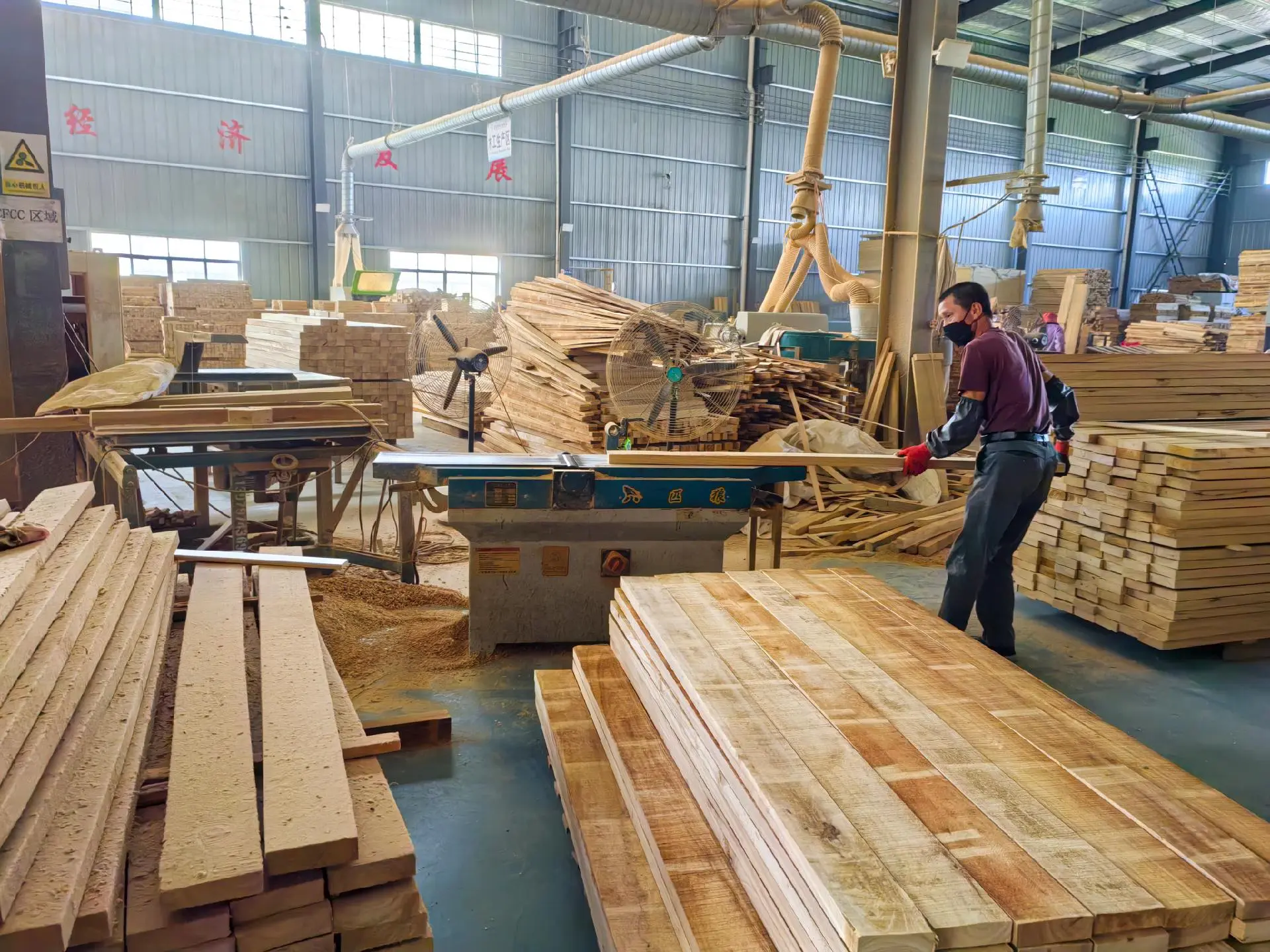
Cutting and CNC Machining: Where the Cat Tree Shape Emerges
CNC machining turns dimensioned lumber into finished cat tree parts — posts, platforms, panels — with repeatability no manual process can match.
Rough boards are ripped, crosscut, and planed to thickness before the CNC routes profiles, drills hole patterns, and cuts joinery. Watch a tool change to see where quality lives: a dull bit burns the wood and leaves a fuzzy edge no finish can hide — tooling is swapped on schedule, not at failure. For hole patterns repeated across hundreds of identical platforms, a dedicated jig fixture holds each part in exactly the same position. That is what makes every platform interchangeable, which is what makes flat-pack assembly work in the customer’s home.
Sanding and Surface Preparation
Every surface a hand or paw will contact moves through a grit progression — coarse enough to remove machining marks, fine enough to feel silky under the finish. Edges get eased, because a sharp arris is where coating fails first.
What separates professional sanding from rushed sanding happens between grits: dust extraction at the sander, a tack-off before finishing, a hand-feel check under raking light. These unglamorous disciplines decide whether the product feels premium or merely painted.
Coating: Spray Booths, Water-Based Finishes, and Curing
Most solid wood cat furniture is finished with water-based coatings applied in spray booths, then cured in drying rooms before handling. The finish needs full cure — not just surface dry — before parts move to assembly. Stacking parts too early imprints texture and traps solvents that later cause odor complaints.
| Coating system | Cure behavior | Strengths | Limitations |
|---|---|---|---|
| Water-based | Hours in a drying room | Low VOC, no ambering, color-stable | Longer drying windows between coats |
| UV-cured | Seconds under lamps | Very fast line speed | Struggles with shadowed recesses |
Our schedule is built around cure, not convenience: parts rack with airflow on all faces, and no batch moves early because a truck is waiting. Between coats comes a light denib sanding, since even the cleanest booth leaves a raised grain the second coat would lock in. For formaldehyde compliance, the EPA’s emission standards for composite wood products set the benchmark every batch must meet.
Assembly, Sisal Wrapping, and Hardware
Assembly is where tolerances prove themselves: any part that drifted out of tolerance announces itself as a gap, a wobble, or a bolt that will not seat. Good factories treat assembly as a final machining audit — assemblers flag misfits instead of forcing them, because a forced joint is a future complaint.
Sisal wrapping is more skilled than it looks: rope wound tight and even with no gaps, both ends anchored so claws cannot unravel it. Then hardware: threaded inserts seated straight, bolts torqued to spec. Each assembled tree gets a shake test by hand before breakdown for packing: the assembler’s body is the first stability instrument.
What Quality Checks a Cat Tree Factory Should Run
A professional cat tree factory inspects at three stages, because each one intercepts a different class of defect:
| Stage | What is checked | Defect class it intercepts |
|---|---|---|
| IPQC (during production) | Moisture, dimensions, coating adhesion, hardware torque | Process drift before it compounds |
| Inline AQL sampling | Statistical sample of each batch | Batch-level variation |
| Pre-shipment inspection | Finished goods against the approved reference sample | Anything that escaped the line |
The tests that matter most are structural — tip-over, joint fatigue, and hardware torque — because a cat tree is load-bearing furniture. This isn’t inspection theater — it’s the direct math of scrap cost: every defect caught one station earlier costs a fraction to fix. For export, packaging is tested too — ISTA 3A test procedures simulate the parcel journey so the flat-pack carton survives the real one.
Packing for Export: Flat-Pack Engineering and Its Limits
Plain limitation: not every cat tree design can flat-pack, and pretending otherwise produces damaged freight. Good flat-pack design nests every part into a compact carton with inserts that immobilize each piece; the carton dimension is engineered, not improvised. Dead space inflates shipping volume; an unsecured part is a damage claim.
Physics sets boundaries: very tall single-piece posts cannot be shortened without adding a joint, and each added joint is a potential wobble point — so some designs ship in longer cartons rather than compromise structure. Curved, sculptural pieces are often the hardest to nest. A cheap factory will promise any design “flat-packs fine”; a specialized manufacturer tells you which designs flat-pack cleanly, which need adjustments, and which should ship partially assembled. When a factory says a design “can flat-pack with minor changes,” ask which changes and what stability tradeoffs they involve.
If this walkthrough raised your bar, good. See our solid wood cat tree manufacturer overview, large cat tree wholesale page, and factory audit guide for evaluating suppliers.
Ready to put your design through these stations? Send your drawings for a production feasibility review.
From our factory: Take a video tour of our workshop, from lumber intake to flat-pack-ready finished pieces.
How Solid Pet Wood Runs a Cat Tree Factory
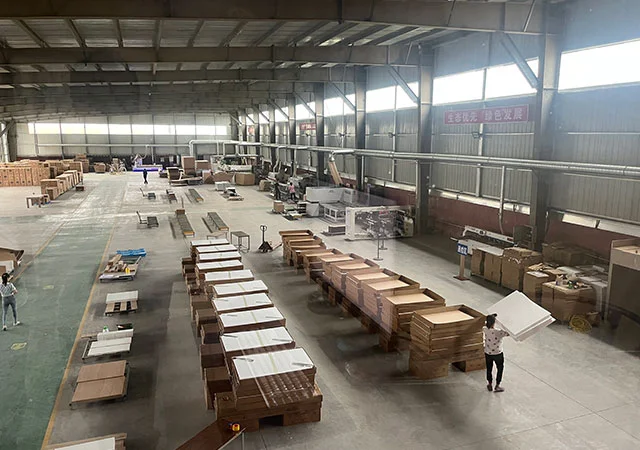
Our workshop runs the discipline this walkthrough describes: metered lumber intake at 8–12% with lot-tied receiving records, CNC machining on jig fixtures with scheduled tooling changes, water-based coating cured on schedule rather than convenience, assembly treated as a final tolerance audit, and three-stage QC — IPQC, inline AQL sampling, and pre-shipment inspection against the retained reference sample. Our in-house design team walks the twenty meters to the production floor whenever a detail looks questionable.
FAQ
What should I look for on a factory tour?
The unglamorous disciplines: moisture meters and receiving logs at intake, tooling change schedules at the CNC, dust control between sanding and coating, cure discipline in finishing, lot-tied records in QC.
Why do factories wrap sisal by hand instead of by machine?
Hand wrapping follows contours and holds even tension around curves and tapers where machines struggle. The wrap quality — tight, even, anchored at both ends — determines how the scratching surface survives years of claws.
What causes wobble in a tall cat tree?
Tolerance stack-up across stacked joints, plus hardware never torqued to spec. Each slightly loose joint adds a fraction of movement, and at height those fractions multiply. Jig-fixtured machining, correct hardware, and torque verification eliminate nearly all of it.
How is a cat tree tested for stability?
Tip-over testing checks base geometry against climbing forces, fatigue testing cycles the joints through repeated loading, and hardware torque is verified against spec. Packaging faces its own regime — ISTA 3A drop testing simulates the parcel journey before the first carton ships.
Can any cat tree design be made flat-pack?
No. Very tall single-piece posts, curved sculptural elements, and heavily braced structures resist compact nesting. A good factory tells you which designs flat-pack cleanly, which need adjustments, and which should ship partially assembled.
OEM/ODM Support
Need a custom cat tree production plan?
Send reference photos, target dimensions, material preferences, packaging needs, and market direction. We can review feasibility, sampling, MOQ, and export packaging before production. Request OEM QuoteRelated Product Lines
Explore wooden cat furniture we can manufacture.
Related Buyer Guides