
The strangest dimension request we ever received came with a tape measure taped to a photo: a Tokyo buyer had photographed their condo shelf, ruler along it, sticky note reading “balcony door opens here — must fit.” That photo did more work than a three-page specification.
Custom Size Cat Tree OEM Starts With the Market, Not the Sketch
What does custom size cat tree OEM actually involve? It is the factory process of resizing an existing cat tree design — taller, narrower, deeper, or lower — for a specific market’s homes and habits, then re-verifying structure, hardware, and carton fit before production. It is not scaling a drawing by ten percent.
A Tokyo apartment, a German Altbau flat, and a suburban US living room ask for genuinely different geometries, and each change forces a new round of engineering.
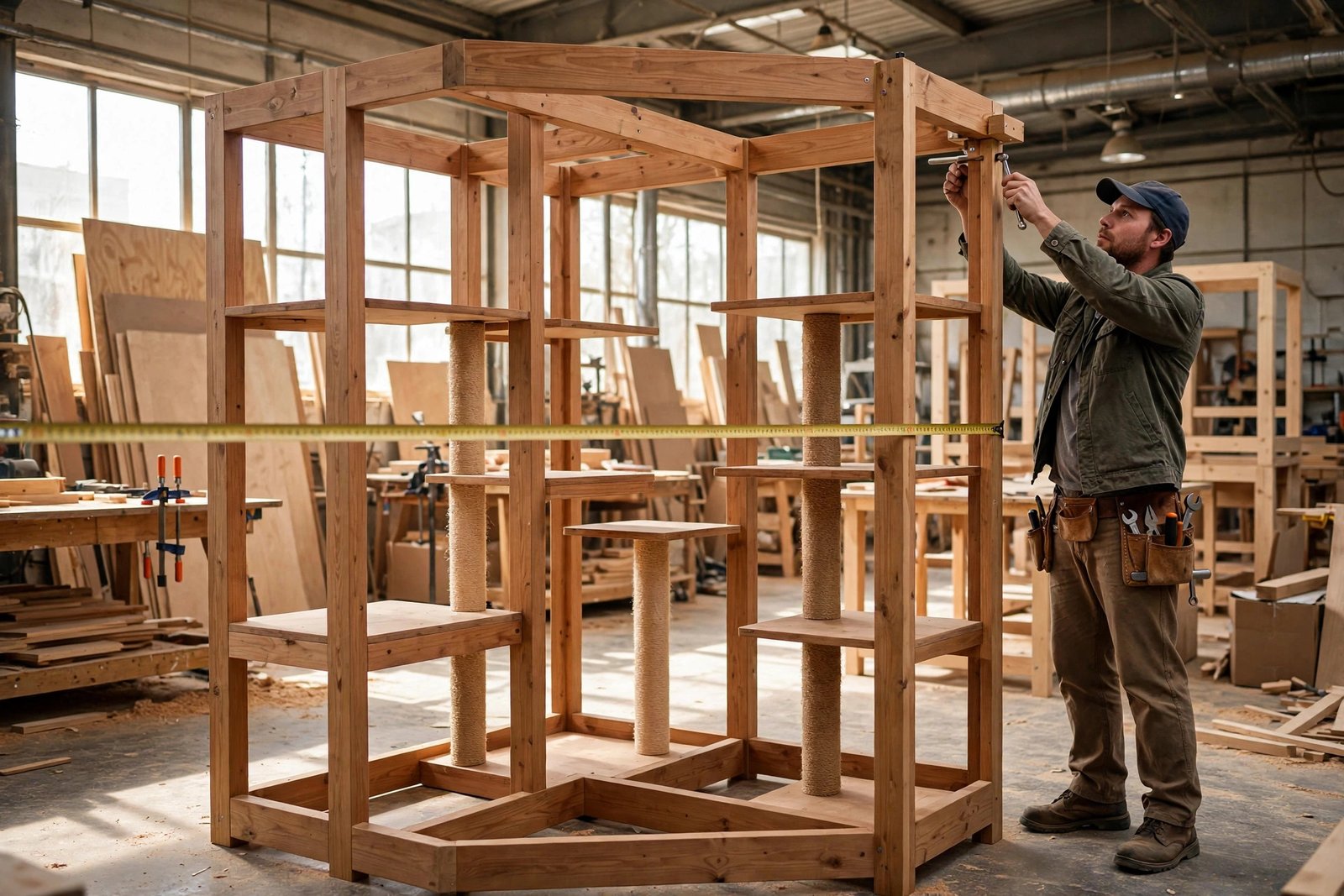
Why One Design Needs Three Footprints: Apartment vs House Reality
Pet furniture is not clothing; it does not drape differently on different bodies.
A typical US family home gives a buyer room for a 60 cm footprint and a tower near 180 cm — the “landmark piece” anchoring a living room corner. A European city apartment trims that toward a 50 cm square under a 240 cm ceiling. A Japanese apartment compresses both toward 45 cm, and details like the balcony door sweep can veto a layout entirely.
We map these as reference footprints first — each one fixes base panel size, column spacing, and maximum height, and everything downstream inherits from those numbers.
Structural Recalculation: The Step Most Resizing Requests Skip
Can a factory just make a cat tree taller or wider? Yes — but the structure must be re-proven, not assumed. Structural recalculation means re-running stability and load checks on the new geometry: base against height, column diameter against span, joint strength against new forces.
A design that is rock-solid at 120 cm can become a tip-over risk at 160 if only the posts grow and nothing else changes. Our engineers treat every resize as a new design review. We recheck three things: the tip-over margin, the load distribution across the posts, and the connection strength at every joint the geometry touched. A wider platform means a longer lever arm on the bracket underneath. A taller column means more bending moment at its base plate.
Buyers sometimes read this review step as reluctance. It is not. A factory that resizes without rechecking is not being fast; it is being lucky. Our durability testing article describes the tip-over, wobble, and load tests we rerun on resized versions — the same set, never shortened.
Load Distribution: Why Taller Is Not Just Bigger
Buyers picture resizing as photography: zoom in, everything scales. Structures do not work that way. When a cat tree grows taller, the load concentrates instead of spreading. The base must widen faster than the height grows, or the design needs a second wall of support: thicker posts, through-bolted platforms, a wider base panel.
The shop practice our engineers follow: base width should grow faster than height, because height concentrates load rather than spreading it. What matters is that somebody does the arithmetic for the specific geometry instead of eyeballing it.
Depth deserves the same caution. A deep platform cantilevered off a column acts like a diving board. Either the bracket under it grows, the column thickens, or the platform depth stays where it was. We flag this in the first review round because it is the resize that looks harmless and fails loudest.
Parametric Design: How a Factory Keeps Custom Sizes Buildable
Parametric design is the technique that makes custom sizes economical to manufacture. Instead of redrawing the product for every size, the engineer builds a master model where key dimensions — post diameter, platform length, base width — are variables. Change the variable, and joinery positions, hole patterns, cut lists, and carton fit all update; the CNC programs regenerate and hardware quantities follow, so every variant inherits the same joinery logic and tested connections — Wikipedia’s parametric design overview explains the principle.
The limitation: parametric models have ranges. Stretch a design beyond its tested envelope — double the height, halve the base — and the model cannot tell you whether the result is safe. That is when the work reverts to first-principles recalculation. We tell buyers up front where each model’s envelope ends, because the envelope is where custom sizing stays economical.
Carton Dimensions: Size Changes Rewrite the Box First
This is the resize consequence buyers feel in the landed cost. Product dimensions drive carton dimensions, which drive container fill and freight cost per unit — a 5 cm growth in carton length can flip a pallet layer from two units to one.
Our resize reviews run the carton check in parallel with the structural check. Wikipedia’s overview of ready-to-assemble furniture covers why flat-pack geometry drives shipping economics; our article on shipping costs shows how carton size feeds the per-unit freight number. A beautiful custom size that ships half-empty containers is a pricing problem wearing a design costume.
The upshot: the best custom sizes are engineered to nest. A tower that disassembles into panels stacking within a standard carton family costs far less to move than one of the same assembled size that does not — and the cheapest time to fix it is before the design is locked.
The Limitation: SKU Proliferation and Cosmetic Resizing
Every size variant is a SKU — a warehouse slot, a barcode, a listing, and inventory that must sell through before it becomes cash. Three market-specific sizes can be a brilliant assortment. Six becomes warehousing; ten becomes a spreadsheet that eats your purchasing manager. We recommend starting with the two footprints matching your two biggest markets and adding the third when sell-through data asks for it. Parametric design makes a later size cheap to create; warehousing never does.
Two cases where we steer buyers away entirely. First: a requested size that violates the structural envelope with no design change to fix it — a 200 cm tower on a 45 cm base with no anchoring is a physics demonstration, not a product. Second: cosmetic resizing — 3 cm on a platform no customer will notice, multiplied through carton, barcode, and listing. A factory that agrees to everything is not accommodating; it is unaccountable.
From our factory: See how a well-built cat tree’s structure carries load — the same engineering our resize reviews recheck for every new size.
FAQ
Can an existing cat tree design be resized for my market without a full redesign?
Usually yes, within the design’s parametric envelope. The factory adjusts the size variables, re-runs structural checks, and re-verifies carton fit. Beyond the envelope, the work becomes a new design with its own prototyping cycle.
Does a taller custom size need a wider base?
Yes. Height increases tip-over risk disproportionately, so the base must grow faster than the height to keep the same stability margin. Our engineers recalculate the ratio per design rather than applying a fixed formula.
Will custom sizing change my shipping cost?
It can, significantly. Product dimensions drive carton dimensions, which drive container fill and freight cost per unit. We run the carton and container check alongside the structural review so the landed-cost impact is visible before anything is built.
How many size variants should a new line launch with?
Start with the two sizes matching your two largest markets. Each variant is a full SKU with warehousing and listing costs; add variants when sell-through data justifies them.
What files does the factory need for a custom size request?
The target footprint and height, the market’s ceiling and space constraints, and your current tech pack. If you need a primer on what a factory expects to receive, see our sample guide for the file package that moves a design into prototyping.
Ready to Resize With Engineering Behind It?
Custom sizing is one of the highest-value things a factory can do for a buyer — when the structure is recalculated, the carton is re-nested, and the SKU count stays sane. Send your target dimensions through Request a Quote, and we will return a resize review with structural and packaging findings before anything is built.
OEM/ODM Support
Need a custom cat tree production plan?
Send reference photos, target dimensions, material preferences, packaging needs, and market direction. We can review feasibility, sampling, MOQ, and export packaging before production. Request OEM QuoteRelated Product Lines
Explore wooden cat furniture we can manufacture.
Related Buyer Guides