
A retail buyer walked our floor last spring carrying a competitor’s oak sample: the label said solid oak, but the stain looked sprayed on and the base had hairline splits at every corner. His pine line sold steadily, yet customers kept asking for “something better.” That is the real decision behind oak cat tree furniture — not whether oak is a fine wood, but whether the species earns its cost in your line, in tooling and shipping as much as in timber.
Should You Build an Oak Cat Tree? The Short Answer
Build an oak cat tree line when your channel supports premium positioning and your factory handles hardwood. Oak’s Janka hardness — red oak about 1,290 lbf, white oak about 1,360 lbf — resists claw denting far better than pine, and its grain finishes like furniture. Skip oak where low price or shipping cost decides: weight and tooling eat the margin fast.
Oak is never the cheapest way to hold a cat. It is the most convincing way to sell cat furniture as furniture: if the buyer judges by surface — grain, color depth, a hand-rubbed feel — oak pays; if by price per inch of height, it never will. Our full species comparison (best wood for a cat tree) puts oak in context. Janka figures are published reference values from the Wood Database, not our lab data.
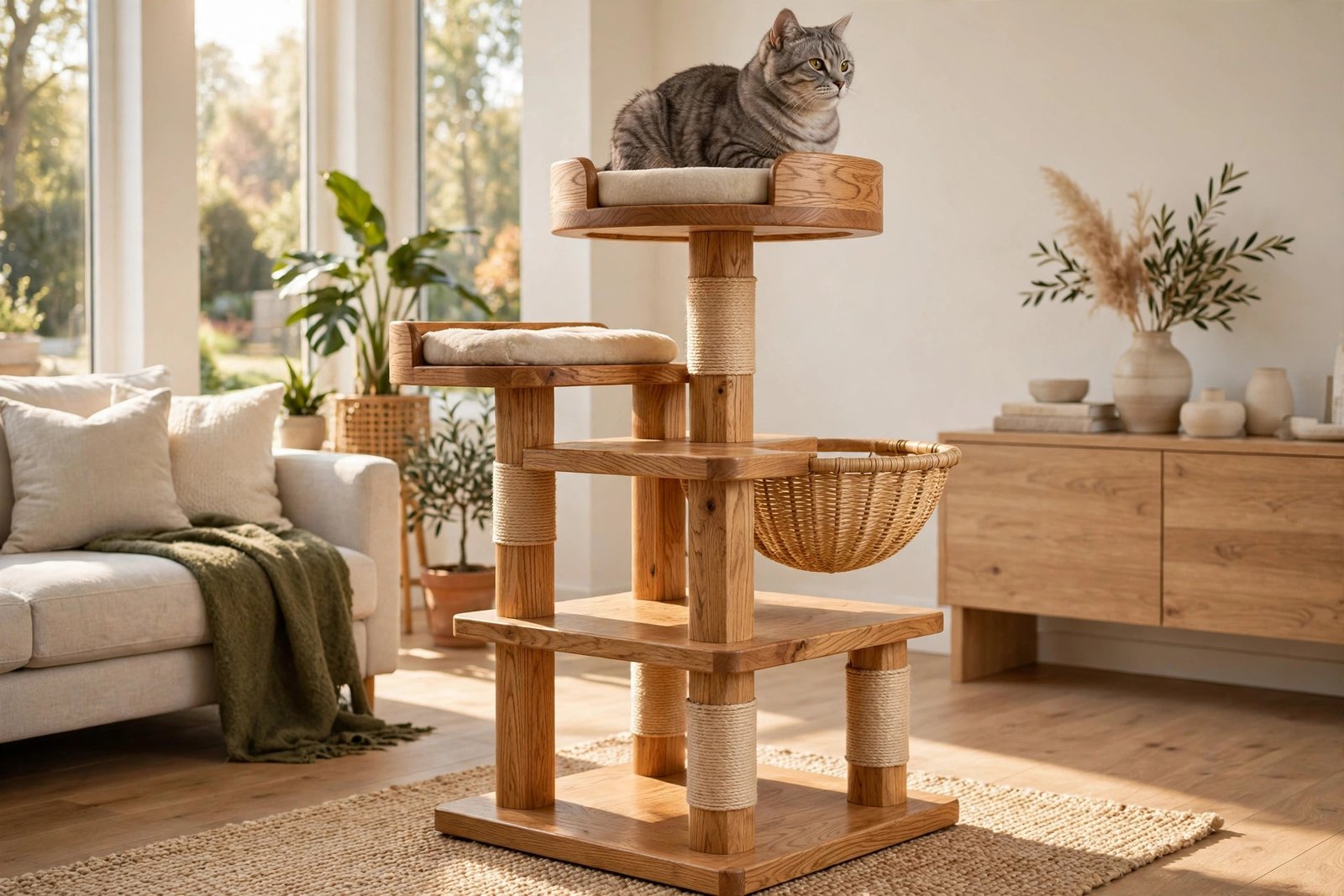
White Oak vs Red Oak: Choosing the Right Oak for Cat Furniture
For indoor cat furniture, red oak is the default: it stains easily, machines predictably, and is widely available. White oak earns its place where moisture resistance matters — entryways, sunrooms, humid export warehousing — thanks to a closed cell structure red oak lacks. Both are true oaks with similar hardness; choose on exposure and stain plan, not strength myths.
The difference is in the vessels. Red oak’s open pores run straight through the board. White oak’s vessels are plugged with tyloses, natural growths that seal the grain — the same property that made it the cooperage wood for wine barrels, and the reason it resists decay and moisture far better.
Color splits them too. Red oak carries a pinkish-red cast that deepens under stain; white oak leans golden-brown and is at its best in a natural or lightly oiled finish. Red oak takes dark stains more uniformly; white oak rewards factories that work with its grain. One constant: both must be kiln-dried to 8–12% moisture content before cutting — see our kiln-dried wood for cat furniture .
Grain Pattern and Stain Absorption: Where Oak Earns Its Premium
With oak, the surface is the product. The buyer paying the premium is buying what they can see: cathedral arches on flat-sawn boards, the ray-flake figure of quartersawn white oak, a stain with visible depth instead of a painted-on film. Grain pattern is oak’s marketing department, and stain absorption is how it gets its budget.
Red oak’s open pores absorb stain deeply and evenly — dark walnut or espresso tones come out rich on standard spray schedules. White oak is more particular: its tighter structure can blotch under rushed staining. End-grain darkening is the classic tell of sloppy oak work; on a perch edge it reads instantly to anyone who has bought real furniture. On our line, every oak stain color is signed off against a physical master panel kept under production lighting — never against a screen photo, because screens lie about wood.
Water-based coatings are the professional default for pet furniture: low volatile emissions, a hard film that resists claw scratching, and grain that shows through instead of being buried. The EPA’s formaldehyde guidance (epa.gov/formaldehyde) is worth a read for any brand making health claims about finishes. Finish quality is the cheapest premium signal oak offers — the coating had better look like it belongs.
Weight and Freight: Oak’s Heaviest Trade-off
Here is the limitation oak’s admirers skip: oak is heavy, and weight follows the product to the customer’s door. White oak runs around 47 pounds per cubic foot, red oak around 44 (published reference values) — roughly double pine. A tall oak tower ships heavier, stacks fewer units per container layer, and lands with freight math that surprises buyers who budgeted for pine.
We have talked buyers out of full-oak tall towers more than once — not because the wood fails, but because the landed cost failed the channel. The professional answer is design discipline: reserve oak for the components the buyer touches and sees — perches, platforms, visible posts — and engineer hidden structure for weight where it does not show.
Hardwood on the Factory Floor: A Capability You Can Audit
Hardwood punishes softwood tooling: dull cutters tear oak cross-grain, and pine feed rates will burn an oak profile. A factory that runs oak uses sharp carbide tooling, dedicated CNC machining programs, and separate sanding schedules. Ask what changes between a pine shift and an oak shift — a specific answer is proof, a shrug is a warning.
This is the professionalism signal hiding inside the species choice. Any shop can buy oak boards; far fewer can cut them cleanly. Tear-out on a visible perch edge cannot be sanded away without rounding the profile, and rounded profiles on premium furniture read as cheap. When we run oak, the CNC programs are separate files — not pine programs with the feed dial turned down — and the first article off every batch is inspected under raking light for tear-out. Ask a supplier to show you exactly that.
The Luxury Segment Play: Positioning Oak Cat Tree Furniture
Oak cat tree furniture belongs in the luxury segment — home-decor channels, design-led retailers, brands whose customers buy cat furniture the way they buy side tables. There the sales logic flips: durability becomes a story, not just a spec. Oak still looks like furniture after years of claws, and its grain photographs like furniture from day one. That is the premium pricing logic, and it only works where the customer shops for the room, not just the cat. Our Luxuriöse Holzmöbel für Katzen line shows how oak sits inside a tiered assortment.
The honest ceiling: oak locks the line into premium positioning, and that is a commitment, not a feature. If the channel later demands promotional pricing or entry-level SKUs, an oak line cannot follow — the wood cost will not bend, and thinning the design to compensate produces expensive-looking cheap furniture. Buyers needing volume flexibility are better served by lighter species in our Katzenbaum aus Massivholz im Großhandel program, where the economics can move.
Aus unserer Fabrik: Watch how our workshop handles solid wood for cat furniture, from machining to finishing.
FAQ
White oak or red oak — which is better for indoor cat furniture?
Red oak, in most cases: it stains more easily and its open grain suits furniture-style finishes. Choose white oak where the piece may face moisture — entryways, humid climates, export warehousing — its sealed vessels resist moisture and decay far better.
Will oak really hold up to claws better than pine?
Yes, measurably. Red oak rates about 1,290 lbf and white oak about 1,360 lbf on the Janka dent-resistance scale, against pine’s roughly 380 lbf (published reference values, Wood Database). Claws are a daily dent test, so the difference shows within months.
Does oak stain evenly?
Red oak stains evenly and forgivingly thanks to its open pores. White oak needs controlled application to avoid blotching, and end-grain on either species darkens if left unsealed — the classic sign of rushed oak finishing.
Why is oak cat furniture so much heavier?
Density. Oak runs roughly 44–47 pounds per cubic foot versus pine’s low twenties, so a tall oak tower can weigh twice its pine equivalent. Model landed freight before committing to a full-oak tall design.
How can I tell whether a factory actually runs hardwood well?
Ask what changes between pine and oak shifts, whether oak has dedicated CNC programs, and how they inspect for tear-out. A factory that runs hardwood answers all three specifically; one that merely buys oak boards goes vague on the first.
Ready to spec an oak line? Angebot anfordern — tell us your target tier and finish, and we’ll map the species, joinery, and structure to fit.
OEM/ODM-Unterstützung
Benötigen Sie einen kundenspezifischen Produktionsplan für Kratzbäume?
Senden Sie Referenzfotos, Zielabmessungen, Materialpräferenzen, Verpackungsanforderungen und Marktausrichtung. Wir können Machbarkeit, Muster, MOQ und Exportverpackungen vor der Produktion prüfen. OEM-Angebot anfordernVerwandte Produktlinien
Entdecken Sie Holzmöbel für Katzen, die wir herstellen können.
Verwandte Einkaufsführer