Two years ago a buyer returned a full container of pine towers: the top perches rocked under a five-kilo cat. We pulled one apart and found the cause in ten minutes — coarse screws in pine end-grain, threads chewed loose by ocean vibration. None of that was the pine’s fault. Search the pine wood cat tree pros and cons and you’ll mostly find retail fluff from people who never touched a saw. This is the factory version: what this softwood earns you, what it honestly costs, and the structural calls that decide whether a pine tower survives its first year.
Pine Wood Cat Trees: The Short Version
A pine wood cat tree earns its place in value and mid-range lines: a softwood that machines fast, finishes clean, and ships light. Its published Janka rating near 380 lbf means claws will mark it — the honest trade, not a defect. Built right, with thicker sections, threaded inserts, and kiln-dried stock, it serves for years.
Pine divides our industry because both camps are half right. Our read: pine is a design obligation — treat it like cheap hardwood and it fails; engineer for softwood and it wins. Context: our best wood for cat tree guide.
The Pros of a Pine Wood Cat Tree
Machinability, finish quality, weight, and cost advantage — pine’s four genuine strengths. It cuts cleanly on CNC with minimal tear-out, takes water-based stains evenly across straight grain, ships lighter than oak, and sits among the lowest-cost furniture-grade softwoods at our gate.
On our CNC line, pine is what every new operator trains on: fast feeds, forgiving of dull tooling, rare tear-out on cross-grain cuts. That means cleaner joinery — crisp mortises, dowel holes that hold tolerance, less sanding per unit. Finishing is the second dividend: pine’s even, pale grain takes water-based coatings without blotching, so the light natural and whitewash looks buyers want most come out consistent.
On knots: furniture-grade pine is not knotty cabin paneling. Our graders cut around large or loose knots at the rough mill; only tight, sound knots stay. The result is a clean, light surface that photographs well.
The Cons of Pine in Cat Furniture: What Softness Really Costs
The cons of a pine wood cat tree are one con in different clothes: softness. A published Janka rating near 380 lbf means lower dent resistance, weaker screw holding in end-grain, and perches that flex unless sections are sized up. Knots and resin complicate finishing when a mill skips proper grading.
Dent resistance is the complaint buyers voice. Claws press the same spots daily, and pine shows it within months: dimpled perch edges, stippled wear where cats launch. Our honest framing: cosmetic patina, not structural failure — the tower aging like a pine farmhouse table. The trouble starts only when a supplier promises a surface that “won’t scratch,” which no softwood delivers.
Screw holding is the more serious tax. Withdrawal strength in pine end-grain is poor, and the classic failure — perch posts loosening after months of jumping — almost always traces to screws driven straight into end-grain. We don’t build that joint; the engineering section shows the alternative. Then resin: under-dried stock bleeds amber spots through light finishes in warm rooms.
What a 380 lbf Janka Rating Actually Means at Home
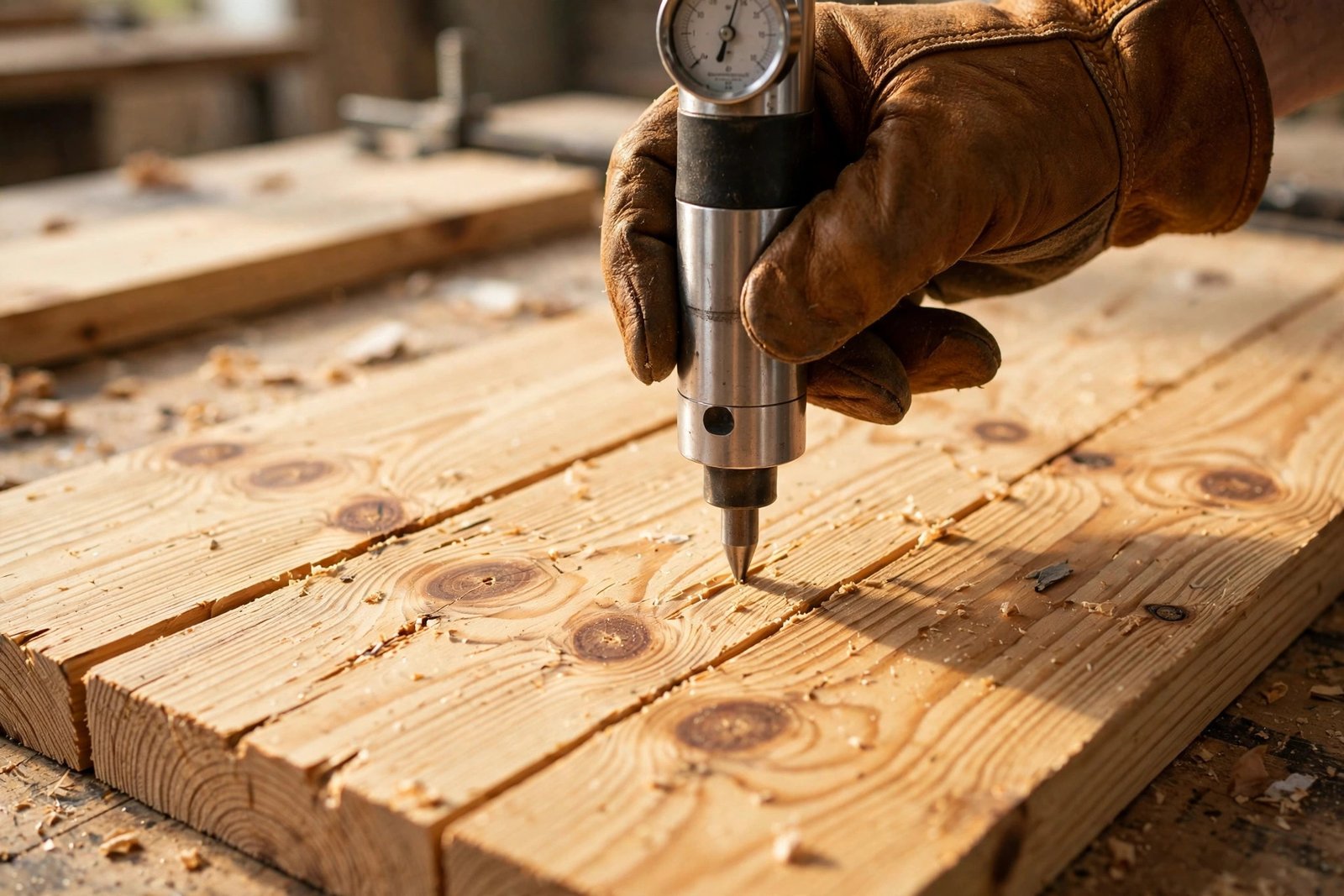
The Janka rating measures the force to embed a steel ball halfway into wood — a lab proxy for dent resistance, in pounds-force (lbf). Eastern white pine publishes near 380 lbf against red oak’s near 1,290. In a living room that means claws dimple pine visibly over months while oak shrugs; published reference values, not lab data.
Two cautions. First, Janka is one axis, not the verdict: a harder species that moves with humidity causes more field trouble than a softer, stable one. Second, the number predicts surface wear, not structural life. A pine tower sold honestly outlasts any supplier claiming a softwood won’t mark. Hardness reference: the Wood Database.
How Factories Engineer Around Pine’s Softness
Structural reinforcement is where pine cat trees are won or lost. On our pine programs, posts run one size heavier than hardwood equivalents, every load joint uses threaded inserts or through-bolts instead of end-grain screws, and tall columns get cross-bracing. Softwood with hardwood-grade hardware outlasts hardwood with cheap fasteners.
The fastener rule fixes the most common field failure. A threaded insert — steel sleeve, machine threads inside, wood threads outside — gives pine a metal thread to bite, so a jumping cat works against steel, not soft fibers. Where inserts don’t fit, we through-bolt: a bolt clean through the post, washered and capped. We pull-test sampled units against our AQL plan; a perch that shifts under load doesn’t ship.
Section sizing comes next: spans that work in oak need more meat in pine — thicker perches, chunkier columns, gussets where cantilevers take a landing cat’s full force. Third is bracing: anything over a meter tall gets cross-members, because racking forces punish soft joints first. None of this is exotic — it’s what happens when the engineer sizes the parts.
Kiln-Dried Pine vs. Under-Dried Stock: The Spec That Decides Everything
Green pine is the true villain behind pine’s bad reputation. Kiln-dried pine at 8–12% moisture content machines true and stays true; stock dried only to the high teens keeps shrinking after assembly, opens joints in dry homes, and lets resin bleed through finishes. We meter every incoming bundle at the gate; out-of-band stock never reaches the saw.
Kiln-drying does three quiet jobs buyers never see: it sets resin so sap stays put, stabilizes knots so they stay seated, and brings the bundle to indoor equilibrium before the first cut. A certificate stating only “kiln-dried” without a moisture number is a souvenir, not a spec — ask for the number. Our standard: kiln-dried wood for cat furniture.
When Pine Is the Wrong Choice: Honest Limitations
Pine is the wrong call for showpiece lines and buyers who inspect surfaces like collectors. If the brief reads “looks untouched after a year of claws,” that line belongs in oak or rubberwood. Pine also wears fast in heavy commercial use like cat cafés, where dozens of animals cycle through daily.
There’s a subtler mismatch: brands selling heirloom permanence. Pine ages visibly, and for buyers pitching “furniture your grandchildren inherit,” that visible aging undercuts the story no matter how sound the structure. We’ve talked buyers out of pine for exactly this reason — and into it just as often when the brief is honest value. Our Luxuriöse Holzmöbel für Katzen range shows where premium species earn their keep; our Katzenbaum aus Massivholz im Großhandel program shows how we tier species.
Aus unserer Fabrik: Watch how our workshop handles solid wood for cat furniture, from machining to finishing.
FAQ
Is pine wood good for a cat tree?
Yes — with kiln-dried stock at 8–12% moisture, thicker sections than hardwood designs, and threaded inserts or through-bolts at load joints. Built that way, pine serves value and mid lines well.
Will cat claws damage a pine cat tree faster than hardwood?
The surface marks sooner — that’s what ~380 lbf Janka means. Expect visible dimpling on well-used perches within months: cosmetic patina, not structural failure.
Does pine need special treatment before it becomes cat furniture?
Kiln-drying to 8–12% to set resin and stabilize stock, furniture-grade sorting for knots, and water-based, low-emission finishes. Emission benchmarks: the EPA’s formaldehyde standards for composite wood products.
How does pine compare with rubberwood for cat trees?
Rubberwood is the harder plantation hardwood (~960 lbf published Janka) — better dent resistance at a moderate cost step up. Pine wins on machinability, weight, and cost; rubberwood on surface durability. Full comparison: our species scorecard.
Can a pine cat tree be genuinely sturdy?
Sturdiness is a joinery question, not a species question. Threaded inserts, through-bolts, upsized sections, and cross-bracing make pine towers rigid; end-grain screws make any species wobble. Ask how the joints are built before asking what wood it is.
Ready to spec a pine line with honest engineering? Angebot anfordern — tell us your target tier.
OEM/ODM-Unterstützung
Benötigen Sie einen kundenspezifischen Produktionsplan für Kratzbäume?
Senden Sie Referenzfotos, Zielabmessungen, Materialpräferenzen, Verpackungsanforderungen und Marktausrichtung. Wir können Machbarkeit, Muster, MOQ und Exportverpackungen vor der Produktion prüfen. OEM-Angebot anfordernVerwandte Produktlinien
Entdecken Sie Holzmöbel für Katzen, die wir herstellen können.
Verwandte Einkaufsführer