
A buyer once forwarded us a competitor’s lab report as a benchmark. It was beautiful: letterhead, stamps, a bold PASS at the bottom. It was also for a different product — the model number on the first page matched nothing in the order. That report taught us the key lesson of third-party testing for pet products: buyers read the verdict; professionals read the first page.
Third-Party Testing for Pet Products: What SGS, TÜV and BV Actually Do
Third-party testing means an independent accredited lab — SGS, TÜV Rheinland, Bureau Veritas, or Intertek — tests your pet product against agreed standards and issues a report. The lab tests; it does not certify legality. Typical pet-furniture scopes combine chemical, mechanical, and flammability tests.
The distinction that matters: a test report describes a sample — “this sample, tested this way, produced these results.” Everything else (“our product line is certified,” “SGS approved our factory”) is somebody else’s sentence built on top of the lab’s. Labs issue reports; suppliers issue claims. Keeping those two roles separate is the whole skill here.
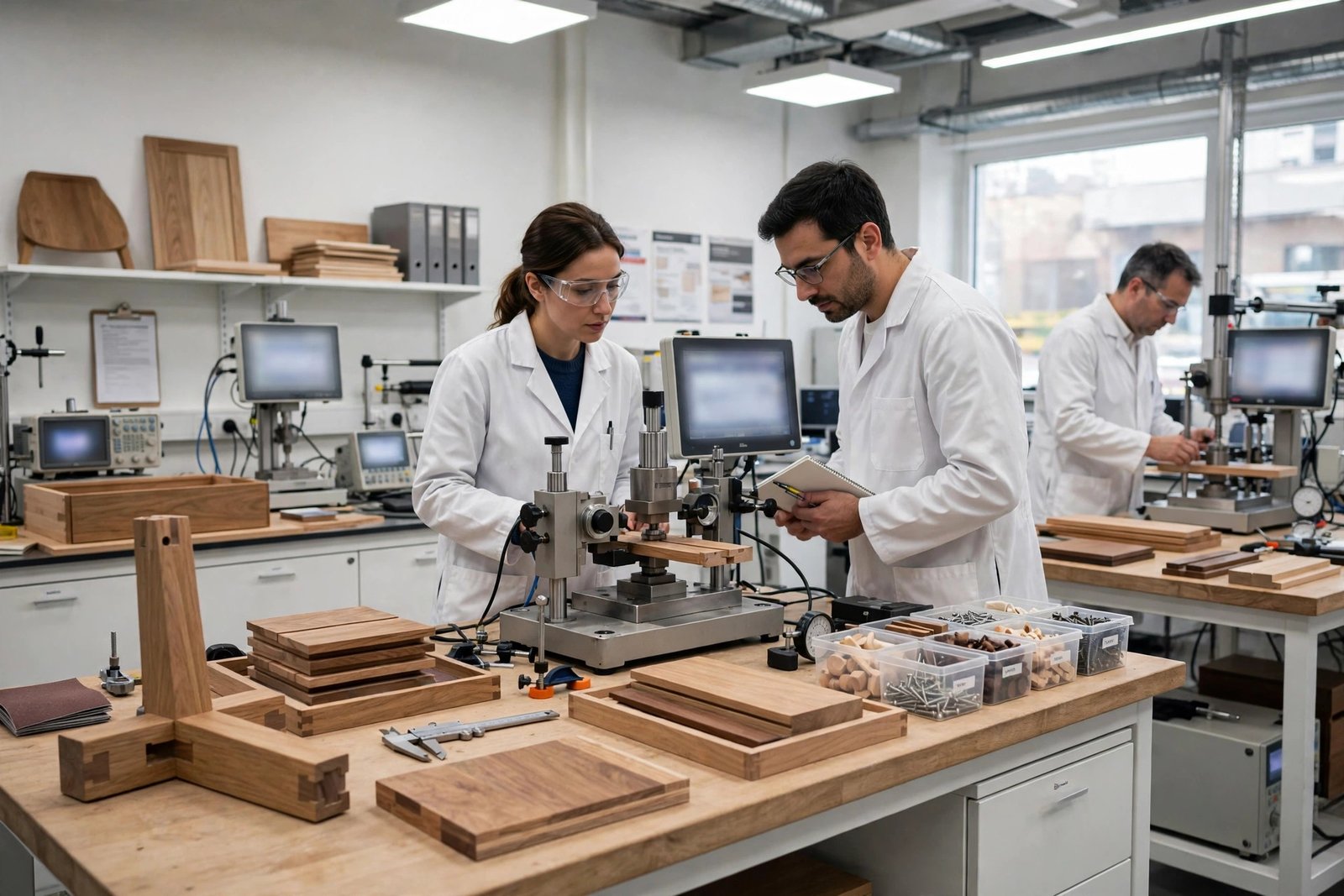
Choosing the Lab: Accreditation Beats the Logo
Choose the facility, not the brand: what matters is ISO/IEC 17025 accreditation for your specific test scope, at the branch doing the work. Accreditation is per facility and per method, not per logo. Comply with the buyer’s named lab, then verify that branch’s scope list before shipping samples.
The big four — SGS, TÜV Rheinland, Bureau Veritas, Intertek — all run large testing operations in China’s manufacturing regions, so samples rarely travel far. Turnaround differences are minor; scope coverage is everything. We once had a buyer insist on a specific lab whose nearest facility didn’t hold the flammability scope — the sample was subcontracted to a rival lab anyway, adding a week and a second invoice. Ask for the scope list before you ship the sample, not after. Also match the lab to the market: a German buyer often wants TÜV because downstream customers recognize the name; a US buyer may prefer SGS or Intertek. The chemistry is identical — the recognition is not.
Defining the Test Scope: Chemical, Mechanical, Flammability
The test scope is the contract between you and the lab, and writing it badly is the most expensive mistake in this whole process. For solid-wood pet furniture, three families cover nearly every buyer requirement.
Chemical tests answer “what comes out of the product.” EN 71-3 migration testing — borrowed from toys — simulates stomach acid and measures which elements leach from chewable surfaces; our guía de certificación de acabado no tóxico walks through that route. REACH screening checks for substances of very high concern in components sold into the EU. Formaldehyde emission testing (E1, CARB Phase 2, EPA TSCA Title VI) covers panels and composite wood — see our formaldehyde standards guide for how factories meet them. Lead-in-surface-coating limits follow the CPSIA logic: 90 ppm on the cured film.
Mechanical tests answer “does it break or fall over”: stability and tip-over testing for tall cat trees, static load on platforms, cyclic fatigue on joints. Flammability tests answer “does it ignite” — BS 5852 for upholstered pet beds bound for the UK. Write the test plan as line items with named standards and years before requesting the quote; labs price per line item, and a vague “full test” invitation returns a vague quote.
Sample Submission: What to Send and How
Send the product as the buyer receives it: production-spec materials, cured finishes at production film thickness, actual hardware, actual packaging if the test involves it. Golden samples — hand-finished, hand-picked, better than production — are the classic self-inflicted wound. A report on a golden sample that production can’t reproduce is a liability document, not an asset.
Quantity: labs typically need one to three units per test family — confirm in the test plan, because destructive mechanical testing consumes samples. Identify every material per component on a packing list: wood species, finish type, fabric, foam, adhesive. The lab can only test what it can identify. And label the samples — model number, production date, batch. The report’s first page will describe your samples back to you; make sure it describes the right product, which is exactly where our competitor’s beautiful report failed.
Lead Time for Testing: Planning Backwards from Shipment
Standard test panels typically run one to three weeks from sample receipt; full chemical suites with SVHC screening can stretch longer, and subcontracted scopes add days. None of this is fast — build it into the critical path.
The planning rule: submit samples the moment a material is shortlisted, not when the production slot is booked. Sequence it as submit → test → review → corrective action → retest buffer → production. Retests happen — a borderline formaldehyde result, a finish needing one more cure day — so budget one retest round. The factories that miss shipments over testing are rarely the ones whose products failed; they are the ones who started testing two weeks before the container.
Reading a Test Report: Pass, Fail, and the Grey Zone
Read a report by its anatomy: sample identification, named test method with version year, per-parameter results and verdicts, and deviations in the fine print. A “pass” with a deviation note is a pass under modified conditions. Treat any deviation as a question to resolve with the buyer, not a detail to file away.
Verify the sample identification first — photos and description must match your product, which is exactly where our competitor’s beautiful report failed. A pass on one parameter does not imply a pass on the others; reports give verdicts per line item, never a blanket. And check the date against your materials: a report from last year on a finish you reformulated in spring describes a product you no longer make.
The most important sentence here: a test report is not a certificate of conformity. The lab issues the report; the supplier issues the certificate of conformity — a declaration that shipped goods conform to the standards, referencing the reports. Anyone selling you a “certificate” as if the lab certified your product legal is selling their own paperwork with a lab logo nearby. Solicitar presupuesto and we’ll map which reports your market actually requires — before you pay for the ones it doesn’t.
The Honest Limits of Third-Party Testing
Three limits. First, testing describes samples, not production runs — a report proves what was tested, not what ships. Pair it with incoming material QC and pre-shipment inspection, or it is decoration. Second, labs test what you send; the golden-sample trap means a report can be perfectly accurate and perfectly misleading at once. Third, no report transfers across constructions: change the foam, the finish, or the supplier, and the old report covers a product that no longer exists. Testing answers “is this sample compliant.” Only a factory audit answers “will every unit match.”
Desde nuestra fábrica: how Lacey Act and REACH compliance work in our pet furniture production.
Preguntas frecuentes
Which third-party lab should I choose for pet products?
Match the lab to the buyer’s requirement first, then verify ISO/IEC 17025 accreditation for your specific test scope at the facility doing the work. SGS, TÜV Rheinland, Bureau Veritas, and Intertek all cover pet-product scopes; recognition in your target market matters as much as chemistry.
How long does third-party testing take?
Standard panels typically run one to three weeks from sample receipt; full chemical suites take longer. Plan backwards: submit samples when materials are shortlisted, and budget one retest round into the schedule.
Does one test report cover all my SKUs?
No. A report describes the tested sample’s construction. Different materials, finishes, or constructions need their own coverage — a report does not transfer across SKUs.
What is the difference between a test report and a certificate of conformity?
The lab issues the test report (sample, method, results). The supplier issues the certificate of conformity — its own declaration that shipped goods conform to the standards, referencing the lab reports. Labs test; they don’t certify legality.
What samples should I send to the lab?
Finished product at production spec — production materials, cured finishes, actual hardware — labelled with model number and batch. Never send hand-finished golden samples that production can’t reproduce.
Soporte OEM/ODM
¿Necesita un plan de producción de árboles para gatos personalizado?
Envíe fotos de referencia, dimensiones objetivo, preferencias de materiales, necesidades de embalaje y dirección de mercado. Podemos revisar la viabilidad, el muestreo, el MOQ y el embalaje de exportación antes de la producción. Solicitar cotización OEMLíneas de productos relacionadas
Explore muebles para gatos de madera que podemos fabricar.
Guías de Compra Relacionadas