
A buyer once asked us for our E0 certificate — for a solid-pine cat tree. We didn’t have one, and told him why he didn’t need one. Of all the formaldehyde emission standards furniture buyers ask us about, E0, E1, and ENF cause the costliest confusion — panel grades applied to solid wood, numbers compared across test methods that cannot be compared. The factory version: what the letters mean, how the two tests differ, and what to demand from a panel supplier.
What Do E0, E1, and ENF Mean in Formaldehyde Emission Standards?
E0, E1, and ENF are formaldehyde emission grades for wood-based panels — particleboard, MDF, and plywood — defined under China’s GB/T 39600-2021 using the 1 m³ climate chamber test: E1 allows up to 0.124 mg/m³, E0 up to 0.050 mg/m³, and ENF up to 0.025 mg/m³. They grade the glue in panels, not solid wood.
E1 began as the European panel industry’s workhorse grade — at or below 0.124 mg/m³ in the 1 m³ climate chamber (EN 717-1). China ran a parallel system under GB 18580-2001 but measured differently: the desiccator method, with E1 capped at 1.5 mg/L and E2 at 5.0 mg/L. E0 was never an official European grade — it was a market invention, Chinese mills offering “half of E1” by the desiccator, typically 0.5 mg/L.
Then the rulers changed. GB 18580-2017 retired the desiccator as referee, moving China to the 1 m³ chamber with one limit: 0.124 mg/m³ — the E1 number as a shared language. GB/T 39600-2021 then built the three-rung ladder in chamber mg/m³: E1 at 0.124, E0 at 0.050, ENF at 0.025. The RFQ trap: “E0 ≤ 0.5 mg/L” is the 2001 ruler; “E0 ≤ 0.050 mg/m³” is the 2021 ruler — same letters, different test, different universe.
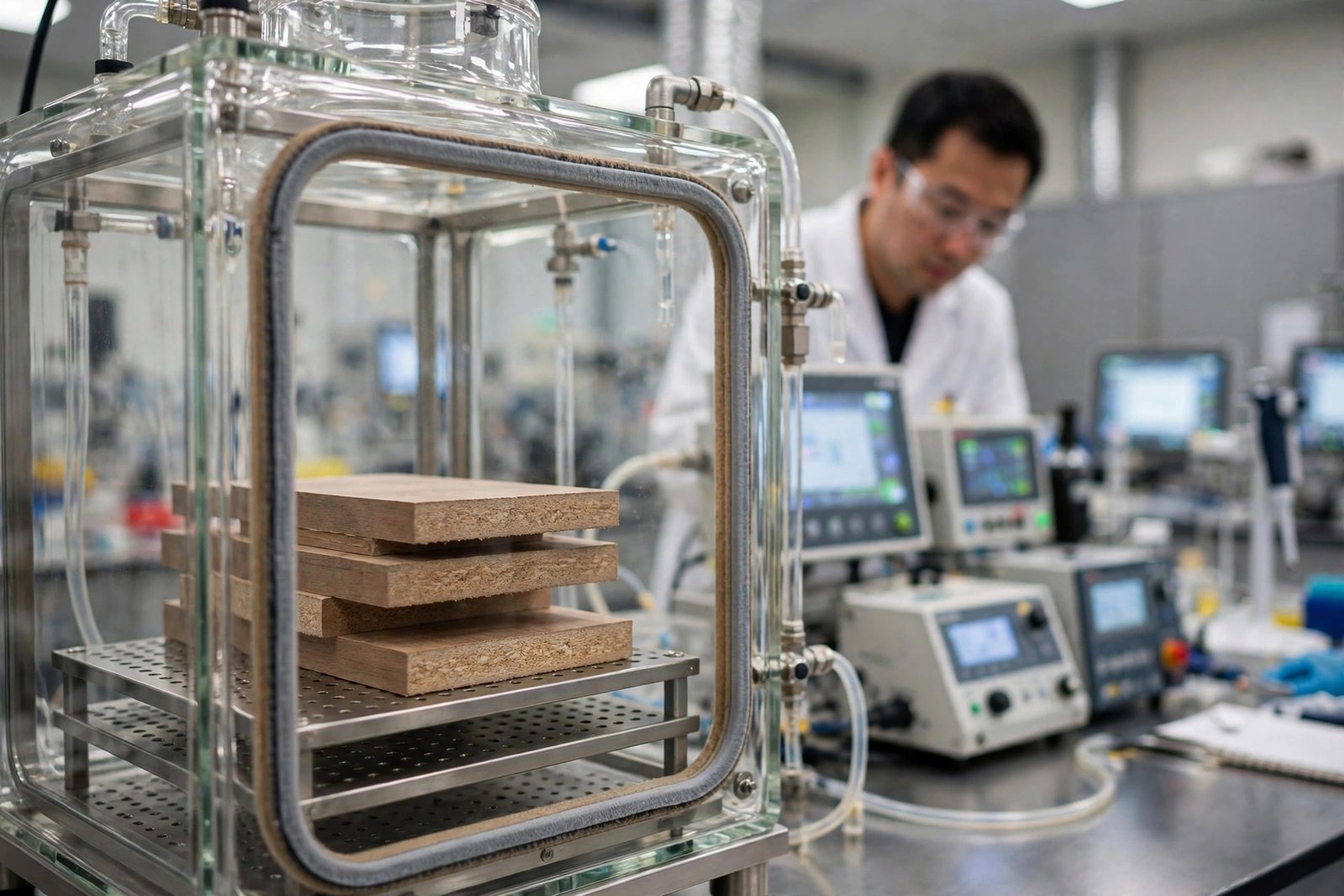
Desiccator Method vs. Chamber Test: Why the Numbers Never Convert
The desiccator method seals panel samples over distilled water for a day and measures what the water absorbs, reported in mg/L. The chamber test conditions specimens for days in a 1 m³ climate chamber at 23 °C and 45 % humidity and measures the air, reported in mg/m³. Fast and cheap versus slow and realistic.
The desiccator method is the quick screen. Small specimens sit in a sealed glass desiccator over distilled water for 24 hours at 20 °C; the released formaldehyde dissolves into the water, then gets analyzed and reported in mg/L. Cheap, fast, repeatable — panel mills still run it daily for in-house QC. But it is no living room.
The chamber test is the referee. Edge-sealed specimens sit in a 1 m³ climate chamber at 23 °C and 45 % relative humidity, with controlled air exchange and a set loading ratio, until the air stabilizes days later. What gets measured is the air itself — mg/m³ — the closest lab analogue to a furnished room. It takes a week or more, at a multiple of a desiccator run’s lab fee. The rule that never bends: no formula converts mg/L into mg/m³ — different physics, different things measured. Any quote sheet treating them as interchangeable has disqualified itself.
What a Panel Supplier’s Test Report Must Actually Show
Where a line genuinely contains engineered panels — backing boards, drawer bottoms, MDF platforms — the test report is the whole ballgame. Four things to demand.
First, standard and method named together: “GB 18580-2017, 1 m³ climate chamber” or “GB/T 39600-2021, class ENF.” A lone “E0” is a slogan, not a spec. Second, sample identification matching what you’re buying — panel type, thickness, resin system. A report is married to one construction: an 18 mm E1 report says nothing about the 9 mm board in your back panels. Third, the measured value, not a “pass” stamp. A report reading 0.118 mg/m³ clears E1 with no margin for batch drift; 0.031 clears it with room to spare. Fourth, a recent date from an accredited lab with a verifiable report number — resin formulations drift, and a three-year-old report on this month’s panels proves little.
Red flags: “E0” with no method; a desiccator mg/L number dressed as a chamber value; a “GB 18580-2017” report in mg/L — that standard’s referee is the chamber, so mg/L means somebody ran the old ruler in the new standard’s clothes.
Why Solid-Wood Cat Furniture Has No Formaldehyde Grade to Chase
Formaldehyde in furniture comes almost entirely from urea-formaldehyde adhesives in particleboard, MDF, and plywood — not from wood itself. Furniture built from solid boards contains no such resin; wood emits only trace natural formaldehyde far below any limit. The E0/E1/ENF system was written for panels, so a solid-wood line simply has no grade to chase.
Our cat trees are solid pine boards — kiln-dried, machined, finished with water-based coatings. The glue in a solid-wood assembly is a thin adhesive line at the joints, not resin saturating every particle — against a panel several percent adhesive by weight, a glue line is a rounding error. So when buyers ask for our E0 certificate, we answer with the bill of materials: solid boards, no engineered panels in the structure, water-based finish.
Panels do appear in cat furniture — usually where a factory cuts cost: MDF platforms, particleboard condo backs, drawer bottoms. If your spec includes them, demand the chamber test report for that exact board. The cleanest formaldehyde strategy for a solid-wood factory isn’t certification shopping — it’s never introducing the resin. Our best wood for cat tree guide makes the same point: the species decision and the emission decision are one decision.
Formaldehyde Emission Standards Across Borders: How Countries Treat Each Other’s Grades
E1 at 0.124 mg/m³ in the 1 m³ chamber is the industry’s closest thing to a global language — Europe’s EN 717-1 and China’s GB 18580-2017 describe the same physical number, so contracts can write “E1 (chamber method)”. Japan runs its own F-star system; the US runs a separate system with its own labels and units (the US framework is published by the EPA). Panel-industry background: Composite Panel Association.
The expensive lesson: the number travels, the paperwork doesn’t always. A Chinese mill’s GB 18580-2017 chamber report satisfies most European private-label technical files — the physics matches — but a brand selling into a regulated market still needs documentation in that market’s format, from a recognized lab.
What the Grade Label Can’t Tell You
Three honest limits. First, the grade describes the board leaving the panel plant — not the finished furniture, whose edge banding, laminates, adhesives, and finishes all move the real-room number. Second, a report is a snapshot of one batch; resin formulations drift, and a grade is only as current as the last test. Third — the one salesmen skip — the ENF premium on a line already built of solid wood with water-based finish buys a laboratory number, not a safer living room. Nothing in that construction needs the grade. We don’t chase ENF labels for solid-wood lines, and we’d rather lose the order than sell a certificate that certifies nothing.
From our factory: how water-based finishes keep wooden cat furniture safe.
FAQ
Is E0 always better than E1?
By the numbers, yes — E0 caps at 0.050 mg/m³ against E1’s 0.124. But “E0” with no named method is meaningless: desiccator E0 (0.5 mg/L) and chamber E0 (0.050 mg/m³) share two letters and nothing else.
Can I convert mg/L into mg/m³?
No — one measures formaldehyde absorbed by water in a sealed jar, the other formaldehyde in circulating chamber air. No formula, no factor; compare numbers only within the same method.
Does solid-wood furniture need an E0 certificate?
No — these grades classify engineered panels, and solid boards contain no panel resin. Ask for the bill of materials: solid wood throughout, plus the finish spec.
Is Chinese E1 the same as European E1?
Physically yes — both mean ≤ 0.124 mg/m³ in the 1 m³ chamber (EN 717-1 vs. GB 18580-2017). Administratively, no: each market wants its own paperwork format from a recognized lab.
What should I request from a panel supplier?
A test report naming standard and method together, sample identification matching your board, the measured value — not just “pass” — and a recent date from an accredited lab.
If your line includes panels, send us the panel schedule — we’ll tell you which test report to demand and what the numbers should read. Solid-wood line? The conversation is shorter: the material list is the answer. Talk to our engineering team.
OEM/ODM Support
Need a custom cat tree production plan?
Send reference photos, target dimensions, material preferences, packaging needs, and market direction. We can review feasibility, sampling, MOQ, and export packaging before production. Request OEM QuoteRelated Product Lines
Explore wooden cat furniture we can manufacture.
Related Buyer Guides