A buyer once asked us for bamboo cat trees at pine prices, assuming bamboo was cheap because it grows fast. We ran the numbers and had to tell him the truth: properly made bamboo panels cost more per cubic meter than rubberwood. He nearly walked away — then sold a full bamboo line to a Scandinavian chain on exactly that story. Fast growth is real. Cheap is not automatic. This guide explains bamboo cat furniture the way a factory sees it: what the material actually is, where its strength comes from, and the mold problem nobody puts in the brochure.
Why Does Bamboo Cat Furniture Work?
Bamboo cat furniture works because strand-woven panels are harder than most hardwoods, dimensionally stable across humidity swings, and carry a sustainability story premium buyers pay for. Harvested in three to five years, bamboo matures while an oak is still a sapling — that renewability is the marketing engine.
Most bamboo falls into two constructions: strand-woven panels, where shredded fiber is compressed under heat and adhesive into a dense board, and laminated bamboo ply, where strips are glued edge to edge. A spec sheet that just says “bamboo” tells you almost nothing. The construction decides hardness, machining behavior, and price. See our best wood for cat tree comparison for the full species picture.
Strand-Woven vs. Laminated Bamboo: Read the Spec Sheet
Published tests place strand-woven bamboo around 3,000 lbf on the Janka scale, roughly three times red oak. Laminated bamboo tests lower, near maple or white oak. That decides the application: strand-woven for posts and platforms under clawing and impact, laminated ply for decorative panels where looks matter most.
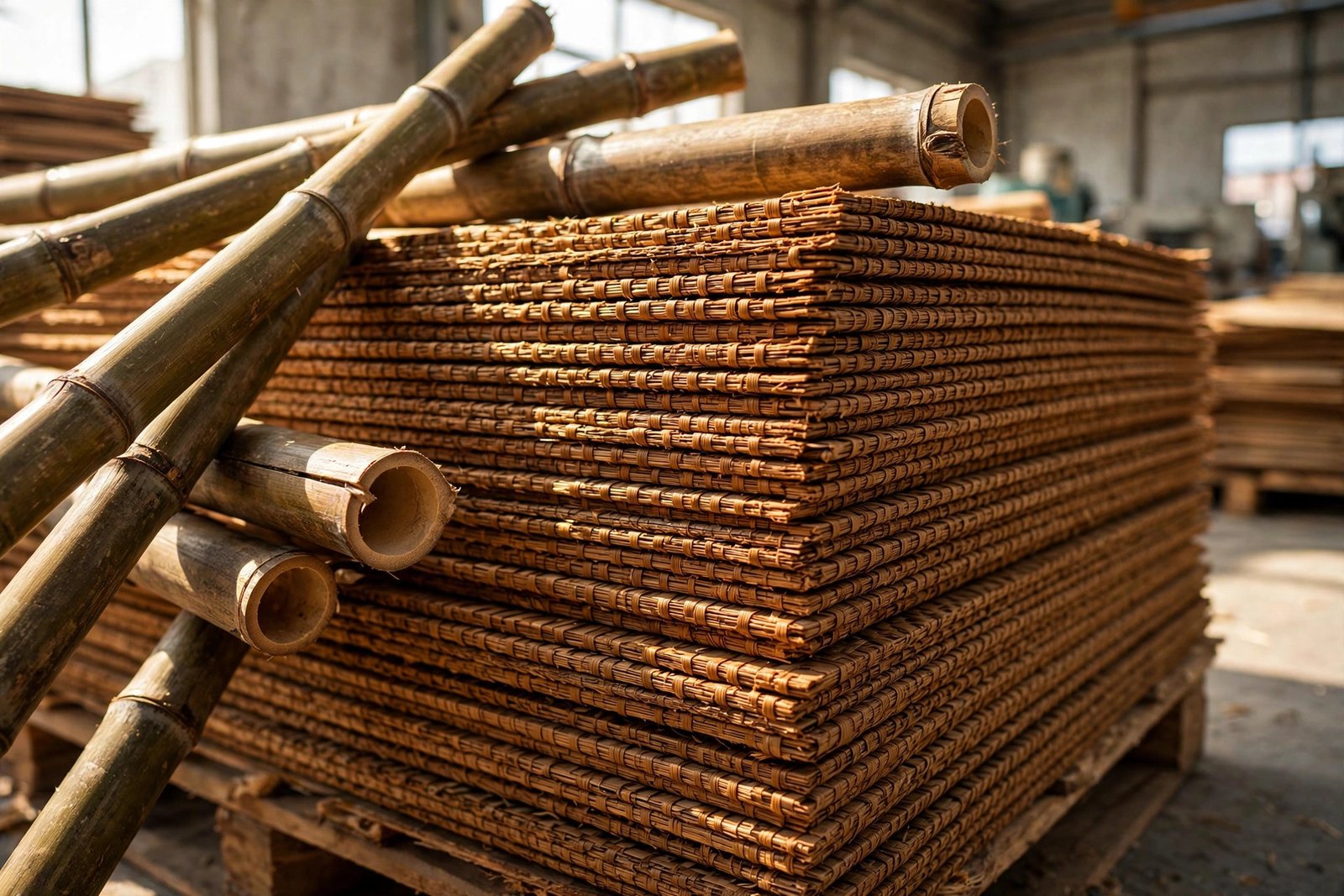
Strand-woven bamboo shreds culms into fiber strands, coats them with adhesive, and presses them under high heat into a dense block. Laminated bamboo glues milled strips into boards — horizontal shows the wide face, vertical the narrow edge.
Watch for a third product sold as bamboo: bamboo veneer pressed over MDF or particleboard — showroom bamboo, commodity board underneath. Ask the supplier what sits under the face layer.
Carbonized Bamboo: Color, Process, and the Trade-Off
Carbonized bamboo is bamboo steamed under pressure until its sugars caramelize, turning the material a rich coffee-brown all the way through. The color is not a stain — a scratch reveals more brown, not pale fiber. Brands love it because the look reads premium without finishing tricks and pairs well with neutral, Japandi-leaning interiors.
The trade-off is mechanical. The heat process that darkens the fiber also softens it: published tests show carbonized bamboo roughly 30 to 40 percent below natural strand-woven in hardness, typically 1,700 to 2,000 lbf. Still harder than red oak — but the gap matters for parts under concentrated load. Our shop rule: carbonized for visible platforms and perches where the color earns its keep, natural strand-woven for posts and structural members. A carbonized post wrapped in sisal is fine either way, since the rope takes the claws.
One more carbonization note: the color fades. Sustained direct sunlight lightens carbonized bamboo toward a honey tone over a couple of years. State it in the product copy for sunroom lines — a material property, not a defect.
Mold: Bamboo’s Real Weakness and How Factories Control It
What the brochures skip: bamboo is starch-rich, and starch feeds mold. A panel that leaves the press dry but then sits in a humid warehouse or unventilated container can bloom with surface mold. The material was fine; the storage chain was not.
Control starts at drying: kiln-dry bamboo to the same 8–12 percent range we demand for solid hardwoods (kiln-dried wood guide). Then seal every face with water-based coating — including the ones nobody sees. The underside of a platform and the inside of a condo are where mold starts, precisely because factories skip coating there.
For humid shipping routes, desiccant in the carton is cheap insurance. A supplier who volunteers the mold conversation before being asked is usually the one who has solved it.
Machining Bamboo: What the Silica Does to Tooling
Bamboo contains silica distributed through its fibers, and silica dulls cutting edges faster than hardwood. When we run strand-woven panels on the CNC, we treat it as a separate tooling program from our hardwood work: carbide tooling on a shorter inspection cycle, feed rates set so the cutter shears the fiber instead of rubbing it.
For buyers the consequence is consistency, not cost panic. Ask to see a cut edge on a sample: clean and dense, no fuzzy tear-out. Torn edges tell you the shop fought the material and lost — and that fight repeats on every production run.
Predrilling is non-negotiable in strand-woven stock. The density that makes it claw-resistant also makes it split-prone at fasteners driven without a pilot hole. Assembly instructions should show predrilled hardware seats with a matching kit — the detail that separates factories that have shipped bamboo from those that have only quoted it.
The Sustainability Story, Told Honestly
Bamboo’s sustainability case is genuine but has boundaries worth stating. The grass itself is remarkable: three-to-five-year harvest cycles, regrowth from the same root system without replanting, high carbon uptake during growth. Against slow-grown hardwoods on multi-decade rotations, the renewability math is not close.
Bamboo panels are still glued products, so ask about the adhesive’s formaldehyde emission grade — our rubberwood guide covers the plantation-timber angle. Transport is the other boundary: bamboo grows in specific regions, and the carbon story weakens over long freight distances, which is true of every material. Eco certification exists — FSC chain of custody covers bamboo — but the label belongs to a certified supply chain, not to the species. A factory claiming “FSC bamboo” should show the certificate code; background at FSC.
Brands that win with bamboo tell the story with specifics: harvest region, adhesive grade, certificate code. Vague “eco-friendly bamboo” copy is what every competitor writes. Value-chain background: INBAR.
Where Bamboo Cat Furniture Loses: Say It Before the Buyer Finds Out
Bamboo is not the answer to every brief. With no open grain to absorb color evenly, custom matching is limited to the natural and carbonized palette plus opaque finishes. If a brand needs six custom stain colors, bamboo is the wrong material — admit it in week one.
Repairability is the second limit. A scratched oak platform sands out and refinishes; a deep gouge in strand-woven bamboo exposes fiber that never sands back to a clean face. Put bamboo where claws do not reach.
Finally, the price assumption from our opening story deserves a formal burial. Fast growth does not mean cheap panels: shredding, pressing, carbonizing, and silica-tolerant machining are real industrial costs, and good bamboo stock lands mid-range — above pine and rubberwood, below walnut. Budget it as a premium sustainable story, not a cost-down move.
voir notre atelier où les meubles pour chats en bois massif sont usinés et assemblés. See how solid wooden cat trees are engineered and built in our factory.
FAQ
Is bamboo strong enough for a cat tree?
Strand-woven bamboo tests around 3,000 lbf on the Janka scale — harder than red oak. Design joints for its density: predrill every fastener.
Is carbonized bamboo weaker than natural bamboo?
Yes — typically 30 to 40 percent below natural strand-woven. Still harder than red oak, so it only matters for parts under concentrated load.
Does bamboo cat furniture get moldy?
It can — bamboo is starch-rich. Kiln-drying to 8–12 percent, sealing all faces including hidden ones, and dry storage through shipping prevent it.
Is bamboo really more eco-friendly than wood?
The renewability case is strong, but the full picture includes the adhesive system and transport distance. Ask for the panel’s emission grade and any FSC certificate code.
Why does bamboo cat furniture cost more than I expected?
Fast growth means renewability, not low price. Shredding, pressing, carbonizing, and silica-tolerant machining are real industrial costs — budget bamboo as a premium sustainable material.
Developing a bamboo line? Send your target retail tier and we will tell you straight whether strand-woven or laminated construction — or a different species — serves the brief. Talk to our engineering team.
Support OEM/ODM
Besoin d'un plan de production personnalisé pour un arbre à chat ?
Envoyez des photos de référence, les dimensions cibles, les préférences de matériaux, les besoins en emballage et la direction du marché. Nous pouvons examiner la faisabilité, l'échantillonnage, les MOQ et l'emballage d'exportation avant la production. Demander un devis OEMLignes de produits associées
Explorez les meubles pour chats en bois que nous pouvons fabriquer.
Guides d'achat associés