
A Hamburg buyer opened the first carton of a cat-tree shipment: perches wrapped in the wrong fabric. The towers were fine; the wrapping was not — and forty cartons had already crossed an ocean. The check that catches this costs one day at the factory: a pre-shipment inspection against a real checklist.
A pre-shipment inspection (PSI) happens when the run is finished and packed — typically 100% produced, 80%+ sealed in cartons. An inspector samples finished cartons against the spec. For wooden cat furniture, PSI is the cheapest place in the supply chain to catch a mistake, and our QC team runs one before every shipment. This is the checklist we use. See also our guide to inspection de qualité des meubles pour animaux de compagnie.
What a Pre-Shipment Inspection for Furniture Actually Covers
A pre-shipment inspection for furniture verifies that finished, packed goods match the approved specification — correct materials and finish, accurate dimensions, working joints and stability, protective packaging, and legible shipping marks. It is a pass/fail gate on the finished product, not a production audit, and it always happens before the container is loaded.
PSI answers one question: does the carton content match the approval? It is not a factory audit, and it fixes nothing mid-production — that is IPQC. Sampling follows AQL tables (ANSI/ASQ Z1.4). Wood makes PSI especially valuable: color drifts between coating batches, and most defects show only on finished units.
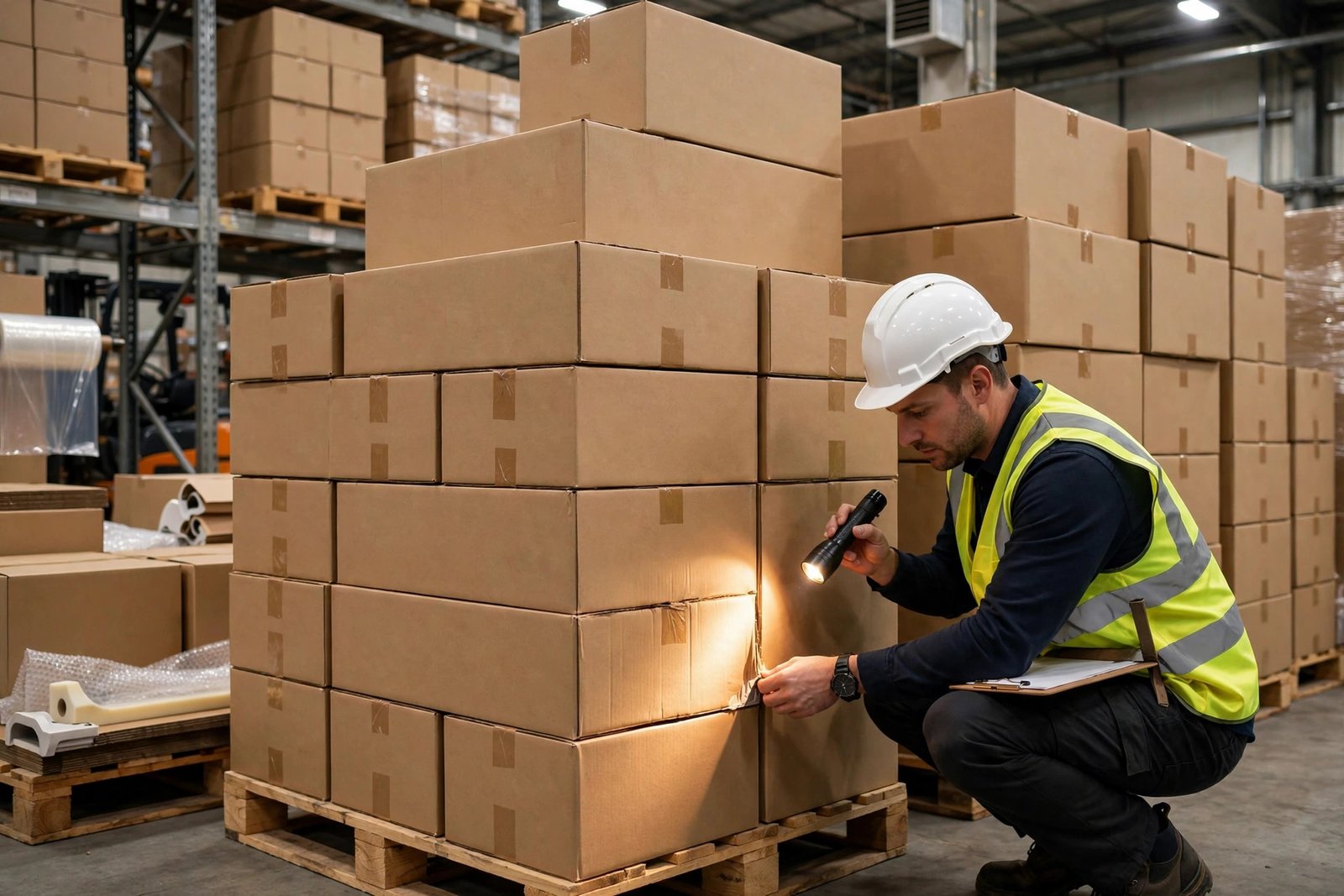
The 5-Category Pre-Shipment Inspection Checklist Framework
A workable pre-shipment inspection checklist for furniture splits the job into five categories: workmanship and finish, dimensional check, function test, packaging verification, and shipping marks, with quantity verification and loading supervision bookending the inspection. Each category gets written pass/fail criteria, agreed with the factory before inspection day.
Send the checklist to the factory before the inspector arrives. The five categories below map to where wooden cat furniture actually fails: cosmetic rejects at the retailer’s dock, assembly complaints, and carrier damage claims — see our notes on choosing a solid-wood OEM manufacturer.
Category 1: Workmanship and Finish
Workmanship inspection compares finished units against the approved sample: finish color and gloss must be uniform, edges smooth and splinter-free, joints tight, scratching wraps even, and every surface free of cracks, glue marks, and dents. Cosmetic defects are the single most common reason wooden cat furniture gets rejected at the destination warehouse.
Start with color: solid wood takes stain unevenly, and perches coated on different days can look like different products under retail light. Compare panels from different cartons against the approved sample. Check coating for runs and missed spots inside cavities and under platforms. Run a hand along every exposed edge — rounded, splinter-free. Check sisal tension and hidden glued ends, seam stitching, bolt-hole tear-out, recessed bolts flush with caps.
Last spring a buyer-side inspector flagged a shade gap our line QC had missed — two batches coated forty-eight hours apart. We re-sorted the run before sealing one carton. Factory eyes get tired; a checklist does not.
Category 2: Dimensional Check and Quantity Verification
Measure against the approved drawings, never another unit — a whole run can drift together. Check overall height, platform sizes, post diameters, and perch openings: holes 10 mm too tight become “my cat doesn’t fit” reviews; bolt spacing off 2 mm turns ten-minute assembly into a forty-minute fight. Our sheets allow ±3 mm on cut panels, ±5 mm on assembled height; beyond that is rework. Measure the assembled unit — assembly stacks tolerances. Then verify quantity: count cartons against the packing list, check SKU mix on labels, weigh random samples — a carton 2 kg light is missing parts.
Category 3: Function Test — Stability, Joints, and Assembly
Pull-test the top platform laterally: a tower that rocks on a flat floor will walk across a living room. Tighten every bolt to spec, re-check after the pull test. Disassemble and reassemble one unit using only the manual and hardware pack — this catches wrong bolt lengths, mislabeled bags, missing steps, and cross-threading posts.
Scratch wraps firmly by hand; shifting wraps will not survive a real cat. Perches must hold an adult cat’s weight without creaking at the joint line. Verify the anti-tip strap is in the hardware bag — ASTM publishes the stability test methods factories reference.
Category 4: Packaging Verification and Drop-Test Readiness
Packaging verification confirms every unit is packed to specification: correct carton dimensions, corner and foam protection in place, sealed and labeled hardware bags, the current manual version included, and cartons sealed to survive stacking. Packaging is what turns “shipped” into “arrived sellable.”
Carton dimensions must match the spec — oversized wastes space and lets the unit shift; undersized crushes foam. Confirm foam and corner protectors match the packing diagram, scratch-prone faces are wrapped, fabric parts bagged, hardware bags sealed, labeled, complete. Check the manual version against the current bill of materials — manuals go stale when designs change.
For new packaging specs we run an ISTA 3A-style drop test before the first run ships; ISTA publishes the procedures. Note: LCL freight is handled far more than full containers, so “fine for FCL” is not automatically fine for consolidated loads.
Category 5: Shipping Marks and Loading Supervision
Every carton needs SKU and product name, quantity per carton, gross/net weight, carton dimensions, country of origin, PO number, and handling marks — this side up, fragile, keep dry. Marks must be printed, legible, on at least two sides; scan one barcode if your retailer requires it.
Then supervise loading: inspect the empty container (dry floor, no daylight through holes, no odor), load heavy cartons at the bottom, leave no voids, photograph each stage, record the seal number. A perfect inspection means nothing if the container leaks.
Where a Pre-Shipment Inspection Checklist Stops Working
An honest checklist names its limits. First, PSI samples finished goods — it cannot see upstream. Moisture sealed inside a panel, formaldehyde from a coating batch, joint fatigue: invisible to a tape measure. Those need lab testing and in-process controls — our QC starts at incoming material.
Second, a factory-run PSI is a second pair of eyes, not an independent verdict. We inspect internally before your inspector arrives, but for high-stakes shipments a third-party inspector answers to you. Put it in writing: who inspects, to which checklist, and what happens on failure.
Third, PSI is a gate, not a workshop. Failures on packed goods mean unpacking and rework. The checklist confirms; it does not discover — the pattern behind the sourcing mistakes buyers make in China.
FAQ
1. How many cartons should a pre-shipment inspection sample?
Follow AQL tables (ANSI/ASQ Z1.4), General Inspection Level II — the sample scales with lot size. Agree AQL limits for critical, major, and minor defects in writing first.
2. Can the factory perform its own pre-shipment inspection?
Yes, as an internal gate — a factory that hides its PSI report is telling you something. But for new suppliers or high-value shipments, use a third-party inspector who answers only to you.
3. What tools does an inspector need for wooden cat furniture?
Tape measure, calipers, a pin-type moisture meter, the approved sample, current drawings and packing list, and a camera. The checklist itself matters most.
4. How long does a full five-category PSI take?
About one working day for a typical sampled lot: workmanship and dimensions in the morning, function and packaging in the afternoon. A two-hour “inspection” skipped categories.
5. What happens when units fail?
Classify defects first: critical (safety-related) stops the shipment; major defects above the agreed AQL mean rework and re-inspection. Never ship now and “fix it next time.”
6. Does a passed PSI guarantee zero defects at destination?
No. PSI is statistical — it certifies the sample met the agreed criteria. It is the strongest affordable assurance before loading, not a warranty.
voir notre atelier où les meubles pour chats en bois massif sont usinés et assemblés. See how manufacturing defects are spotted before a cat tree leaves the factory.
Before Your Next Shipment Leaves the Factory
Ask your factory for its pre-shipment checklist before booking the inspector — that document tells you most. Want a manufacturer that runs this five-category inspection as standard? Start with a Demande de devis — or reach us via our page de contact.
Support OEM/ODM
Besoin d'un plan de production personnalisé pour un arbre à chat ?
Envoyez des photos de référence, les dimensions cibles, les préférences de matériaux, les besoins en emballage et la direction du marché. Nous pouvons examiner la faisabilité, l'échantillonnage, les MOQ et l'emballage d'exportation avant la production. Demander un devis OEMLignes de produits associées
Explorez les meubles pour chats en bois que nous pouvons fabriquer.
Guides d'achat associés