
The most expensive quality problem in wooden pet furniture is the one discovered at the container door. By then the panels are cut, the joints are glued, and the coating is cured — every correction costs far more than it would have at the right moment on the line. In-process quality control exists to catch drift where it starts, not where it lands.
On a factory floor it is everyday vocabulary; off the floor, buyers hear only “we have strict quality control,” which says nothing about where problems get caught. This article translates that internal language into something a buyer can audit.
What IPQC Means in Wood Furniture Production
IPQC — in-process quality control — is the system of inspections a wood furniture factory runs while production is underway, at incoming materials, cutting, assembly, and finishing, instead of only checking the finished product. It controls the process so defects are stopped where they start, before one error compounds into a failed shipment.
Wood moves: moisture shifts, grain changes how a joint behaves, and a drilling template wears with every setup. A finished-product check can only reject what is already built; in-process QC corrects the run while it is still correctable. The three terms you will hear constantly — incoming, in-line, and finishing inspection — form the checkpoint system below.
Checkpoint 1: Incoming Material Inspection
Incoming material inspection is the first checkpoint in an IPQC system: the factory verifies wood species, moisture content, panel grade, and hardware batches before anything is cut. Defective material stopped here costs almost nothing; the same defect found after assembly means scrapping a finished unit and rebuilding it.
This checkpoint is wood-specific: kiln-dried panels arrive with paperwork, but the two are checked against each other — a pin-type moisture meter reading, a flatness check, a look for warping in transit. Hardware gets its own check too.
In our receiving area, a warped panel never reaches the cutting saw: the stamp says release or the batch goes back. Cheaper than every alternative — including the fantasy that a later checkpoint can fix bad wood. See our guide to the best wood for cat trees.
Checkpoint 2: In-Line Inspection at Cutting and Joinery
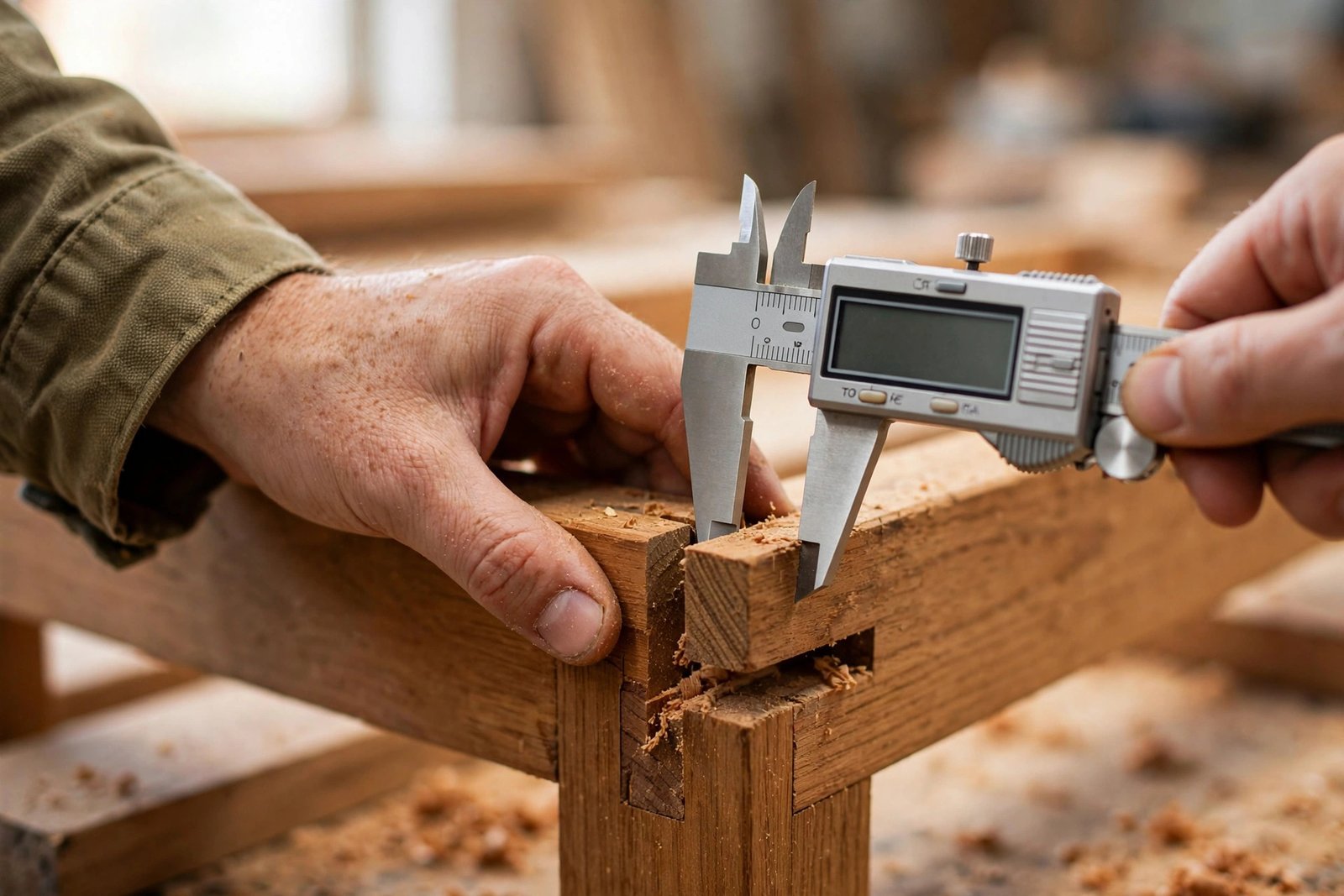
Every new setup on the line begins the same way: the first piece is cut, then measured against the drawing before the run continues. This is first-piece verification, the core habit of in-line inspection, and it catches setup errors — a fence set a millimeter off, a template clamped slightly rotated — before they become a hundred identical wrong parts.
Cutting and joinery are where dimensional check discipline lives: panel thickness, post diameter, hole positions, and slot depths are measured against the technical dossier. Fixtures are wear items, so drilling templates are checked on schedule and retired before drift accumulates. And note: in-line inspection is sampling-based by design — the sampling rhythm is worth asking about during a audit d'usine.
Checkpoint 3: In-Process QC During Assembly
At the assembly checkpoint, in-process QC verifies what the end customer will actually feel: frames are checked for squareness, joints for full seating, perches for stability under load, and scratching-post wrap for even tension along the post. Units that fail are tagged as non-conforming product and routed into the rework loop instead of moving forward.
Assembly is where small cutting errors surface. A frame a degree out of square probably drifted at glue-up — which is why assembly jigs matter as much as the glue. Testers check what hands will find: perch seating, wrap tension, knock-down joints.
In our shop, a perch post with holes off by a couple of millimeters does not get “adjusted” with a larger screw. It gets a red tag — logged, remade, re-inspected before it rejoins the line.
Checkpoint 4: Finishing Inspection Before Packing
Finishing inspection is the last checkpoint in the IPQC sequence before packing: coating coverage, edge smoothness, color consistency across batches, and hardware completeness are verified on unpacked units. It is not the same as pre-shipment inspection — it happens before units go into cartons, so corrections are still practical and cheap.
For water-based coatings, the inspector checks the places machines miss: undersides, inside corners, shadow lines a spray gun cannot reach. Runs are caught by raking light; a quick odor check catches coating that has not cured fully. Once units pass, hardware packs are counted; see our quality inspection guide et pre-shipment checklist.
QC Records: What Makes an IPQC System Verifiable
Any factory can say it runs in-process QC. The ones that actually do leave a paper trail — first-piece verification logs, dimensional check sheets, checkpoint sign-offs, non-conforming product reports, and rework loop records with dates and responsible names. QC records are the difference between a system and a story.
During a factory visit or third-party audit, ask to see last month’s records for a product similar to yours: the checkpoint list, a few completed check sheets, the non-conforming log. A factory with nothing to hide shows you the failures too.
The Limits of In-Process QC: What IPQC Cannot Do
First: the system validates conformance to the drawing, not the drawing itself. A structurally weak design will pass every checkpoint and still fail in a customer’s living room. Design validation through prototype testing is a separate discipline; in-process QC keeps the build faithful to a sound design.
Second: sampling-based inspection manages defect rates; it does not eliminate defects. Occasional non-conforming units are what the rework loop exists to catch. Be wary of any factory promising zero defects: it is either misunderstanding statistics or hoping you do.
Third: wood keeps responding to its environment after the last checkpoint. Moisture-related movement during sea freight or warehouse storage is a packaging and logistics question, not something an in-line inspection can freeze in place.
How to Tell Whether a Factory’s IPQC Is Real
Strip away the terminology and the test is simple. Ask four questions: Show me your checkpoint list for this product. What happens when a unit fails at assembly — who decides, and where does the unit go? Can I see last month’s non-conforming product log? Who has the authority to stop the line?
The last question matters most: where the system is real, a QC inspector can halt production and management backs that authority. Where it is theater, QC stamps paperwork and the line never stops.
For the formal framework, ISO’s quality management overview describes the process approach these systems grow out of; ASTM International publishes the consensus test methods, such as furniture stability standards, alongside in-process QC.
FAQ
1. What does IPQC stand for?
In-process quality control: inspections performed during production — incoming, cutting, assembly, finishing — so defects are caught at the checkpoint where they originate.
2. How is IPQC different from a pre-shipment inspection?
IPQC runs throughout production and corrects the process mid-run; pre-shipment inspection checks finished, packed product at the end. Complementary, not substitutes.
3. What are the main checkpoints for wooden pet furniture?
Four: incoming material inspection (wood, panels, hardware); in-line inspection at cutting and joinery (dimensions, fixtures, first-piece verification); in-process QC at assembly (squareness, joints, wrap tension); finishing inspection before packing (coating, color, hardware completeness).
4. How do I verify a factory’s IPQC is real?
Ask for the checkpoint list, a sample of completed QC records, and the non-conforming product log — plus who has authority to stop the line. Documented failures beat a perfect record.
5. Can IPQC guarantee zero defective units?
No — be wary of any factory that claims it can. In-line inspection is sampling-based: it keeps the defect rate low, and the rework loop catches what sampling finds.
voir notre atelier où les meubles pour chats en bois massif sont usinés et assemblés. See how defects are caught on the factory floor before a cat tree leaves the factory.
Start the Conversation About Your Product’s Quality Plan
Tell us what you are building and how your brand defines quality. Start with a Demande de devis, or reach us via Contact.
Support OEM/ODM
Besoin d'un plan de production personnalisé pour un arbre à chat ?
Envoyez des photos de référence, les dimensions cibles, les préférences de matériaux, les besoins en emballage et la direction du marché. Nous pouvons examiner la faisabilité, l'échantillonnage, les MOQ et l'emballage d'exportation avant la production. Demander un devis OEMLignes de produits associées
Explorez les meubles pour chats en bois que nous pouvons fabriquer.
Guides d'achat associés