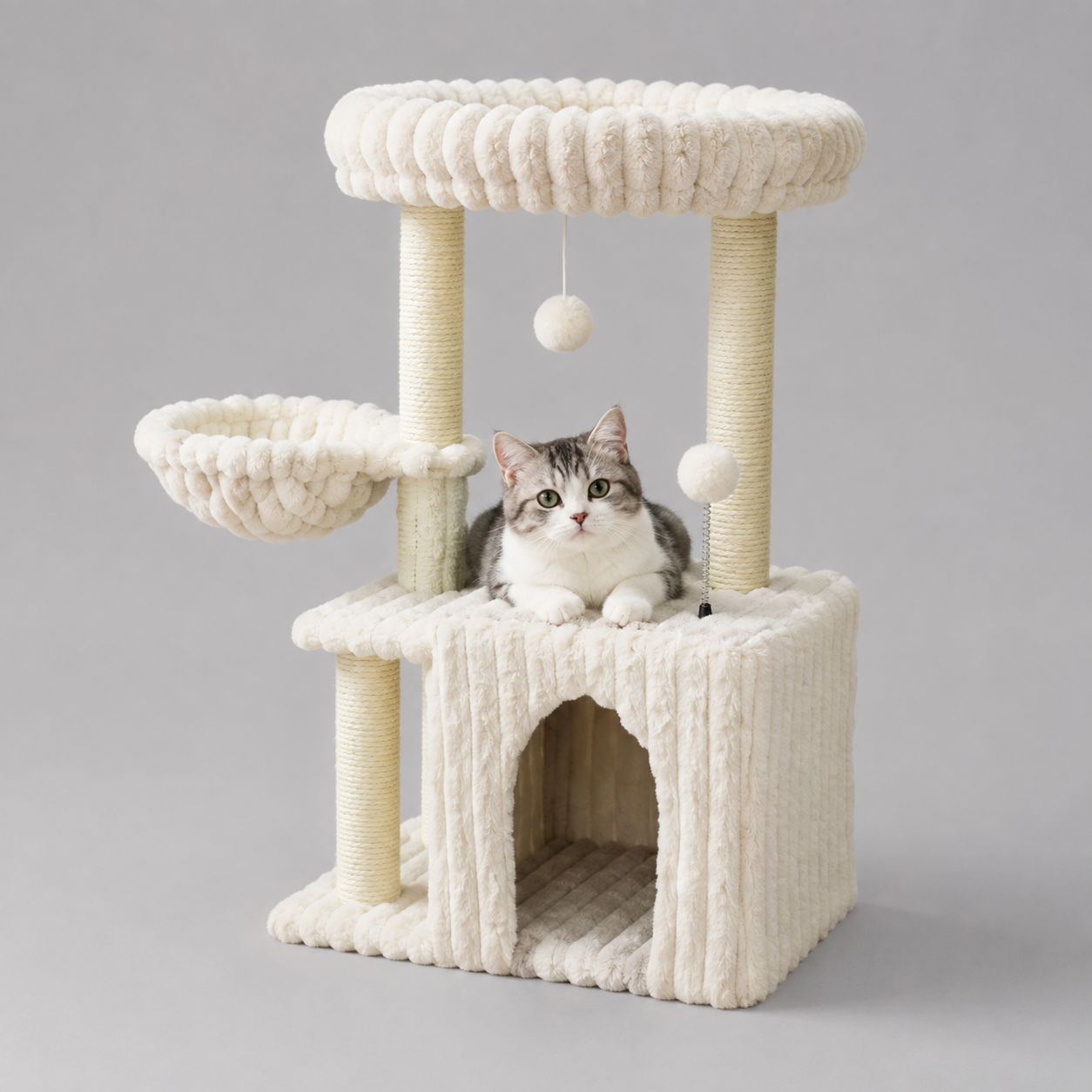
Place a carpeted tower beside a pale-ash minimalist model — three platforms, two slim columns, fingertip roundovers, clear hardwax oil. The carpeted tower looks busy and bulky; the wooden one looks like furniture. That contrast is the whole brief for the modern wooden cat tree — every visible surface must earn its place, with no upholstery hiding the structure.
This wholesale style guide covers design language, edge and finish details, hidden engineering, and original design capability from the factory side.
Modern Wooden Cat Tree Design: What “Minimalist” Actually Means
A modern wooden cat tree is defined by visual restraint: exposed solid-wood structure, one or two materials, clean rectilinear or gently curved geometry, no decorative cladding. If removing an element makes the tree look better, it was never minimalist — just undecorated.
True minimalism is harder to manufacture than ornament: a carpeted tower hides sins — uneven joints, filler, mismatched grain — under fabric, while a modern wooden cat tree hides nothing. Every joint line and grain transition is visible — each must be intentional. A buyer can judge the maker in ten seconds — which is both the risk and the selling point. For private label, the clean canvas takes branding better: a laser-etched logo on pale wood reads premium in a way no carpet badge can.
Lines and Silhouette: The Geometry of Restraint
Modern wooden cat tree silhouettes work with a small geometric vocabulary: horizontal platforms of consistent thickness, vertical columns on a strict grid or a single deliberate offset, and curves used sparingly — one arched perch per design, never more.
Proportion does the heavy lifting: a working ratio of platform thickness to column diameter of roughly 1:3 — 30 mm platforms on 90 mm columns read solid, not chunky. If the silhouette does not read in a flat product photo, it will not read on a product page — during prototype iteration, our design team photographs each version against a white wall first.
Edge Treatment: Chamfers, Roundovers, and the Sense of Touch
Edge treatment is where a modern wooden cat tree wins or loses at the showroom: a 3 mm roundover transforms how the piece feels — fingertips register softness before eyes register design — while a sharp arris reads cheap regardless of timber quality.
| Treatment | CNC process | Feel and read |
|---|---|---|
| 3 mm roundover | Second toolpath + sanding | Warm, premium |
| Chamfer, 3–5 mm | Single pass, chamfer bit | Crisp |
| Sharp arris | None | Cheap read — never on a finished product |
Mixing them — chamfers on structure, roundovers on touch surfaces — marks a considered design and a factory comfortable with multi-step edge programming. Specify edge treatment on all six faces — buyers run their hands underneath, and a sharp underside breaks the illusion.
Finish as Design: Hardwax Oil and the Natural Look
The signature finish of the modern wooden cat tree is clear hardwax oil or matte water-based coating that leaves the grain visible and the surface feeling like wood, not plastic — finish is part of the design.
| Finish | Look | Scratch behavior |
|---|---|---|
| Hardwax oil | Warmest, most tactile | Patina look; easy spot repair |
| Matte water-based | Uniform matte film (finish comparison) | Uniform; harder to spot-repair |
| UV matte coating | Most consistent film | Best consistency; flat panels only |
Color discipline separates professionals from amateurs: pale ash that drifts yellow between batches destroys the minimalist promise. On our line, every coating batch change on a pale-ash run is checked against the master sample — even small drift shows when two units stand side by side. For designs with composite panels, US EPA TSCA Title VI and CARB Phase 2 set the formaldehyde limits.
Modern Wooden Cat Tree Engineering: Hiding the Structure
A modern wooden cat tree must look effortless while carrying real loads — so the engineering hides inside: threaded inserts instead of visible screws, blind dowels instead of through-bolts, steel reinforcement buried in slim columns that could never stand on wood alone.
The resolution of the category’s central tension is concealed engineering — a 60 mm column that looks impossibly slender carries a steel core, and a floating platform cantilevers off a hidden steel bracket. A cheap factory thins the wood and hopes; a specialized manufacturer buries the strength where the eye never goes.
Visible hardware breaks the spell, so modern designs use concealed cross-dowels, barrel nuts, and threaded inserts. A 1 mm misalignment becomes a visible gap, so the AQL plan must be stricter on cosmetics. In our workshop, a minimalist prototype once failed review over a single 1 mm shadow line at a platform joint — invisible on a carpeted tower, disqualifying on one promising visual silence.
Original Design Capability: From Sketch to Prototype
Original design capability: the factory’s design team takes a rough brief — “Scandinavian, 120 cm, two cats, flat-pack” — and returns dimensioned drawings, a prototype, and a revised prototype after testing, without the buyer solving the engineering.
The process has a recognizable shape: concept sketches, a technical drawing with joinery details and carton plan fixed early, then a prototype in production timber — tested and assembled by fresh hands. Revisions go through an engineering change order so the production run matches the approved sample — if a factory’s “ECO process” is a verbal note on the shop floor, you don’t have an original design partner. Ask for the revision history: three dated prototype photos explaining what changed between each means a real process. Custom design options for cat trees outline OEM/ODM development; the OEM vs ODM guide explains which model fits your brand’s stage.
The Limits of Minimalism
Minimalism has genuine trade-offs. First, cats aren’t minimalists — many prefer enclosed hideouts to open perches, and a strictly open modern tree serves the owner’s taste; the best modern lines include at least one semi-enclosed element.
Second, pale natural finishes show claw marks faster than dark stains or carpet: an oiled ash platform records every scratch. No finish is both pale-natural and scratch-invisible.
Third, slim profiles leave no structural redundancy: a chunky traditional tree tolerates a loose joint; a minimalist one with 60 mm columns does not. Tighter tolerances and zero tolerance for green stock — kiln-dried 8–12% moisture content is mandatory, not aspirational. The thinner the wood, the less forgiveness for shrinkage — not styling advice, just the math of slender members.
From our factory: A look at how our factory designs and builds modern minimalist cat trees, from CNC edge details to concealed engineering.
How Solid Pet Wood Designs Modern Wooden Cat Trees
We’re a specialized solid wood pet furniture manufacturer; minimalist lines are our proving ground — where every shortcut is visible.
Our design team develops original minimalist silhouettes in-house: proportion studies against white-wall photography, concealed engineering resolved before the first prototype, and carton plans fixed at the drawing stage. Our production line runs multi-step CNC edge programming, steel-core concealed reinforcement in slim columns, and batch-to-batch color checks against a master sample. Our quality system applies stricter cosmetic AQL criteria — on a modern wooden cat tree, a 1 mm shadow line is the defect.
Building a minimalist line? Request a quote with your silhouette — our design team will show you what it takes to make it stand.
FAQ
What defines a modern wooden cat tree?
Visual restraint: exposed solid-wood structure, one or two materials, clean geometry, no decorative cladding — every visible joint must be intentional.
Is hardwax oil or water-based coating better for minimalist cat trees?
Hardwax oil feels warmer and repairs easily but needs days to cure; matte water-based is more uniform and lower-maintenance but films the wood slightly.
Why does minimalist construction demand more engineering?
The engineering hides inside: steel-reinforced slim columns, concealed inserts, multi-step edge work, and tighter CNC tolerances.
Do cats like minimalist open designs?
Many cats prefer enclosed hideouts to open perches — the best modern lines include at least one semi-enclosed element, even at the cost of pure aesthetics.
How do factories keep color consistent across a minimalist line?
Sorted timber, consistent coating batches, IPQC color checks against a master sample — pale finishes show batch variation mercilessly.
Can minimalist cat trees be flat-packed?
Yes — with concealed knock-down hardware like cross-dowels and barrel nuts. Fix carton dimensions at the drawing stage, since slim parts need precise packaging.
OEM/ODM Support
Need a custom cat tree production plan?
Send reference photos, target dimensions, material preferences, packaging needs, and market direction. We can review feasibility, sampling, MOQ, and export packaging before production. Request OEM QuoteRelated Product Lines
Explore wooden cat furniture we can manufacture.
Related Buyer Guides