
A 68-inch tower can still rock on a 60 × 60 cm base: stable on the showroom floor until a 5 kg cat leaps onto the top perch. The tipping moment was never recalculated when the design grew from 48 inches to 68.
Height changes everything in a cat tree, and the engineering must change with it. This tall cat tree wholesale guide covers base geometry, center-of-gravity design, wall anchoring, joint specs, flat-pack limits, and testing.
Tall Cat Tree Wholesale: Why Height Changes the Engineering
Above roughly 60 inches, tall cat tree wholesale buyers face a different product: the tipping moment grows faster than the footprint, so base width, column stiffness, and wall anchoring must be engineered together — not scaled up from shorter models.
Tipping moment scales with height, restoring moment with base width — so a tree 40% taller needs far more than 40% more base. Many factories simply stretch a 48-inch design onto the same 50 × 50 cm base with the same dowel joints — and ship a rocking tower. Tall trees amplify joint play: 1 mm of joint gap invisible at 40 inches becomes centimeters of sway at 68.
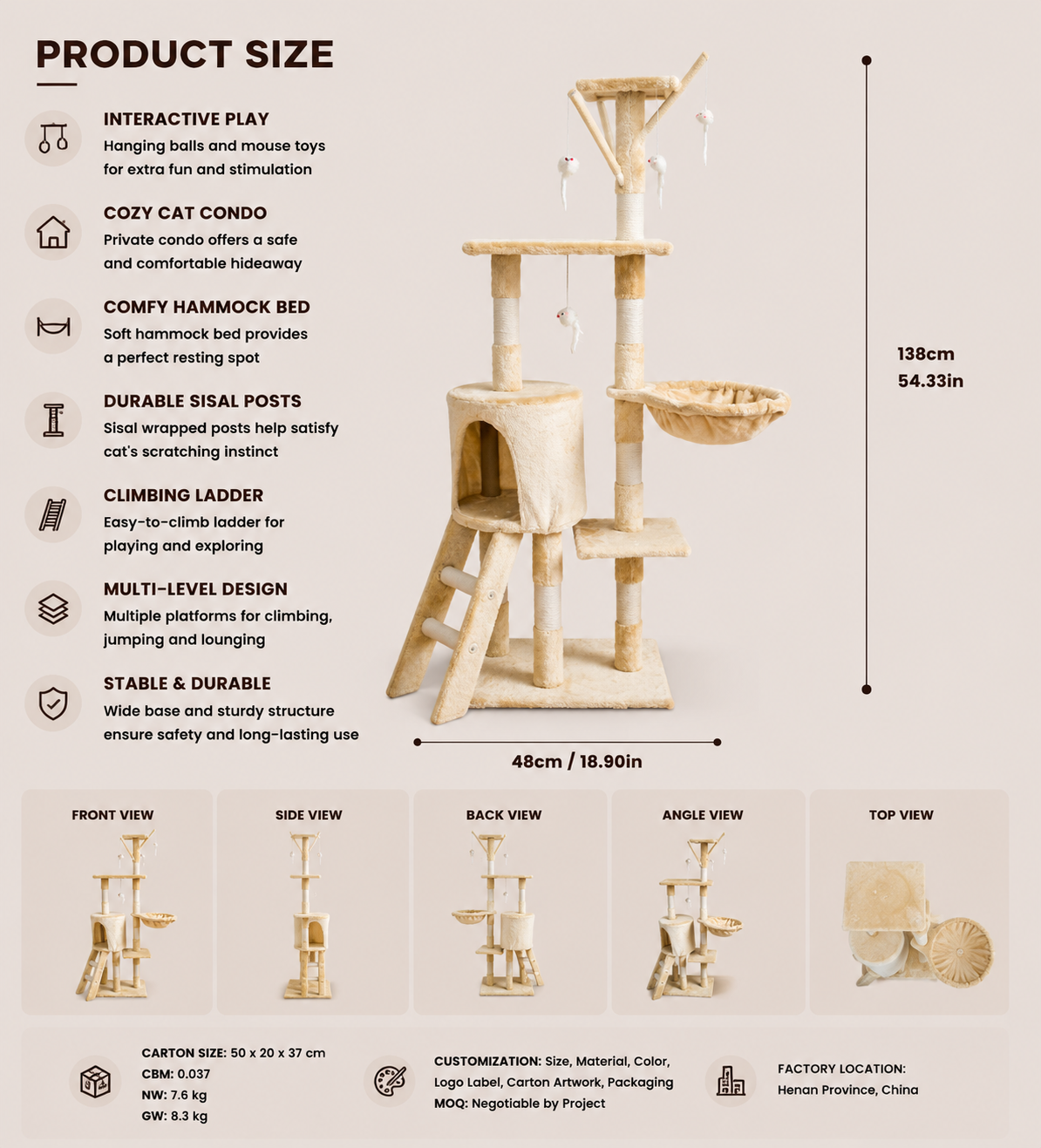
Base Geometry: The Physics of a 60-Inch Tower
For a 60-inch-plus wooden cat tree, the base should be at least 55 × 55 cm — wider if the top perch overhangs the footprint. Base-to-height ratio matters more than absolute size — a low, heavy cabinet base outperforms a thin panel base of the same dimensions.
| Tree height | Min. base | Column section |
|---|---|---|
| 60–64 in (150–163 cm) | 55 × 55 cm | 90 × 90 mm laminated |
| 64–70 in (163–178 cm) | 60 × 60 cm | 90 × 90 mm laminated |
| 70 in+ (178 cm+) | 65 × 65 cm / cabinet base | 90 × 90 mm laminated, through-bolted |
A square base resists tipping in all directions; a rectangular base is weak along its short axis — exactly the axis a cat uses launching sideways off a perch. Weight distribution beats raw weight: a 12 kg tree with mass in the bottom third outstands a 16 kg top-heavy one. In our workshop, lowering a top platform by 15 cm is the routine first fix for a swaying tower — it cuts the tipping moment at the source.
Wall Anchoring: When the Base Alone Is Not Enough
Above 60 inches, a wall anchor or anti-tip strap is the responsible specification — not an accessory. The anchor transfers the tipping moment into the wall, removing the height penalty and keeping the freestanding base within standard shippable carton dimensions.
| Method | Stiffness | Install burden | The catch |
|---|---|---|---|
| Rigid L-bracket into wall stud | Highest | Drilling required; stud position fixed | Useless on drywall alone |
| Tension strap | Moderate — stretches under shock | Forgiving of stud positions | Consumer may never tension it |
| Floor-to-ceiling tension pole | High — ceiling becomes second anchor | Needs correct ceiling height | Fails on soft ceiling/floor |
You cannot control whether the consumer installs the anchor — so the freestanding design must pass the tip-over test alone; the anchor is redundancy. Floor-to-ceiling tension designs use the ceiling as the second anchor instead.
Tall Cat Tree Wholesale Specs: Joints, Columns, and Hardware
Tall cat tree wholesale specs should call out through-bolted column joints with threaded inserts, laminated columns of at least 90 × 90 mm, and metal-to-metal hardware at every platform connection — height multiplies the load cycles cheap joints cannot survive.
Laminated columns — strips glued with alternating grain — resist the bending that sways tall towers; a single solid-sawn post twists as it dries. Kiln-dried stock at 8–12% moisture content is non-negotiable at this height, since shrinkage in a tall column opens every joint above it. Through-bolts hold torque through thousands of sway cycles; end-grain screws have no place in a 60-inch tower.
A cheap factory assembles a tall tower on the same joint schedule as its 48-inch model and hopes. A specialized manufacturer writes a separate joint schedule per height band — the taller the tree, the less forgiveness each joint gets. Jig-fixtured drilling keeps bolt holes aligned; 2 mm of misalignment compounds into a visibly leaning tower.
Center of Gravity: Designing the Platform Stack
A tall cat tree’s platform stack should place the largest, heaviest platforms low and the smallest perches high, with the center of gravity in the bottom third. Top-heavy stacking — big condos near the top — is the most common design mistake in tall wooden trees.
Each platform should bear directly on a column or cabinet wall below, not cantilever off a single bracket — at 60 inches a cantilevered perch is a lever on its mounting joint, and the fatigue test will find it. A spiral platform layout distributes load evenly but complicates the carton — asymmetric parts need custom protection.
Flat-Pack Limits: Why Ultra-Tall Trees Fight the Carton
The hard ceiling for flat-pack tall cat trees is the parcel network: past roughly 180 cm on the longest carton side, carriers surcharge or refuse the box, and the design must split into more sections — more joints, more assembly steps.
Every additional split adds a joint, and every joint is a future wobble point. A 72-inch tree in three sections has two mid-column joints a 60-inch tree does not — through-bolts, alignment dowels, and clear instructions, or the customer builds a leaning tower. The carton dimension belongs on the design brief from day one.
Testing Tall Trees: Tip-Over, Fatigue, and Drop Protocols
Tall wooden cat trees should be validated with a tip-over test applying lateral force at the highest perch, a fatigue test cycling that perch through jump-and-land loads, and an ISTA 3A drop test on the shipping carton — ASTM F2057 stability logic plus parcel-drop procedure.
The tip-over test is the gatekeeper. Per ASTM F2057 (ASTM International), the protocol applies a controlled lateral force at the top perch and requires the unit to stand alone, without the wall anchor. A tall tree that needs its anchor to pass is a tall tree that will fall in the homes where the anchor never gets installed. The fatigue test attacks the joints through hundreds of cycles; the carton goes through the ISTA 3A parcel sequence (ISTA) — long panels are most vulnerable in transit. IPQC checks joint torque at fixed intervals under an AQL-sampled pre-shipment inspection. Durability testing protocols for pet furniture describe the full sequence.
From our factory: See how we engineer tall solid wood cat trees for stability and safety.
How Solid Pet Wood Engineers Tall Cat Trees
We are a specialized solid wood pet furniture manufacturer, and tall towers are where generic factories fail loudest.
Our design team writes a separate structural brief per height band: base footprint, column section, joint schedule, center-of-gravity target, and the constraining carton dimension. Our production line runs kiln-dried 8–12% stock through jig-fixtured drilling and through-bolts every column joint at height. Our quality system validates every tall design freestanding first — tip-over per ASTM F2057 logic, jump-and-land cycling, ISTA 3A on the carton. The wall anchor is backup, not the fix.
Developing a 60-inch-plus line? Request a quote with your target height and carton constraints — we return an engineering review, not a guess.
FAQ
At what height does a cat tree need wall anchoring?
Above roughly 60 inches, a wall anchor or anti-tip strap is the responsible specification. but the freestanding design must still pass the tip-over test alone; the anchor is backup.
What base size does a 60-inch wooden cat tree need?
At least 55 × 55 cm, wider if the top perch overhangs the footprint — base-to-height ratio matters more than absolute size.
Why do tall cat trees wobble more than short ones?
Height amplifies joint play: 1 mm of gap invisible at 40 inches becomes centimeters of sway at 68. Tighter tolerances and through-bolted joints are the fix.
Can a 72-inch cat tree ship flat-pack?
Only if the longest carton dimension stays near 180 cm — beyond that, more sections mean more joints where joints matter most.
What column construction suits tall wooden cat trees?
Laminated columns of at least 90 × 90 mm, kiln-dried to 8–12%, joined with through-bolts and threaded inserts — laminated stock resists bending better than single solid-sawn posts.
How is a tall cat tree stability-tested?
With a tip-over test at the highest perch (ASTM F2057 logic), a fatigue test cycling that perch through jump-and-land loads, and an ISTA 3A carton drop test.
OEM/ODM Support
Need a custom cat tree production plan?
Send reference photos, target dimensions, material preferences, packaging needs, and market direction. We can review feasibility, sampling, MOQ, and export packaging before production. Request OEM QuoteRelated Product Lines
Explore wooden cat furniture we can manufacture.
Related Buyer Guides