A buyer once sent us a screenshot of a cat condo she wanted to replicate. It took us a minute to realize it was our own design — photographed better than ours, sold under a brand name we had never heard of. She wasn’t complaining. She was asking how soon we could do the same for her. That is private label in one scene.
What Private Label Cat Furniture Actually Means
Private label cat furniture is furniture built by a manufacturer to a buyer’s specifications and sold under the buyer’s brand name. The buyer controls the design direction, the branding, and the market positioning; the factory controls production. Unlike white label — where one fixed catalog model gets rebranded for many buyers — private label models are developed for a single brand.
That distinction decides who answers the hard questions. You approve the wood species, the joinery, and the finish — Wikipedia’s overview of private-label products frames the same split of roles. When a brand partner asks us to change a platform depth after launch, the change goes straight into their production file. On a white-label catalog piece, that change is simply a no.
Tier 1: Logo Laser Engraving — Branding Burned Into the Wood
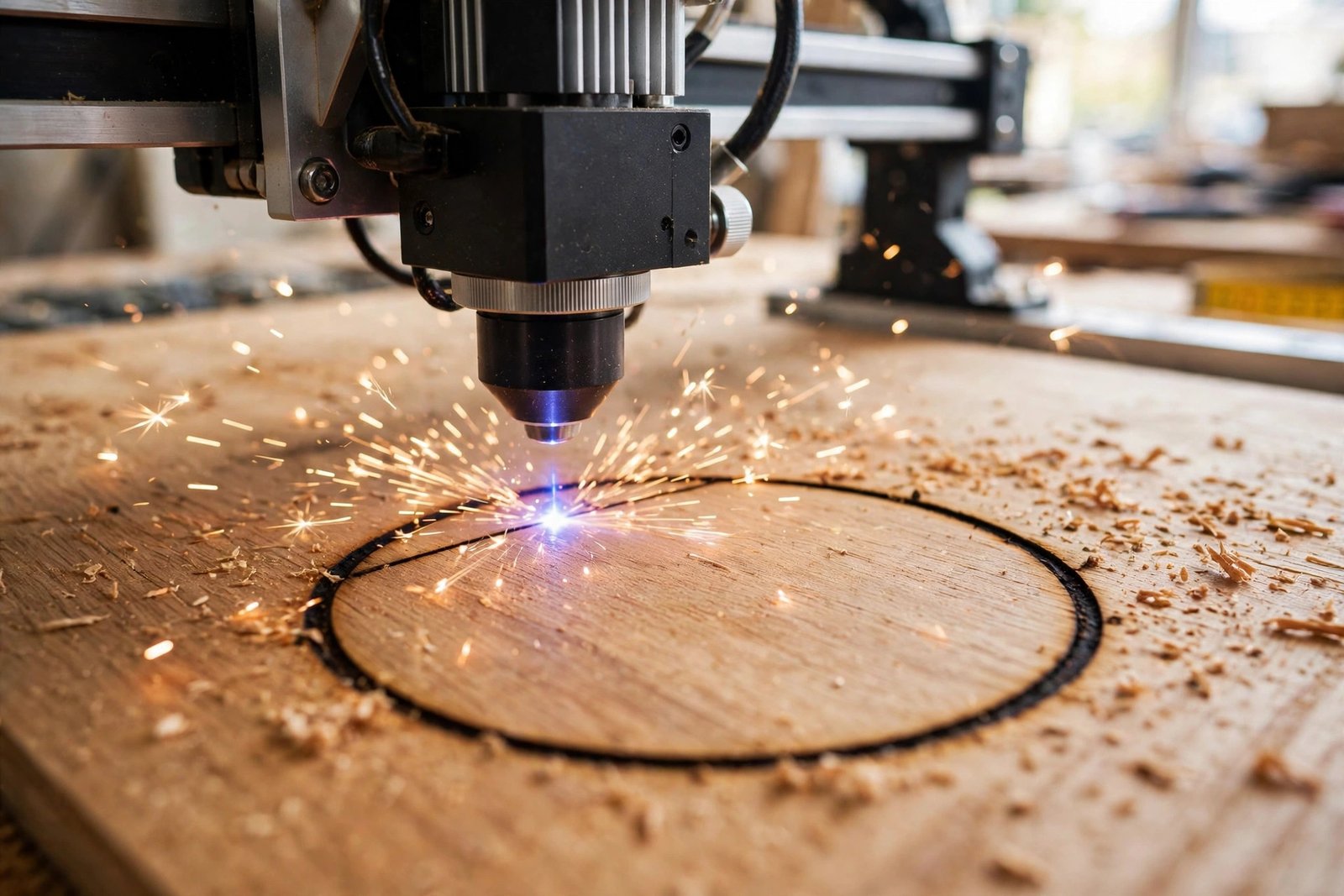
Laser engraving burns the logo into a solid-wood component: a condo side panel, a tree base, or the wooden collar of a scratching post. Nothing to peel or fade. It suits móveis de madeira de luxo para gatos positioning because the mark becomes part of the furniture itself.
One of our brand partners learned the contrast lesson the practical way: their fine-line mark on dark-stained walnut read as texture, not branding. On light rubberwood, the same file read crisply at arm’s length. Engraving also eats thin strokes, so send the simplified mark.
We engrave before the final coating pass so the finish seals the recessed lines. Our guia de certificação de acabamento não tóxico explains the coating standards behind pet-contact surfaces.
Tier 2: Woven Labels and Hang Tags — Branding That Rides Along
Woven labels give you branding on the soft parts: sewn into a cushion seam, attached to a hammock edge, or woven into a hang-tag cord. Where engraving needs flat wood, a woven label works on fabric and rope.
A woven label is a textile product with its own logic. Threads have a minimum width, so small text below that threshold turns to noise — send a separate simplified file, because the full logo rarely survives the loom. Damask weave gives the sharpest edges; taffeta is cheaper but coarser. Lock that choice in your brand guidelines.
Placement deserves the same discipline. A label sewn into a removable cushion cover travels with the cushion, not the tree — decide once whether the mark lives on the furniture or the accessory.
Tier 3: Custom Packaging — The Color Box That Starts Your Brand Launch
Custom packaging turns the shipping carton into a retail-ready color box: printed outer box, fitted inserts, and a dieline — the flat template showing every fold, glue flap, and cut line — engineered around your product’s exact dimensions. This is the tier that makes a brand launch look like a launch.
A brand launch needs three things plain boxes skip: the dieline, built from final dimensions and confirmed with a physical proof; print artwork locked to your brand guidelines; and a scannable identifier — most retailers expect a GTIN barcode, and GS1’s barcode standards define how those are structured. Leave the barcode panel as a defined blank in the dieline.
One honest note: wood is heavy, so a tall tree may need double-wall board where a lighter product gets away with single-wall — and that call belongs to the packaging engineer, not the brand designer.
Private-Label Branding: The Cost Logic Behind the Three Tiers
Each tier has its own cost structure, and understanding it lets you choose the right one for your launch stage.
Laser engraving carries a one-time file setup plus a small per-unit burn time; once the file is proven, adding engraving to later runs is nearly frictionless. Woven labels work differently: the loom runs a woven batch per design, and the strike-off needs approval before the loom starts. Color boxes sit at the top of the commitment curve — dieline engineering and print setup are front-loaded, so this tier rewards stable designs and punishes late artwork changes.
That is the logic: engraving is the low-friction entry, woven labels sit in the middle, custom packaging is the full commitment. Match the tier to how settled your design is.
The Limits We Tell Every Buyer Upfront
Every branding tier adds a proof cycle, and proof cycles are where private-label projects slip: a burn proof on the actual wood species, a loom strike-off for woven labels, a physical dieline proof for color boxes. Each is a round trip between your desk and the factory, and none runs in parallel — branding proofs come after the furniture design is frozen. Lock artwork early; the artwork delays more launches than the furniture does.
The second limit is physical. Laser engraving on dark-stained wood has low contrast — a law of optics, not a factory skill problem. Woven labels pucker on tightly curved condo edges. Place the mark where the material lets it win: engraving on light panels, woven labels on flat seams.
Getting Your Brand Guidelines and Artwork Files Production-Ready
Private-label branding fails on missing files more often than on factory capability. Before production, the factory needs vector artwork files — AI, EPS, or SVG with text converted to outlines — plus a brand guidelines sheet covering logo clear space, approved CMYK color codes, and the simplified one-color mark for engraving and weaving.
One more file rule: an engraving machine cannot use a font it doesn’t have, and font licensing rarely travels with the artwork. Outlined text removes the problem entirely. For packaging, confirm your GTIN before print — a box with the wrong identifier is a full reprint.
Solicite um orçamento and we will map which branding tier fits your models and your launch timing before you commit to artwork. For general inquiries, reach us through our página de contato.
Da nossa fábrica: Watch how we engineer retail-ready packaging for branded cat furniture.
FAQ
What is the difference between private label and white label cat furniture?
Private label means the factory builds furniture developed for your brand — your dimensions, your details — and no other buyer gets that model. White label means an existing catalog model ships with your logo. Private label gives exclusivity; white label is faster, but the same product can appear under other names.
Can my logo be laser-engraved on any cat tree model?
Any model with a flat, accessible wood panel works. Engraving reads best on light wood and needs a simplified one-color mark with adequate line weight. Dark-stained panels give low contrast, and curved surfaces can’t hold a flat pass — for those, woven labels are the better tier.
How do woven labels attach to cat furniture?
They are sewn into fabric seams — cushion covers, hammock edges, or hang-tag cords — not onto the wood. Send a simplified file sized for the loom, and approve the strike-off before the run starts.
What files does the factory need for private-label branding?
Vector artwork files (AI, EPS, SVG) with outlined text, a brand guidelines sheet with CMYK codes and logo clear space, and a simplified one-color logo. For packaging, you also approve the dieline before printing.
Will my private-label model be exclusive to my brand?
Yes — that is the defining feature of private label. The model is developed for your brand and not sold to other buyers. Put exclusivity and artwork ownership in your manufacturing agreement; our custom OEM process page outlines how development agreements typically handle this.
Can the packaging be retail-ready with a barcode?
Yes. Custom packaging includes a barcode panel on the dieline for your GTIN, printed to GS1 standards so it scans at retail. Confirm your GTIN with your GS1 member organization before the artwork is finalized — a reprint over a wrong identifier is entirely avoidable.
Suporte OEM/ODM
Precisa de um plano de produção personalizado de árvore para gatos?
Envie fotos de referência, dimensões alvo, preferências de material, necessidades de embalagem e direção de mercado. Podemos revisar a viabilidade, amostragem, MOQ e embalagem de exportação antes da produção. Solicitar Cotação OEMLinhas de Produtos Relacionadas
Explore móveis de madeira para gatos que podemos fabricar.
Guias do Comprador Relacionados