
A buyer’s message arrived: our sample tree, one perch leaning like a tired ear. “Perch wobbles.” Our bench had built that tree, but nobody had leaned on the perch the way a six-kilo Maine Coon would. That wobble taught both sides more than two rounds of comments — sampling is not about proving we can read your drawing. It is about finding where your drawing argues with wood, gravity, and cats.
What the Cat Furniture Sampling Process Is Really For
The cat furniture sampling process turns your drawing into a prototype that has survived three scrutinies: the drawing’s logic, the wood’s behavior, real cat physics. Each prototype iteration closes one gap — and a sample that skips rounds skips the evidence your production run stands on.
Search “cat furniture sampling process prototype” and most results describe generic development. Here the prototype is a communication device: your drawing says what you want, the prototype says what the wood heard.
Round Zero of the Sampling Process: The Drawing Review
Most projects arrive as a hand sketch, a phone photo with arrows, or a proper CAD file. The bench needs at minimum a dimensioned three-view drawing: front, side, top. A photo has no thickness; a sketch has no tolerance.
Our DFM feedback comes back as a marked-up sheet, and the marks repeat: a perch deeper than the base is tip-over geometry; a curved backrest with no radius cannot be bent; a 12 mm tenon in a 15 mm rail leaves no cheek.
For curves we build a simple 3D rendering first — flat drawings hide how a curve reads in the round. Answer DFM questions in one reply; drip-fed answers create drip-fed rounds.
Prototype Iteration One: The White Model
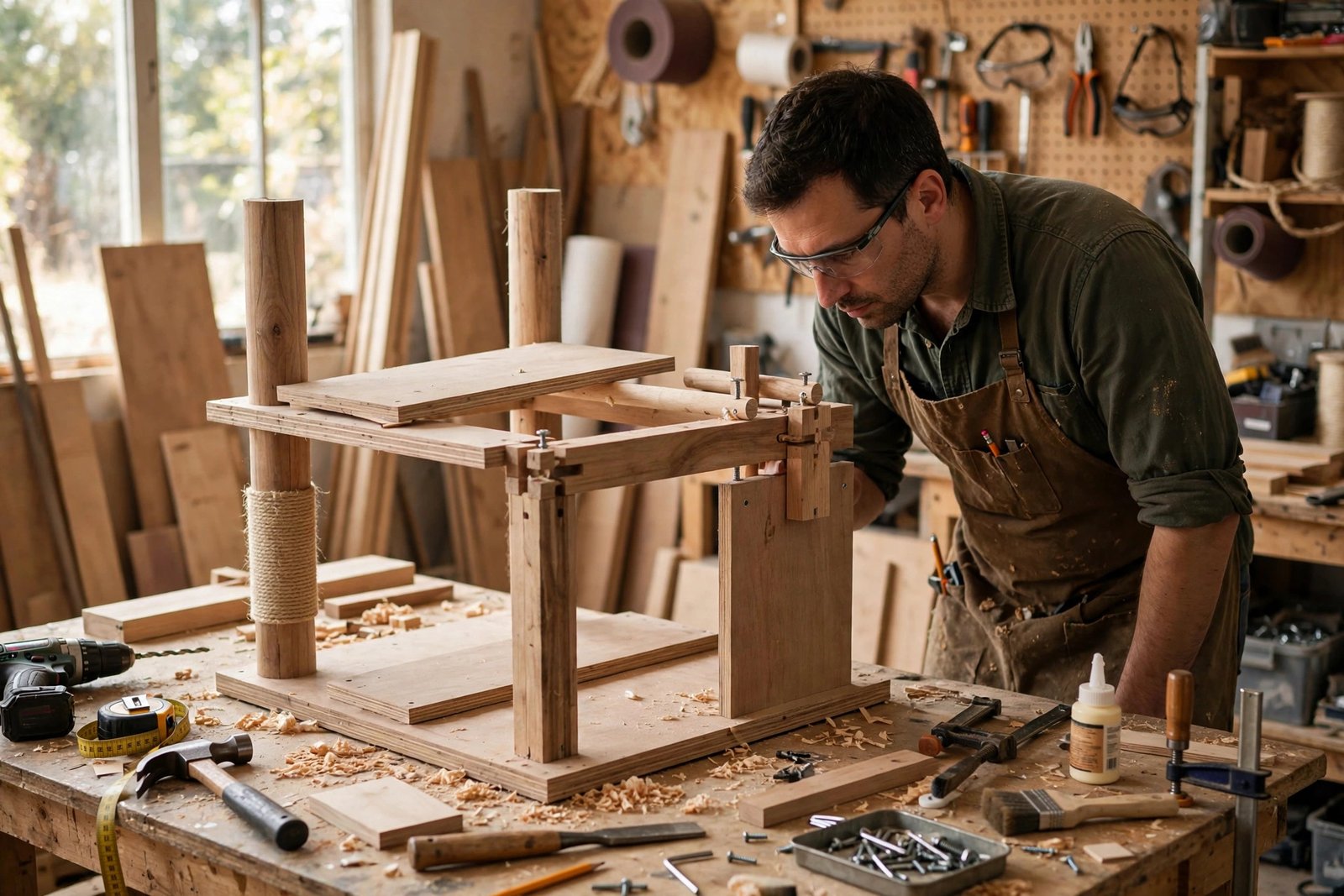
The first prototype iteration is usually a white model: uncoated, built from ordinary shop stock, joinery simplified where it does not affect the question. Its only job is to prove geometry — proportions, clearances, whether a cat can turn around inside the condo.
It answers what a drawing cannot: perch height a cat bothers to climb, a condo opening a person can reach into. The classic mistake is judging it like a finished product — it will look rough, and that roughness is the point.
The First Article: Your Design in Real Wood
The first article is the first piece built as production would build it: the specified species, real mortise-and-tenon joinery, actual hardware in true positions. If the white model asked whether the shape works, the first article asks whether the engineering works.
Inspection runs a fixed list. Dimensions are measured, not eyeballed. Joinery: a hairline glue line is honest; a gap that takes paper goes back to the bench. Hole patterns are checked with a template before glue-up — a slightly-off insert means the column leans, visible only after wrapping. Stability goes on our tilt jig, because a tree that stands still is not one that survives a cat launching off the top perch.
Prototype Iteration Three: The Finished Sample
Only after engineering is proven does the sample get its finish: specified coating, color matched across boards, accessories fitted. End grain drinks stain deeper than face grain, so a rail end reads darker than its panel; two boards from one batch never finish identically.
Tooling adjustments live here too: a new bending jig for a curved perch took a full shop cycle to build and prove. Our guia de certificação de acabamento não tóxico explains what this sample’s coating is certified to do.
Three Rework Points Behind Most Revision Rounds
Mortise-and-tenon tolerance. Drawings specify the joint, rarely the fit. A tenon cut dead flush swells with glue and splits the mortise cheek; we cut tenons a fraction proud and pare to fit. The first article shows whether the call was right.
Coating color across boards. The most avoidable revision round: the buyer compares the sample to a screen photo, declares it “wrong,” and a round burns for nothing. Approve color against a physical wood swatch, not a JPEG.
Hardware hole positions. A misaligned insert is invisible until the column is wrapped and mounted — then the post leans and the fix is a new part. Freeze hardware before the first article.
Lead Time for Samples: Where the Calendar Really Goes
Most of the lead time for samples is not bench time. It is drawing and DFM review, material acclimatization, coating cure days, and the queue between stations. Cutting and assembly are the shortest part — and the rounds buyers ask to delete are the ones that catch problems.
The honest sequence: DFM review first — on paper a question costs nothing, in wood it costs a round. Then stock prep, white model, your geometry review, first article, your engineering review, finished sample, cure, pack. Your reviews are stations too: one consolidated comment set per round is the fastest thing a buyer can do.
Sample Approval: What Your Sign-Off Freezes
Sample approval signs two things: the drawing at its final revision and the physical reference sample. Your approved cat furniture sampling process prototype becomes the QC standard for every production piece.
Frozen: dimensions, joinery, species, hardware, finish. Not frozen: natural board-to-board color variation or the small seasonal movement of solid wood — an honest factory says this upfront. After approval, changes go through an engineering change order with a new prototype iteration. No quiet tweaks on the line. For branding on the same flow, see our private-label playbook.
A Buyer’s Checklist: Keeping Sampling to Two Rounds
Two clean rounds are achievable for buyers with five habits:
- Send dimensioned drawings, not just inspiration photos. Photos are wishes; a dimensioned three-view drawing is instructions.
- Lock species and finish before the first article. A change restarts sampling at the white model.
- Answer DFM questions in one consolidated reply. Every unanswered mark is a future round trip.
- Review on video when you can. A photo hides wobble; glare hides color.
- Judge the white model on geometry, not beauty. Approving looks in round one moves the geometry argument to round three, where it costs more.
Nossos custom OEM process page shows where sampling sits in the full flow.
Start sampling with your drawings — we return a DFM review before a single board is cut. For general questions, our página de contato.
Da nossa fábrica: Watch how a cat tree moves from design drawings through prototype rounds to a finished sample in our workshop.
FAQ
What does a cat furniture sampling process prototype include?
Three stages: a white model for geometry, a first article in the specified species for engineering, a finished sample for surfaces and color. Each answers questions the previous one cannot.
How many prototype iterations are usually needed?
Two to three. Simple designs converge in two; compound curves, new tooling, or late changes add rounds. The count follows the number of open DFM questions.
What should I send the factory besides inspiration photos?
A dimensioned three-view drawing at minimum, plus species, finish, and hardware requirements upfront. CAD speeds everything up; a 3D rendering helps when curves are involved.
Why does my second sample sometimes look different from the first?
Because round one found something — a tolerance that did not seat, a color shift, a moved hole pattern. A second sample identical to a flawed first would mean nobody looked.
What delays sampling the most?
Not bench time: scattered feedback, unanswered DFM questions, species or finish changes mid-process. One consolidated comment set per round is the fastest thing a buyer can do.
Does sample approval freeze the design forever?
It freezes the signed drawing revision. Later changes go through an engineering change order with a new prototype iteration — production never runs on a verbal tweak.
Suporte OEM/ODM
Precisa de um plano de produção personalizado de árvore para gatos?
Envie fotos de referência, dimensões alvo, preferências de material, necessidades de embalagem e direção de mercado. Podemos revisar a viabilidade, amostragem, MOQ e embalagem de exportação antes da produção. Solicitar Cotação OEMLinhas de Produtos Relacionadas
Explore móveis de madeira para gatos que podemos fabricar.
Guias do Comprador Relacionados