
Two cats sharing one condo entrance is where most multi-cat furniture quietly fails. One cat claims the interior, the second gets ambushed at the only door, and the buyer ends up with a returned product and a review that says “cats won’t use it.” The fix is rarely a bigger box — it’s the layout: how many openings the condo has, where they face, and what a cat can do when another cat is already inside.
Why a Solid Wood Cat Condo Works Differently in a Multi-Cat Home
A solid wood cat condo serves multi-cat households better than carpeted board designs because the layout can separate territory instead of forcing cats to share it: twin entrances prevent cornering, offset platforms break sightlines, and the mass of solid panels keeps the structure still when two cats land at once.
Single-cat thinking produces a single box with a single hole. Multi-cat reality needs zones — a sleeping cavity, an observation perch, an escape route — arranged so no cat has to pass within striking distance of another to use them. Solid sections make those zones possible: panels thick enough to carry a second entrance without flexing, and interiors that stay dark and enclosed rather than sagging open over time.
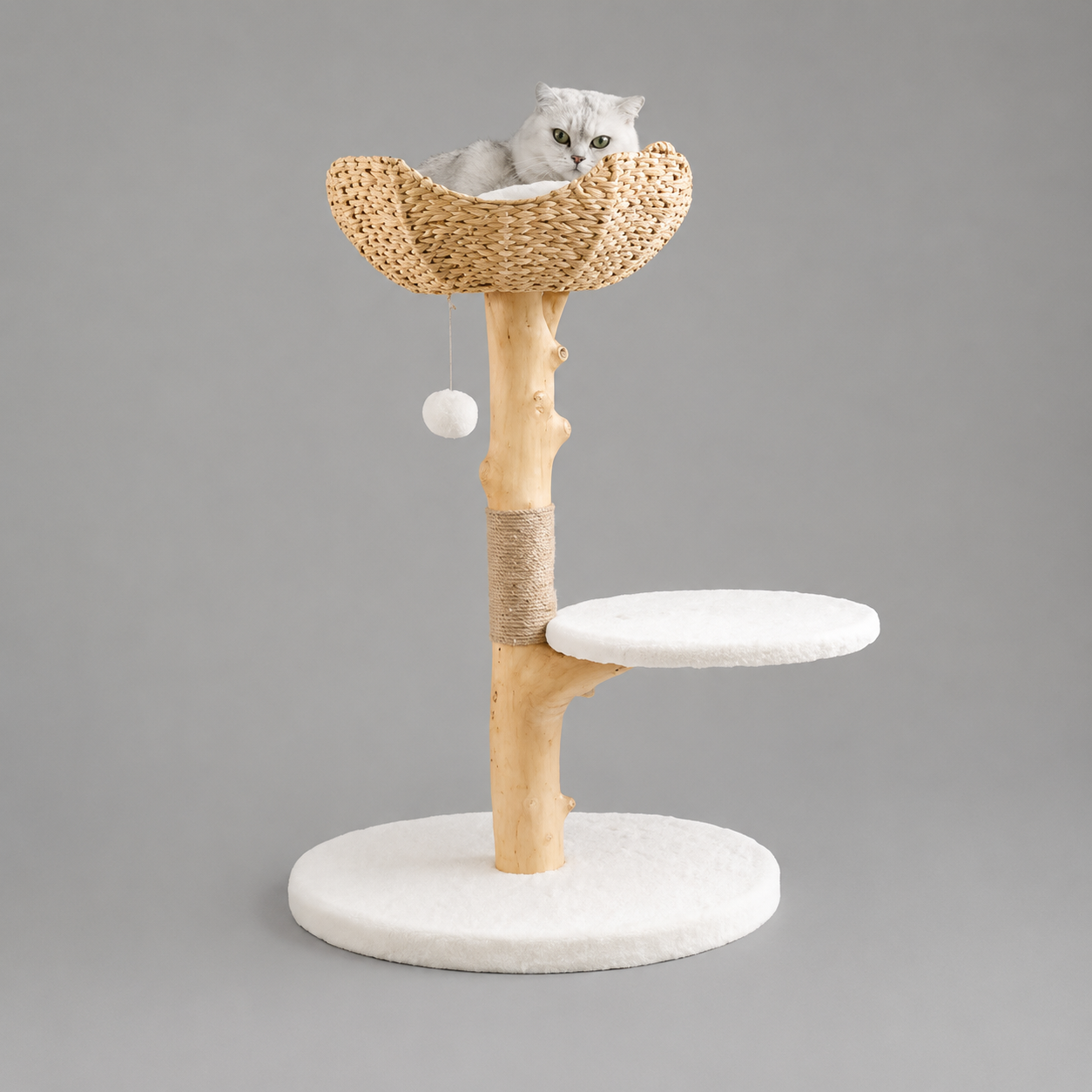
Four Solid Wood Cat Condo Layouts That Reduce Conflict
Four layouts cover most multi-cat assortments: twin-entry ground condos, staggered double condos at different heights, L-shaped wrap condos, and condo-plus-refuge designs pairing an enclosed box with an open hammock level. Each solves a different household pattern, so stocking two beats stocking one larger model.
| Layout | How It Separates Cats | Ideal Para |
|---|---|---|
| Twin-entry ground condo | Two openings on different faces; no cornering | Timid cats, senior cats |
| Staggered double condo | Two cavities at different heights, offset entries | Households with a clear hierarchy |
| L-shaped wrap condo | Bent interior breaks the sightline inside one cavity | Pairs that tolerate proximity but not eye contact |
| Condo + open refuge | Enclosed box below, open perch above | Cats that alternate hiding and watching |
On our line, the layout decision happens at prototype iteration, not at the drawing stage: our in-house design team builds each candidate layout, then checks whether a cat can exit every cavity without crossing the other cavity’s entrance zone. Layouts that fail that walk-through get redrawn before any production run is quoted — a second entrance cut in the wrong wall is worse than none, because it turns the condo into a through-route neither cat will sleep in.
Entry Points, Sightlines, and Escape Routes
Entry geometry decides whether a condo gets used: entries on two different faces, roughly 15–18 cm across, with at least one opening that doesn’t face the room’s main traffic. A cat that can watch the door from inside, and leave without being seen, will actually rest there.
Sightlines matter as much as openings. A straight interior lets one cat stare down the other from the back wall; an offset entry or internal step interrupts that line. Height placement matters too — a ground-level condo reads as refuge, an elevated one as territory, and multi-cat assortments usually need one of each. The ASPCA’s cat care guidance makes the same point from the owner side: cats manage hierarchy through space and retreat options, not through sharing. For how condos combine with scratching functions, see our cat tree condo and scratcher guide.
What Solid Wood Changes: Stability, Hygiene, and Repair
Solid wood changes three things buyers feel in year two: the condo doesn’t rock when a second cat lands on the roof, the interior can be wiped clean instead of trapping odor in carpet, and scratched or chewed panels can be sanded and refinished rather than replaced.
Carpeted particleboard condos hide wear until they can’t — the board swells at the base, carpet holds smell permanently, and a wobbling cavity stops feeling safe to a cautious cat. Solid panels kiln-dried to 8–12% moisture content hold their geometry, and a water-based coating rated E0/E1 under Documentação EPA TSCA Título VI expectations keeps the sleeping cavity low-emission. Our guia de acabamento de madeira seguro para animais de estimação details how we evaluate coating systems.
The honest limitation: solid wood is heavier, and a chunk of that weight sits in the condo. Carton dimension and freight class move with it, so a layout that’s perfect for the cat can be wrong for a container plan. Every multi-cat design we ship gets its carton validated for LCL and FCL loading before the assortment is finalized — layout and logistics get decided together, not sequentially.
Construction Details That Decide Whether the Layout Survives
Layout only works if construction holds it: full-thickness panels joined with through-bolts, entries round-overed on a jig fixture so every unit’s opening is identical, and CNC machining that keeps platform heights consistent enough for cats to learn the route.
Multi-cat use doubles the dynamic load on the condo roof — it’s a landing pad, not a lid. We machine entry edges on the same jig fixture across a production run so the round-over radius never varies, and IPQC checks entry geometry and joint torque before packing. Panel movement is the slow failure: wood dried below 8% can crack, above 12% can twist, and either one misaligns the entries the layout depends on. AQL sampling at pre-shipment inspection includes a two-cat static load check on the condo roof — the structure has to hold the argument the cats are going to have on it.
How Solid Pet Wood Builds Multi-Cat Condos
Our in-house design team develops each multi-cat condo from a layout brief — how many cats, what hierarchy, which rooms — then iterates prototypes until the escape-route check passes. Production holds the design honest: kiln-dried solid panels, CNC-machined entries, through-bolt joinery, and water-based finishes cured fully before packing.
Private label and white label programs adapt dimensions, finishes, and scratch-post placement while validated layouts stay constant. Browse our árvores de gato de madeira maciça e wooden cat houses for the current range, or send your household profile through our solicita uma cotação page for a layout review.
Da nossa fábrica: Watch how we machine condo entry openings and verify escape routes on the production line.

FAQ
How many condos does a three-cat household actually need?
Two separate resting cavities minimum — cats rotate rather than assign permanent ownership, so the count follows cavities, not cats. A staggered double condo covers most three-cat homes; add an open refuge level if one cat prefers watching to hiding.
Why do cats abandon condos with a single entrance?
Because a single entrance can be guarded. A cat resting inside has one exit, and a cat outside can block it — cautious cats learn this once and stop using the box. Twin entries on different faces remove the ambush point entirely.
Is solid wood harder to keep clean than carpeted condos?
The opposite. A sealed solid-wood interior wipes clean and doesn’t retain odor; carpet traps dander and smell permanently and can’t be washed without damaging the board underneath. Finish condition is checked at IPQC so the coating that makes wiping possible survives shipping.
Can condo dimensions be adapted for larger breeds?
Yes — entry diameter, interior height, and platform depth all scale during prototype iteration, provided the base footprint grows with them. Larger cavities need proportionally wider bases to keep the tip-over geometry inside ASTM F2057 logic.
What layout mistakes should buyers watch for in samples?
Entries facing each other across a shared platform, interiors with a direct sightline from door to back wall, and condo roofs too thin to serve as perches. All three show up in showroom samples and all three predict returns.
Solid wood cat condo layouts are where our OEM/ODM work earns its keep: one lumber stream, one finishing line, and layouts validated for how cats actually share space. Explore the solid wood cat condo range and send your assortment plan for an engineering review.
Suporte OEM/ODM
Precisa de um plano de produção personalizado de árvore para gatos?
Envie fotos de referência, dimensões alvo, preferências de material, necessidades de embalagem e direção de mercado. Podemos revisar a viabilidade, amostragem, MOQ e embalagem de exportação antes da produção. Solicitar Cotação OEMLinhas de Produtos Relacionadas
Explore móveis de madeira para gatos que podemos fabricar.
Guias do Comprador Relacionados