
The question we get most often from buyers building a cat furniture product line: should we go with wall mounted or freestanding cat trees? It usually gets framed as either/or. It shouldn’t be.
Wall mounted vs freestanding cat tree isn’t a replacement decision — it’s a market-fit decision. The two products serve different end-buyer profiles, ship differently, and carry different retail margins. If you’re sourcing for a wholesale program, understanding when each one wins tells you how to build your product mix, not which one to drop.
We manufacture both categories under solidpetwood.com, and this page walks through the trade-offs we discuss with buyers before they finalize a purchase order.
The Quick Comparison
For buyers who need the structural and commercial differences on one screen:
| Dimension | Wall Mounted | Freestanding |
|---|---|---|
| Target end-user scenario | Urban apartments, modern décor buyers | Suburban homes, multi-cat households, large-breed owners |
| Weight capacity ceiling | Limited by wall stud strength | No structural ceiling (base + post determines it) |
| Large-breed suitability | Requires reinforced anchor spec | Easier to build for 8kg+ cats |
| End-user install effort | Requires drilling into studs | Assembly only, or ready-to-place |
| Common return drivers | Install failures, wall damage complaints | Wobble, tipping under load |
| Retail price band | High (modular add-on sales) | Mid to high (single-unit purchase) |
| Flat-pack carton volume | Small (panels + hardware) | Large (posts + platforms + base) |
| CBM efficiency on ocean freight | High | Lower |
| Rental market accessibility | Low (can’t drill) | High |
Neither category is “better.” They win in different markets.
When Wall Mounted Cat Trees Win
Wall mounted systems perform strongest in three market conditions:
1. Dense urban markets with small floor plans. Tokyo, New York, London, Berlin, Shanghai — apartments in these markets often can’t accommodate a 60×60cm base. Wall mounted shelves and modular climbing systems free up floor space entirely. If your target retail channel is urban lifestyle stores or online sellers targeting metropolitan zip codes, wall mounted is usually the higher-velocity SKU.
2. Modern and minimalist buyer profiles. Wall mounted systems photograph well in styled interiors, which drives Instagram-era buying behavior. Buyers in this segment pay premium for aesthetic integration — a natural pine wall shelf that looks like an intentional design element sells at a higher margin than a functional freestanding tower.
3. Modular upsell strategy. A wall mounted line can be sold as a starter kit (3 shelves) with expansion modules (additional shelves, bridges, hammocks). This lifts AOV significantly versus one-and-done freestanding purchases. Our wall cat furniture line is built for exactly this expansion model.
Where wall mounted struggles: rental markets, older housing where wall structures can’t reliably hold anchors, and consumer segments who don’t want to commit to holes in the wall.
When Freestanding Cat Trees Win
Freestanding remains the default product for most global markets, and there are structural reasons why:
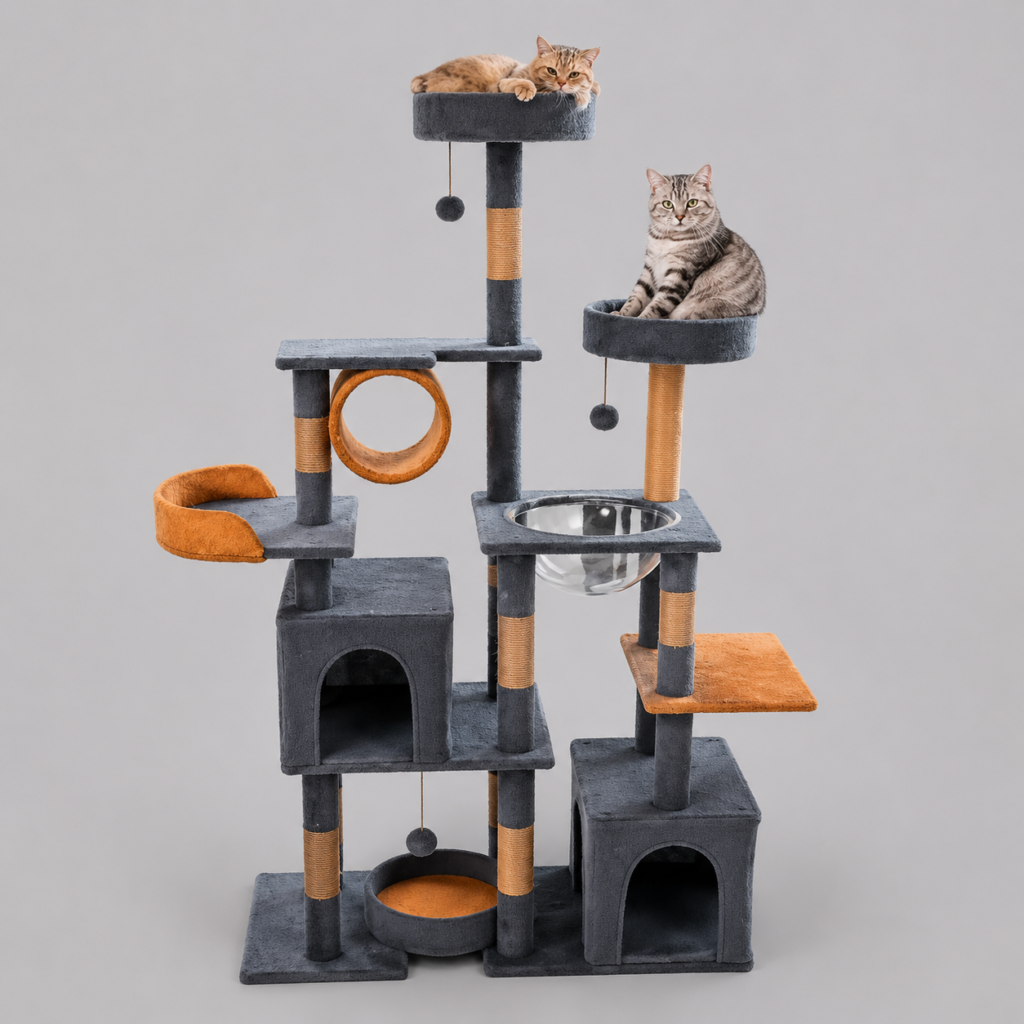
1. No wall dependency. The end user unboxes, assembles, and places. No drilling, no stud finder, no landlord conversation. For wholesale buyers targeting broad-market retail — pet chains, big-box, Amazon — this removes the single largest install friction point.
2. Large-breed and multi-cat households. For a 9kg Maine Coon or a household with three cats climbing simultaneously, freestanding gives you structural capacity that wall mounts can’t match without industrial-grade anchor systems. If your product line targets premium or large-breed segments, a freestanding hero SKU is non-negotiable. Our large-cat wholesale range is covered here.
3. One-purchase completeness. Consumers don’t want to buy hardware separately or plan an install project. Freestanding is a single SKU that solves the problem. This drives higher conversion on first-time cat furniture buyers.
Where freestanding struggles: urban small-format apartments, buyers with strict aesthetic requirements, and shipping cost sensitivity on final-mile delivery.
The B2B Question: How to Configure Your Product Mix
The real decision for wholesale buyers isn’t wall mounted vs freestanding cat tree — it’s what ratio to carry in your product line. A few things we’ve seen work across different buyer channels:
Amazon / marketplace sellers. Freestanding usually leads volume; wall mounted lifts margin. A common configuration is 3–4 freestanding SKUs at various price points with 1–2 wall mounted systems positioned as premium upsells.
Independent brand DTC. Wall mounted often becomes the brand hero if the visual identity is urban/modern. Freestanding fills out the range for buyers who need a bigger footprint solution. Ratio can invert entirely from marketplace norms here.
Pet retail chains. Freestanding dominates because in-store demonstration is easier and buyers can carry it home the same day. Wall mounted is often carried as a special-order or online-exclusive SKU.
European specialty retail. Wall mounted has a stronger position here than in North America — smaller average living spaces and higher acceptance of design-forward pet products.
We supply both categories under one OEM relationship, which matters when you’re managing a mixed product line. Consolidating with one solid wood manufacturer means one certification package, one QC process, one shipping consolidation, and one point of contact. Our OEM/ODM process is documented here.
How We Build Each Category
Both product lines are FSC-certified solid wood with CARB Phase 2 compliant finishes across the board. Where they diverge is structural.
Wall mounted systems — Our wall shelves are built from natural pine or birch, mounted with concealed steel brackets and heavy-duty wall anchors rated for stud installation. Individual shelf load rating is 15kg with a 2× safety margin. Modular design lets buyers offer 3-piece starter sets and expansion packs as separate SKUs, which is how most of our brand-partner buyers structure their retail assortment.
Freestanding cat trees — Multi-level towers built on solid wood post-and-platform construction, bolt-through joinery, and weighted bases sized to prevent tipping under dynamic load. Full sisal wrap on posts, staple-tested for scratching wear. Large-breed configurations get 40×40cm platforms minimum and 60×60cm bases, with load-tested documentation on request.
For buyers who want to see the material and certification standards in detail, our materials and certifications page covers both product categories. For custom design options across the cat tree range, the same OEM flexibility applies to wall mounted formats.
One Honest Limitation
Wall mounted systems have a market ceiling we can’t engineer around: end users who can’t or won’t drill into walls. That excludes a meaningful share of the rental market, older housing stock, and buyers with damage-deposit concerns. If your target retail geography skews heavily to renter demographics, wall mounted volumes will underperform freestanding on the same marketing spend.
Freestanding has its own ceiling in the other direction — buyers in small urban apartments will look at a 60×60cm base and pass. There’s no design fix for this. It’s why serious cat furniture brands carry both categories.
For buyers evaluating whether to add wall mounted alongside an existing freestanding line, we usually recommend starting with a small modular set to test market response before committing to deeper stock. Our approach to MOQ for wholesale programs is covered here.
Next Steps
If you’re deciding how to split your cat furniture product line between wall mounted and freestanding — or adding one category to complement the other — the useful conversation isn’t about product specs in isolation. It’s about your target market, retail channel, and volume projections.
Send us a brief with those variables and we’ll come back with a product mix recommendation and quote.
External references:
[1] American Pet Products Association (APPA) — 2025–2026 National Pet Owners Survey: https://www.americanpetproducts.org/research/industry-statistics/
[2] Grand View Research — Pet Furniture Market Analysis: https://www.grandviewresearch.com/industry-analysis/pet-furniture-market
OEM/ODM Support
Need a custom cat tree production plan?
Send reference photos, target dimensions, material preferences, packaging needs, and market direction. We can review feasibility, sampling, MOQ, and export packaging before production. Request OEM QuoteRelated Product Lines
Explore wooden cat furniture we can manufacture.
Related Buyer Guides