
Walk a pet trade show floor this year and the visual shift is obvious: beige carpeted towers that dominated aisles for a decade give way to oak-finish columns, wall-mounted perches, and furniture that looks designed, not assembled. Cat furniture market trends are moving the category from “pet supply” toward “home furniture that happens to be for cats” — and retailers are restocking to match. This article maps trends from buyer briefs — no spreadsheets pretending to predict the market.
What Cat Furniture Market Trends Are Retailers Actually Stocking?
Retailers’ cat furniture market trends point in one direction: furniture-grade design. Solid wood construction, minimalist silhouettes, wall-mounted systems, and verifiable eco credentials dominate new product briefs. Buyers want assortments that blend with modern interiors — and original designs, not copies of last year’s bestsellers.
The shift changes what the factory must be good at: a carpeted tower is a commodity; a solid-wood wall-mounted system is a design and engineering product. Retailers moving upmarket need factories with in-house design capability, not capacity alone.
| Aspect | Carpeted Commodity Tower | Furniture-Grade Solid Wood |
|---|---|---|
| Visible material | Carpet and fabric wrap | Solid wood grain as decoration |
| Joinery | Hidden staples, screws | Visible mortise-and-tenon, dowels |
| Finish | Fabric covering | Water-based coating, grain visible |
| Design input | Copied catalog shapes | Original in-house design |
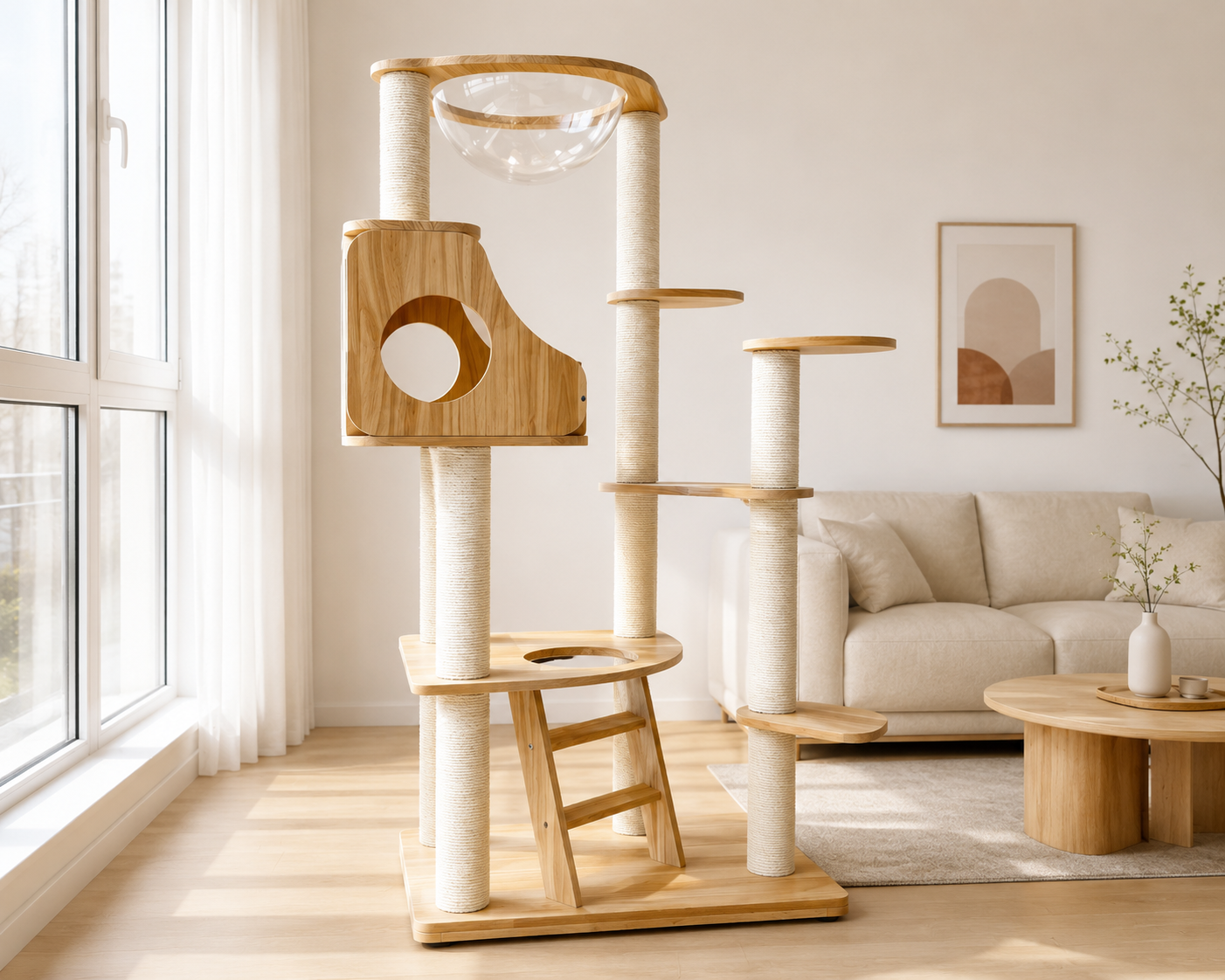
Solid Wood Takes the Spotlight: the Craftsmanship Signal
The clearest trend is the move to solid wood as the visible, structural material. Buyers specify oak, beech, and walnut — not for fashion, but because solid wood photographs well, survives showroom handling, and signals quality against home furnishings. The grain itself becomes the decoration; poor workmanship has nowhere to hide.
For factories, the bar rises: kiln-dried stock at 8–12% moisture, clean joinery, finishes that protect without masking the grain. Water-based coatings dominate new briefs — they keep the wood’s natural tone and meet low-odor expectations for indoor pet products.
| Species | Tone | Character | Finish Note |
|---|---|---|---|
| Oak | Warm honey to light brown | Open grain, hard-wearing | Matte water-based shows the grain |
| Beech | Pale cream to pink-brown | Fine, even grain | Stains evenly; clean minimalist look |
| Walnut | Chocolate brown | Rich figure | Premium signal; protect from UV |
| Rubberwood | Pale straw | Stable, uniform | Workhorse for painted or natural finish |
| Pine | Light yellow | Soft, knotty | Budget-friendly; seal knots first |
Before asking about species and sourcing, read our solid wood vs MDF pet furniture comparison and 5 wood species for premium pet furniture.
Minimalist Design: a Cat Furniture Market Trend Reshaping Silhouettes
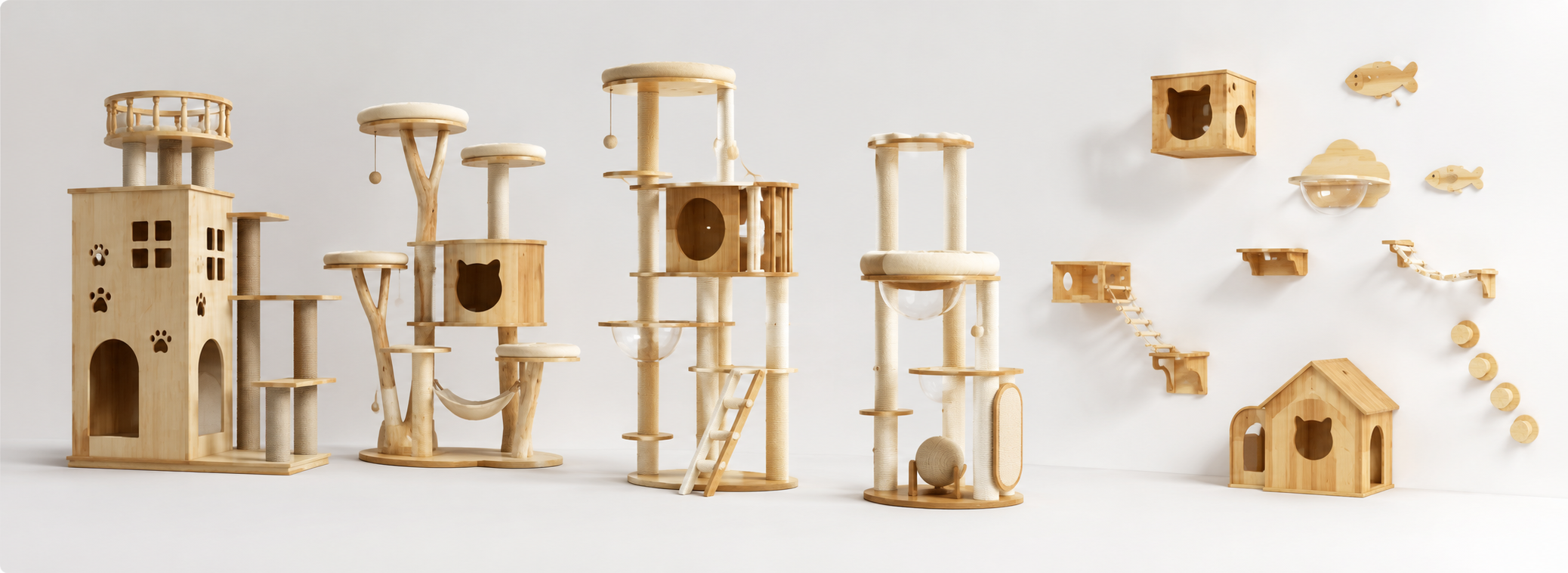
The second visible trend: form follows the living room. Bulky carpeted towers lose shelf space to slim tension-pole trees, single-column posts with clean bases, and low-profile loungers that read as side tables. The design language borrows from Scandinavian furniture: light wood tones, visible joinery, negative space.
Good news for engineering factories, bad news for copy shops. Minimalist pieces expose every joint and every finish flaw, so the manufacturing story becomes the selling story: precise CNC machining, tight tolerances, hardware that disappears into the design. Our floor-to-ceiling cat tree line shows how a tension-pole structure achieves height without visual bulk. Retailers increasingly brief “furniture first, cat second” — how the category’s best-performing new SKUs are positioned.
Wall-Mounted Systems Move From Niche to Mainstream
Wall-mounted cat furniture — shelves, perches, bridges that turn a wall into a climbing landscape — has crossed from enthusiast niche into mainstream assortments. The appeal is practical: vertical space in small apartments, clear floors, and expandable systems instead of single pieces. This isn’t trend-chasing — it’s the direct math of repeat purchase: a customer who buys two shelves this month comes back for the bridge next month.
From the factory side, wall-mounted systems are an engineering product. In our workshop, a wall-mounted shelf goes through repeated prototype rounds before tooling — bracket strength, inter-piece fit, anchor pull-out — because load ratings, anchor hardware, and modular compatibility are designed in, not bolted on.
| Engineering Element | What to Specify |
|---|---|
| Load rating | Design for 3–4× the animal’s weight |
| Wall anchors | Matched to wall type: stud, drywall toggle, concrete sleeve |
| Modular compatibility | Shared bracket geometry across shelves, perches, bridges |
| Hardware | Concealed, rated fasteners — no visible brackets |
Our modular cat wall shelves went through repeated prototype rounds with the in-house design team. Ask factories for load-test data and anchor specifications; a shelf that looks sturdy and a shelf that is engineered sturdy are different products.
Eco Materials: FSC Certification and Finishes as Shelf Signals
Sustainability claims are moving from marketing copy to verifiable credentials: FSC-certified wood and low-emission finishes — no longer a premium upsell, but table stakes. The FSC certification system provides the chain-of-custody verification behind credible shelf claims, and buyers have learned to ask for the certificate number, not just the logo.
The formaldehyde conversation has matured: buyers who once accepted vague “non-toxic” claims now ask about E0/E1 grades and EPA TSCA Title VI compliance for composite components — because their customers ask them. Factories that build structural parts from solid wood sidestep the entire question, which is why the solid-wood and eco-material trends reinforce each other. Our FSC-certified wood buyer’s guide explains what certification verifies.
Reading the Trend Line Honestly: What We Won’t Claim
A note on method: no market-size figures or growth forecasts — the honest basis is what we observe: buyer briefs, trade-show floors, prototype requests, designs retailers commit to. Those signals are real and actionable. Projected percentages are not; sourcing decisions should rest on observable demand, not forecasts.
Second caveat: trends are not uniform — minimalist solid wood dominates urban and premium retail, while value channels move volume in traditional styles. Stock to your own customer base, not to a trend article. The useful question is not “what is trending” but “which trend direction matches my shelf and my customer” — then find a factory that matches.
From our factory: From our factory: a quick look at how our solid wood cat furniture is made.
How Solid Pet Wood Turns Market Trends Into Products
Trends only matter if a factory can convert them into shippable products. Our in-house design team works from trend briefs as an OEM/ODM partner should: original silhouettes, prototypes, structure testing, buyer feedback — then tooling. Recent iterations focused on wall-mounted modularity and visible mortise-and-tenon joinery.
A cheap factory copies last year’s bestseller. A specialized manufacturer prototypes next year’s. For private label buyers, that’s the practical edge: a factory that only executes drawings builds what you design; one with original design capability proposes what you haven’t imagined, then engineers it for flat-pack shipping. Refreshing your assortment? Request a quote with your trend direction — original design starts with a trend brief.
FAQ
What are the main cat furniture market trends?
Solid wood construction, minimalist furniture-grade silhouettes, wall-mounted modular systems, and verifiable eco credentials (FSC, low-emission finishes). Retailers select assortments that blend with modern interiors.
Why is solid wood trending in cat furniture?
Solid wood photographs well, survives showroom handling, signals quality against home furnishings. It sidesteps formaldehyde concerns around composite panels and lets craftsmanship — visible joinery, clean finishes — become the selling story.
Are wall-mounted cat furniture systems becoming mainstream?
Yes — wall-mounted shelves, perches, and bridges have moved from enthusiast niche to mainstream assortments. They suit small apartments and let retailers sell expandable systems. Ask factories for load-test data and anchor specifications.
What eco credentials do retailers ask for?
FSC-certified wood with verifiable chain of custody, E0/E1 formaldehyde grades, and EPA TSCA Title VI compliance for composite components. Buyers now ask for certificate numbers, not logos or vague “non-toxic” claims.
How should retailers use trend information for sourcing?
Stock to your own customer base, not to a trend article. Match trend direction to your shelf and customer, then find a factory whose capabilities match. Observable buyer behavior beats forecasts.
Can a factory develop original designs around these trends?
Yes — a factory with an in-house design team converts trend briefs into original prototypes, tests structures, and iterates with buyer feedback before tooling. That OEM/ODM capability separates trend-following from trend-leading assortments.
OEM/ODM Support
Need a custom cat tree production plan?
Send reference photos, target dimensions, material preferences, packaging needs, and market direction. We can review feasibility, sampling, MOQ, and export packaging before production. Request OEM QuoteRelated Product Lines
Explore wooden cat furniture we can manufacture.
Related Buyer Guides