
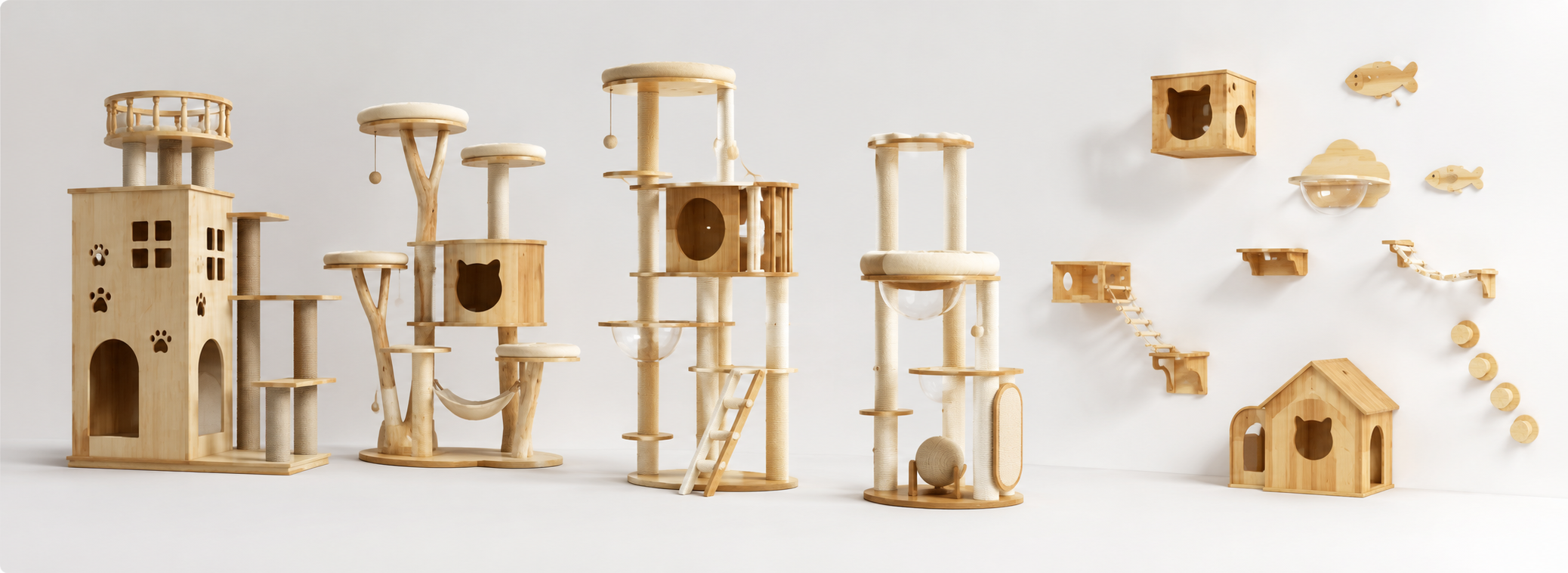
A buyer once asked for “a cat tree, but as a collection” — pieces designed together, shipped together, sold together. That’s the discipline of cat furniture sets: shared hardware, dimensions, and packaging logic, judged as one product.
Cat Furniture Sets Bundles: Why Coordination Sells
Cat furniture sets and bundles sell because they solve the customer’s hardest problem: making separate pieces look intentional together. A coordinated collection — matching hardware, consistent finish, modular dimensions — raises average order value while reducing the retailer’s styling risk.
The retail logic is straightforward: a customer buying one cat tree worries whether it matches their home; a coordinated set answers that worry. For the factory, though, a set is a systems problem — every shared component multiplies across pieces, so a hardware choice for one piece constrains all of them.
Unified Hardware: The Invisible Backbone of a Set
A furniture set lives or dies on hardware consistency: the same connector specification, the same screw sizes, the same hinge model across every piece. Unified hardware means one spare-parts kit serves the whole set, one assembly tool works everywhere, and a customer who loses a bolt finds its match in any hardware bag.
| Hardware Strategy | Tooling & Spares | Customer Experience | Our Call |
|---|---|---|---|
| Standardize up (heavier connector everywhere) | One system: one tooling set, one spares kit | One tool, one assembly logic | Default |
| Two hardware systems | Doubled tooling and spares | Assembly confusion | Avoid |
| Lightest connector everywhere | One system | Tower joints under-engineered | Never |
When our design team developed a three-piece collection, the tower needed a heavier connector than the side table — so we standardized up, putting the heavier connector in all three pieces. It added a little steel to the smallest piece and eliminated a second hardware system. That is the real trade-off in set development: a small over-engineering on the lightest piece buys simplicity across the whole collection.
Modular Assembly: Pieces That Combine and Stand Alone
Modular design means each piece works alone and combines with the others: shared platform heights so a bridge spans two towers, common footprint grids so pieces sit flush, connector points that stay hidden when pieces stand solo.
The discipline is dimensional, and drawings don’t catch all of it. During prototype iteration we build the full set together on the shop floor — on one collection, a bridge that reached between two towers on the drawing missed by a few millimeters in wood, because tolerances had stacked across three pieces. The correction went into the family jig fixtures, cut from the same reference — not just the drawing. Once shared dimensions are programmed into CNC machining, every piece in every run holds them.
Cat Furniture Sets Bundles: Packaging the Collection as One Shipment
Packaging cat furniture sets and bundles as one shipment means designing the carton around the collection, not the pieces: nested components, shared void fill, and a single carton dimension that keeps the bundle shippable. One box, one label, one damage claim surface — that simplicity is worth real money in retail operations.
| Packaging Decision | Constraint It Creates | Design Feedback |
|---|---|---|
| One carton for the set | The longest member sets the carton dimension | Overlong members get redesigned, not excepted |
| Nested components | Pieces must not damage each other in transit | Corner protection where pieces meet |
| Single consolidated hardware kit | All pieces share one connector spec | Reinforces the unified-hardware decision |
Packaging starts with a nesting study: platforms stack, posts bundle, hardware consolidates into one labeled kit. We validate the bundle carton against ISTA 3A procedures with the actual combination inside — a multi-piece carton has internal movement that single-product boxes don’t, and the test must prove the pieces don’t damage each other. Corner protection goes where pieces meet, not just where the carton meets the world.
Color and Finish Consistency Across the Set
A set is judged as one object, so finish consistency across pieces is non-negotiable: three pieces cut on different days from different boards drift in tone even with the same finish formula — we’ve seen it on the rack. Our answer is batch discipline: boards sequenced from the same lumber batch, one production run, one finish schedule for every piece.
Pre-shipment inspection adds a side-by-side comparison under neutral light — the pieces checked as a customer would see them. Any panel components stay within EPA TSCA Title VI expectations; sample panels from each production run are compared under the same light, because a set that matches on paper but not in the living room is a return.
QC for Sets: Checking the Collection, Not Just the Pieces
Set QC inspects the collection as a system on top of the per-piece checks:
| QC Layer | What It Checks | Method |
|---|---|---|
| Per-piece standard | Dimensions, finish, joints | IPQC + AQL pre-shipment inspection |
| Set-level fit check | Sampled pieces actually joined | Full set assembled from sampled parts |
| Set-level finish check | Tone consistency across pieces | Side-by-side under neutral light |
| Set-level documentation | Instructions cover combined configurations | Manual review before packing |
IPQC verifies shared dimensions against the family jig fixtures during the run, and a full set is assembled from sampled pieces to confirm every interface still fits — bridges reach, platforms align, combined arrangements stand stable. Hardware kits are counted per set, not per piece: a bundle missing one bolt bag is a whole-set return.
Limitations: Where Bundling Adds Complexity
Bundling adds three honest complexities: the combined carton is heavier and bulkier, and may cross into oversize parcel tiers; one weak piece drags the whole set — a wobbly side table generates returns for all three — so set QC holds every piece to the highest standard; and design lock-in, where a change to one piece ripples across the collection through a formal ECO process.
A cheap factory bundles after the fact: three separate products in one carton. A specialized manufacturer designs the bundle first — shared hardware, modular dimensions, one carton.
How Solid Pet Wood Develops Cat Furniture Sets
Our in-house design team develops each collection as one engineering project: a shared hardware library, modular dimensions proven in prototype iteration, packaging designed around the collection through nesting studies, and finish consistency held by batch discipline. Set QC checks the collection as a system: fit checks on sampled assemblies, side-by-side finish comparison, hardware counted per set.
This is the direct math of multiplication: one disciplined decision at the design table compounds through tooling, spares, packing, and assembly. We make those decisions once, up front.
From our factory: Watch how our team develops coordinated cat furniture collections, from shared hardware and modular dimensions to set-level QC.
FAQ
How many pieces make an effective retail set?
Two to four: a pair reads deliberate, three to four build display presence. Beyond four, carton math and assembly patience both break down. We prototype the full set together regardless — interfaces are where sets fail.
Can existing single pieces be bundled into a set later?
Only if they share hardware and dimensions — retrofitting unrelated pieces fails on connectors and finish matching. Design the set as a set.
Do sets need different packaging testing than single pieces?
Yes — a multi-piece carton has internal movement single-product boxes don’t, so we validate bundle cartons against ISTA 3A with the actual combination inside. The test must prove the pieces don’t damage each other.
How do you keep finishes consistent across a multi-piece set?
Batch discipline: components cut from sequenced boards of the same lumber batch, finished in the same schedule, compared side by side under neutral light at pre-shipment inspection. The set runs as one production run, not three.
Should a set share one instruction manual?
One manual per set, covering standalone assembly and the combined configurations — the customer buys the collection to combine it, so the manual must show the combinations, with shared hardware clearly identified.
Cat furniture sets bundles are one engineering project, not three products in a trench coat: shared hardware, modular dimensions, one carton. Request a quote for cat furniture sets and we’ll walk through the collection engineering for your line. Related: shipping cost planning, sample program guide, private label program guide, solid wood factory overview.
OEM/ODM Support
Need a custom cat tree production plan?
Send reference photos, target dimensions, material preferences, packaging needs, and market direction. We can review feasibility, sampling, MOQ, and export packaging before production. Request OEM QuoteRelated Product Lines
Explore wooden cat furniture we can manufacture.
Related Buyer Guides