
Every factory has seen it: a six-kilo Maine Coon launching off a display tree’s top perch while the whole tower rocks like a sailboat. Premium looks, undersized base, shallow end-grain screws. That failure shaped our 2027 shortlist. The seven styles below are generic types any solid-wood manufacturer can build — each names the craft detail deciding whether it sells for years or returns in boxes.
What Makes a Wooden Cat Tree Worth Stocking in 2027?
A wooden cat tree earns shelf space in 2027 when four engineering details check out: kiln-dried solid wood at 8–12%, reinforced load-bearing joints, base weight proportioned to height, and a water-based, pet-safe finish. Miss any one and you’re stocking returns, not revenue — everything else is secondary to structural honesty.
Retailers judging the best wooden cat trees for 2027 should ask how the factory verifies each — vague answers are a red flag.
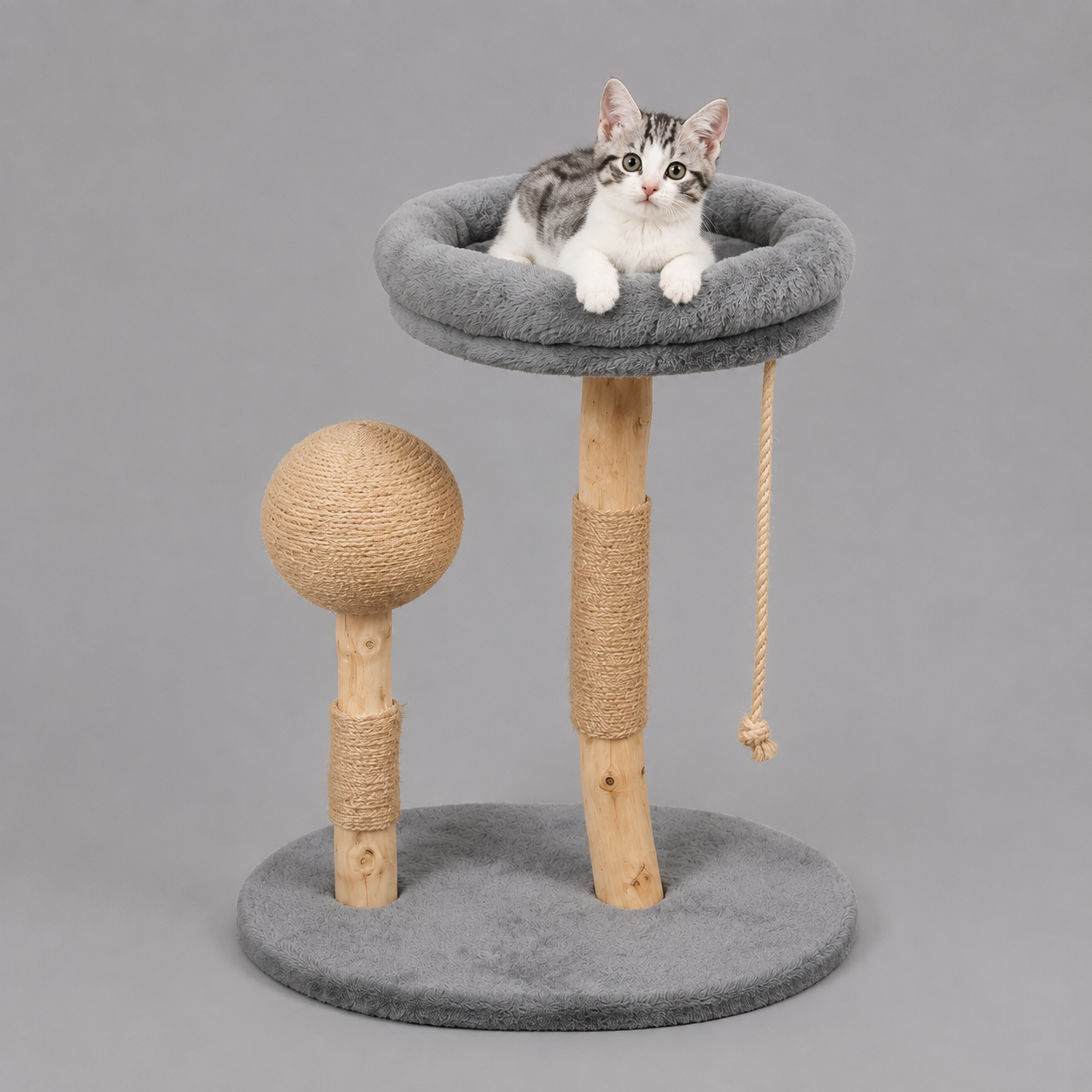
1. Full-Height Tall Tower — Vertical Territory Without a Big Footprint
Tall towers remain the category workhorse: apartment dwellers buy vertical territory when floor space is scarce. The craft reason is the load path: a jumping cat’s force must travel straight down the column — mortise-and-tenon or reinforced dowels, never screws alone. Confirm carton dimensions early: a freight-only tower changes your channel math. See our floor-to-ceiling tension-pole designs.
2. Compact Corner Unit — Built for Small-Format Living
Sub-1.2-meter corner trees serve first-time owners and small-space buyers. At small scale, sloppiness shows fastest: a two-millimeter tolerance error is a visible wobble. Jig-fixtured joinery keeps parts interchangeable; solid wood gives a small footprint planted mass. Cats sleep nose-to-surface: water-based coating with no solvent odor is non-negotiable, edges hand-sanded round. Compare with solid wood versus carpet-covered designs.
3. Multi-Hideaway Condo — The Return-Proof Family Favorite
Condos with two or three hideaways are the family default; returns trace back to box construction, not the concept. The craft detail is edge treatment: sealed edges, countersunk fasteners, no exposed heads inside sleeping areas, paw-safe ventilation. Any composite panels should meet CARB Phase 2 or EPA TSCA Title VI limits — an enclosed sleeping space concentrates whatever the material off-gasses; see the CARB composite wood products program. Our formaldehyde compliance guide shows what documentation to request.
4. Wall-Mounted Climbing System — Premium Segment, Premium Craft
Wall-mounted shelves, bridges, and perches hold the premium end. Here the craft is the bracket and mounting system: a landing cat multiplies its body weight several-fold, so brackets must be rated for dynamic load and the manual must guide installers to studs, not drywall. Platforms need anti-slip surfacing — a cat that slides off a wall perch never trusts the system again. See wall-mounted versus freestanding cat trees and browse modular cat wall shelves.
5. Designer Luxury Piece — Where Finish Is the Product
Furniture-first statement trees sell to buyers who chose the cat tree like the sofa. In this tier the finish is the product: multi-pass sanding between coats, water-based coating with a UV topcoat option, grain-matched panels. In our workshop, luxury pieces run on a separate finishing line — visible as depth in the final sheen. A factory that can’t show close-up finish photos likely has no separate line.
6. Kitten Starter Tree — Small Size, Big Repurchase Funnel
Low starter trees are the category’s funnel product: a kitten’s first tree is often a household’s first purchase from your brand, and the upgrade follows. The craft details are safety geometry — spacing for short kitten jumps, rounded edges, light platforms, no head-trap gaps. Tip-over is unlikely at this height, yet we test every new low design — kittens climb with chaotic energy. Our guide on moving from first sample to full production runs shows how small-scale engineering carries forward.
7. Heavy-Duty Multi-Cat Tower — Where Engineering Actually Shows
For multi-cat households, the strongest wooden cat trees share three traits: solid posts with no hollow cores, reinforced joints, and a base wide enough to pass tip-over testing. Demand the factory’s stability test records — a verbal “it’s very sturdy” isn’t engineering. We run fatigue cycles on column joints — thousands of load repetitions — because a joint holding on day one can loosen by month eighteen on a starved glue line. Stability work follows ASTM F2057’s logic — see the ASTM F2057 standard page.
The 7 Styles at a Glance: Engineering Checklist
| Style | Decisive craft detail | What to demand from the factory |
|---|---|---|
| Full-height tall tower | Load path down the column | Joint map — no screws-alone joinery |
| Compact corner unit | Tolerance control | Jig-fixtured interchangeability |
| Multi-hideaway condo | Edge treatment | CARB Phase 2 / TSCA Title VI docs |
| Wall-mounted system | Bracket load rating | Stud-mounting guidance |
| Designer luxury piece | Finish quality, grain matching | Close-up finish photos |
| Kitten starter tree | Safety geometry | Tip-over test records |
| Heavy-duty multi-cat tower | Reinforced joints, wide base | Stability and fatigue test records |
How We Judge Wooden Cat Tree Quality Before Adding It to a Line Plan
Before a design reaches our line plan, it passes four checks: incoming lumber at 8–12% on the pin meter, a static load on the highest platform, finish-edge and fastener inspection, AQL pre-shipment sampling. A design failing any single check is reworked, never stocked.
| Check | Method | What it catches |
|---|---|---|
| Moisture content | Pin meter, 8–12% band | Warping, joint opening |
| Static load | Weighted load on highest platform | Undersized bases, weak joints |
| Finish and fasteners | Close inspection of edges and placement | Prep failures, exposed hardware |
| Pre-shipment | AQL sampling against reference sample | Batch drift |
Most assortment mistakes hide in inspection: IPQC catches glue-line and drilling errors while correctable; pre-shipment verifies finished units against the reference. Retailers cannot run a factory’s QC system, but they can ask for its records — AQL levels, inspection photos, corrective actions from the last failed lot.
One Honest Limitation of This List
A shortlist cannot predict your market: luxury pieces need showroom space, tall towers need ceiling height, wall systems need stud walls. The details that matter most — joint reinforcement inside a column — are invisible in product photos. In our workshop we photograph every load-bearing joint before finishing — buyers cannot see them afterward. Demand structural drawings and close-up joint photos; treat a supplier sending only lifestyle renders as unvetted.
Best Wooden Cat Trees 2027: Building Your Assortment
The best wooden cat trees for 2027 are engineered for real constraints: small spaces, tall ceilings, shy cats, kittens, multi-cat chaos. Judge each candidate on moisture content, joints, base proportion, and finish chemistry. Want engineering eyes on your shortlist? Send your 2027 line plan or via our contact page.
How Solid Pet Wood Engineers the Best Wooden Cat Trees for 2027
Our design team scores every candidate against the same four criteria before tooling: moisture-verified solid wood, reinforced joints, height-proportioned bases, pet-safe water-based finishes. We prototype in real materials, test tip-over and fatigue, photograph load-bearing joints before finishing, and hold each lot to AQL sampling. For large cat tree wholesale and custom cat tree design options, the engineering discipline is identical — only assortments change.
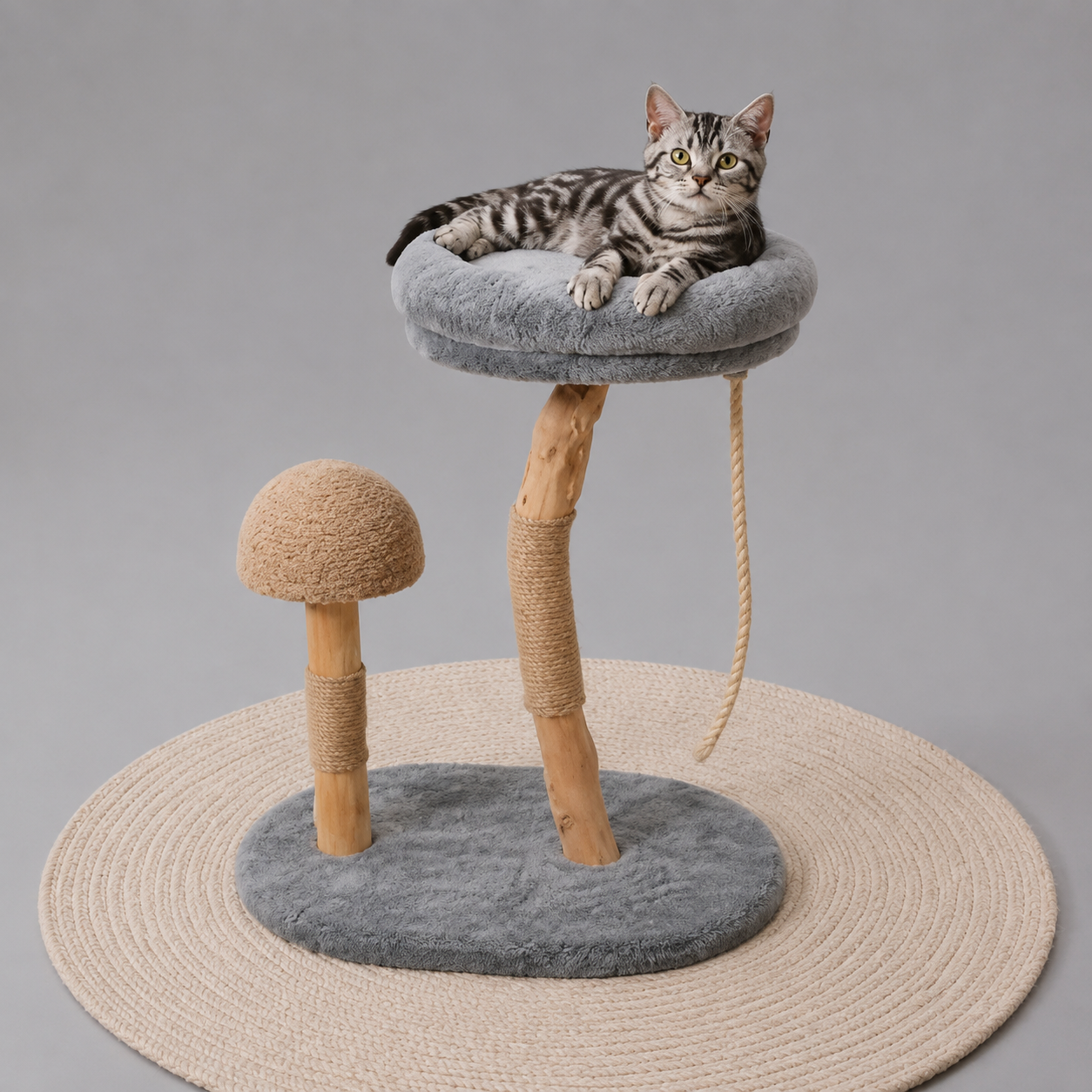
From our factory: How we prototype and test the solid wood cat trees on this shortlist.
FAQ
How can a retailer verify kiln-drying to 8–12%?
Ask for pin-meter readings on incoming lumber, moisture checks during IPQC, and kiln-dried certification from the lumber supplier.
Which joinery should load-bearing joints use?
Mortise-and-tenon or reinforced dowel joints with quality wood glue at every load-bearing connection. Screws alone, especially into end grain, loosen under cyclic jumping loads. Ask for a joint map showing the connection type at each structural node.
What stability standard applies to cat trees?
Cat trees follow ASTM F2057’s logic, the standard safety specification for furniture stability and tip-over resistance. Its tip-over methodology is the industry reference for tall freestanding furniture.
Can these styles carry our branding as private label?
Yes. Solid wood takes laser engraving cleanly, and most styles accept custom cushions, hang tags, and packaging artwork under a private label or white label arrangement.
OEM/ODM Support
Need a custom cat tree production plan?
Send reference photos, target dimensions, material preferences, packaging needs, and market direction. We can review feasibility, sampling, MOQ, and export packaging before production. Request OEM QuoteRelated Product Lines
Explore wooden cat furniture we can manufacture.
Related Buyer Guides