
A distributor once showed us his top-reviewed kitten tree and his most returned one — the same SKU. Five-star reviews came from owners of eight-week-old kittens; one-star reviews from owners of five-month-olds whose cats outgrew it, chewed the trim, and toppled it mid-zoomie. A kitten cat tree is not a small adult tree — it’s a product for a fast-moving target: an animal that doubles in weight in weeks, chews everything, and attacks furniture at full sprint.
Why Kitten Trees Are Not Scaled-Down Adult Trees
A kitten cat tree serves a lighter but far more energetic user — sharper claws, teething that turns trim to chew toys, sprint launches striking furniture sideways. Shrinking an adult design yields a tree too tall for clumsy kittens, too flimsy for six-month-olds.
Kittens ricochet where adults lounge: impact loads come from horizontal launches, changing where reinforcement belongs. The buying cycle is short — owners buy in the first months — so safe finishes and compact, photogenic design drive conversion, not tower height. A cheap factory shrinks an adult CAD file and calls it a kitten line. A specialized manufacturer writes a new brief for a different animal.
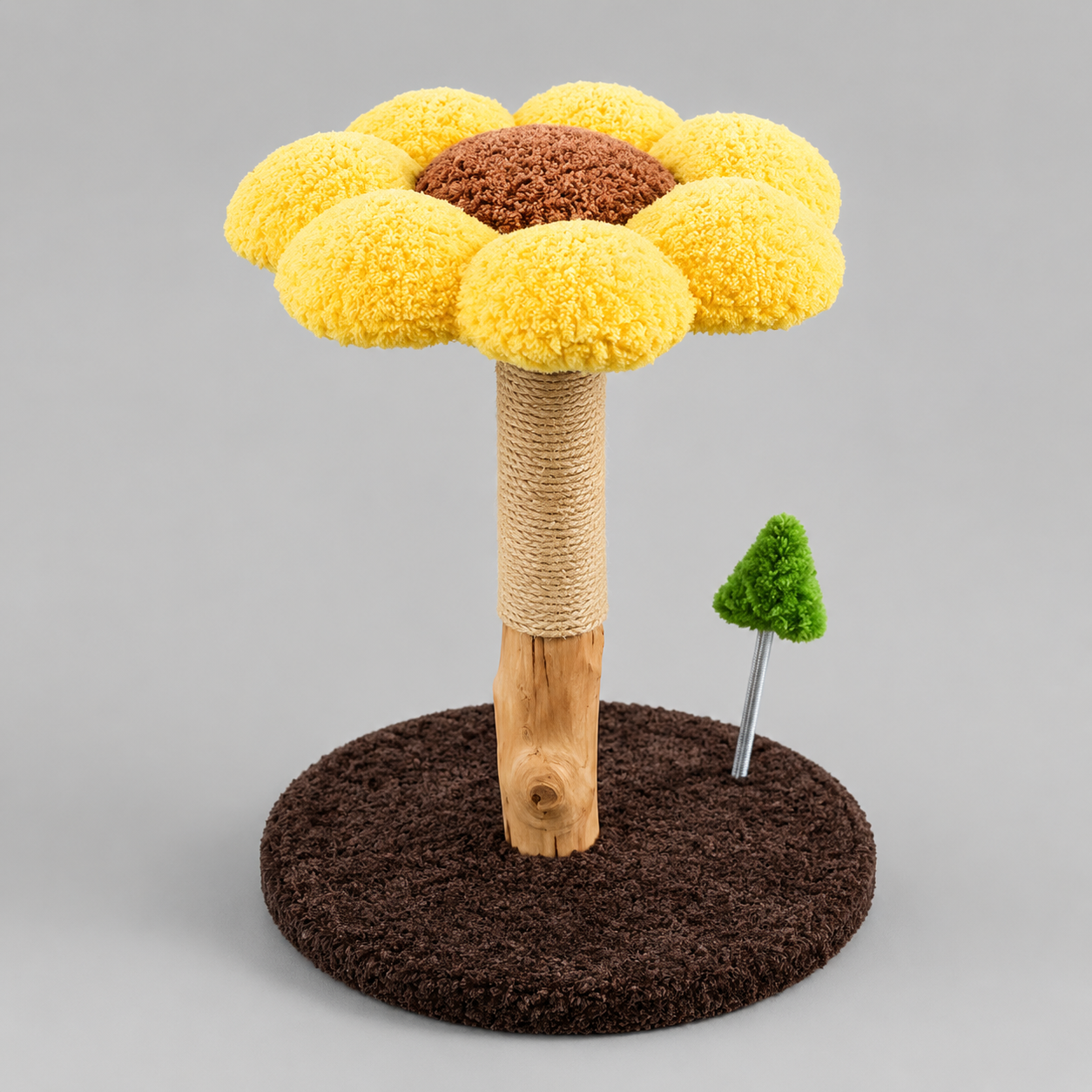
Stability Engineering for a Kitten Cat Tree
A kitten cat tree should be tip-tested with lateral impact loads, not just static weight — kittens hit furniture sideways at speed. Our protocol swings a weighted bag into the mid-post and platform edges to simulate sprint collisions, checking for base lift and joint loosening — the two failure modes kitten returns show.
Low height does not excuse a narrow base: a kitten tree’s light weight means less self-ballast, so the base-to-height ratio is more generous than adult lines require. Posts get bolt-through connections, not screws — cyclical side loads work screws loose faster than vertical loads. Every prototype goes through a fatigue sequence on the post joints before tooling is cut — a lesson from our workshop: an early kitten design passed static tests but loosened during repeated lateral cycling. Our durability testing protocols cover lateral and vertical sequences.
Kitten Cat Tree Edges: Rounded and Impact-Safe Detailing
Kittens misjudge jumps constantly, so every edge on a kitten cat tree is a collision point. We cut a full 6–8 mm round-over on platform edges, post tops, and condo openings — a shaped CNC radius, not a sanding pass. Sharp corners on small furniture read as negligence after the first face-plant.
| Detail | Our specification | Why it matters |
|---|---|---|
| Platform edges, post tops, condo openings | 6–8 mm shaped round-over on the CNC | Every edge is a collision point |
| All fasteners | Countersunk and wood-plugged, flush | A proud bolt head at kitten-head height is a hazard and a chew target |
| Post joints | Bolt-through, never screws | Cyclical side loads back screws out fast |
| Condo interior corners | Eased within kitten reach | Kittens wedge into corners you forgot existed |
These details cost minutes per unit on the line and save the listing from the injury-adjacent reviews that kill kitten products — the direct math of review economics.
Upholstery and Stitching That Survives Kitten Claws
Kitten claws are needles and kitten teeth wire cutters — fabric selection decides whether upholstery lasts the kitten phase or shreds in week three. We specify tight-weave, high-denier fabrics with no looped pile — loops catch claws and run — with dense edge stitching and bar-tacked stress points where fabric meets wood.
Foam, where used, must be fully encapsulated: no exposed foam edges a kitten can chew, because ingested foam is a veterinary emergency. We wrap foam cores completely, stapling the wrap on the underside, away from teeth. At IPQC, upholstery lots are pull-tested at the seams — a seam opening under a firm tug will open under a teething kitten. Cushion covers should be removable for washing; a washable cover extends the product’s lifespan past the destructive phase.
Kitten Cat Tree Finish Safety: Specified for Mouths, Not Just Paws
Everything on a kitten cat tree gets chewed, so finish chemistry matters most here. We use fully cured, low-VOC water-based coatings with no heavy-metal driers, masking all joinery surfaces before coating so glue bonds stay structural. Our pet-safe wood finish guide covers the full specification logic.
| Parameter | Specification | Rationale |
|---|---|---|
| Coating chemistry | Low-VOC water-based, no heavy-metal driers, fully cured | Everything gets chewed |
| Cure verification | Verified before packing, not assumed | Soft film plus teething kitten equals ingested finish |
| Wood stock | Kiln-dried solid wood, 8–12% moisture content | Dimensional stability in small joints |
| Composite panels (if any) | E0/E1 grades, EPA TSCA Title VI (EPA) | Formaldehyde limits |
| Colorants | Water-based, lightfast dyes and stains | A color that bleeds onto paws becomes a support ticket |
For buyers building sustainability stories, FSC-certified lumber is available — chain-of-custody documentation integrates cleanly with the compliance dossiers retailers request.
The Limitation: Kittens Outgrow Them — Design for It
The honest boundary of the kitten cat tree category is time: the customer fitting at eight weeks outgrows it by seven months. No engineering extends the useful window beyond the growth curve. Products that survive convert into small-cat furniture and state the weight range honestly in the listing.
We design kitten platforms and condo openings for cats up to 4 kg — covering the kitten phase and the smaller end of adult cats, not pretending a kitten tree serves a Maine Coon. Margins are specified for that upper bound, not the eight-week-old in the hero photo. Plan the upsell path: a kitten line visually matching the adult line turns an outgrown purchase into a second purchase, not a brand switch.
From our factory: see our workshop where solid-wood cat furniture is machined and assembled.
How Solid Pet Wood Builds Kitten Cat Trees
We are a specialized solid wood pet furniture manufacturer, and kitten lines get their own engineering brief on our floor — never a shrunk adult file.
Our design team writes the one-page kitten brief with you: target weight range, maximum platform height, round-over radius, fabric and stitch specification, finish chemistry, and the lateral impact test the prototype must pass. A real design partner questions your numbers rather than nodding — ours do. Our production line rounds every reachable edge on the CNC, countersinks and plugs every fastener, encapsulates all foam, and pull-tests upholstery seams at IPQC. Our quality system runs lateral-impact fatigue on every kitten prototype before tooling; any structural change triggers a new test cycle through an engineering change order (ECO).
Kitten lines suit private label programs — the category rewards distinctive styling, and shared platforms across colorways keep tooling efficient. Review our custom furniture options for how co-development runs. When your brief is ready, send it through our request a quote page for an engineering review before tooling.
FAQ
How is a kitten cat tree different from a small adult cat tree?
Beyond size, the engineering brief differs: lower heights for clumsy climbers, tighter joints for lateral sprint impacts, chew-resistant detailing on every reachable edge, and mouthing-safe finishes. Shrinking an adult design without these changes produces a tree too tall for young kittens and too flimsy for older ones.
What edge treatment is appropriate for kitten furniture?
A full 6–8 mm round-over on all platform edges, post tops, and condo openings — a shaped radius, not a light sanding. Hardware must sit flush, recessed, and plugged.
Are water-based finishes safe for teething kittens?
Fully cured water-based coatings with low VOC and no heavy-metal driers are the kitten-line specification. Joinery surfaces are masked before coating so glue bonds stay structural, and cure times are verified before packing — stricter than the finish brief for adult furniture.
How long does a kitten tree stay useful?
Through the kitten phase and into small-cat adulthood — we design openings and platforms for cats up to 4 kg. The products that age best convert into small-cat furniture; listings should state the weight range honestly instead of implying the tree suits all cats.
Can we develop a private-label kitten line?
Yes. Kitten lines reward distinctive styling, and shared platforms across colorways keep tooling efficient, while the validated structure stays constant. Structural or dimensional changes trigger new prototyping and lateral impact testing.
OEM/ODM Support
Need a custom cat tree production plan?
Send reference photos, target dimensions, material preferences, packaging needs, and market direction. We can review feasibility, sampling, MOQ, and export packaging before production. Request OEM QuoteRelated Product Lines
Explore wooden cat furniture we can manufacture.
Related Buyer Guides