
Two posts can fail very differently: one sheds its rope in loose loops within weeks, the other wears fuzzy but intact for months. The difference is wrapping tension, glue coverage, and rope-end locking — a wholesale cat scratcher is a wear product, built to be destroyed slowly and safely.
Wholesale Cat Scratcher Materials: Sisal, Jute, and Corrugated Compared
Wholesale cat scratcher surfaces come in three materials: sisal (the stiff, durable standard), jute (softer, less claw-resistant, faster to wear), and corrugated cardboard (the most attractive to cats, the shortest-lived). Sisal dominates the premium segment; corrugated dominates the disposable one.
Material choice is a lifespan choice — spec it as service life, not adjectives. A cheap factory sells all three materials with the same durability claims; a specialized manufacturer specs each honestly — returns come from the gap between claim and wear.
| Material | Claw feel | Wear mode | Typical service life | Best use |
|---|---|---|---|---|
| Sisal | Stiff, springy, claw-catching | Frays fuzzy, wears locally | Months of daily use | Premium posts, long-life lines |
| Jute | Softer, smoother | Pills, shreds faster | Shorter than sisal | Budget lines |
| Corrugated | Flute gives way under claws | Reduces to confetti | ~1 month heavy use | Disposable pads |
Sisal comes from agave leaves — the irregular texture cats prefer. Corrugated is the feline favorite: sell it on preference, not durability.
Sisal Rope vs. Sisal Fabric: The Wrapping Decision
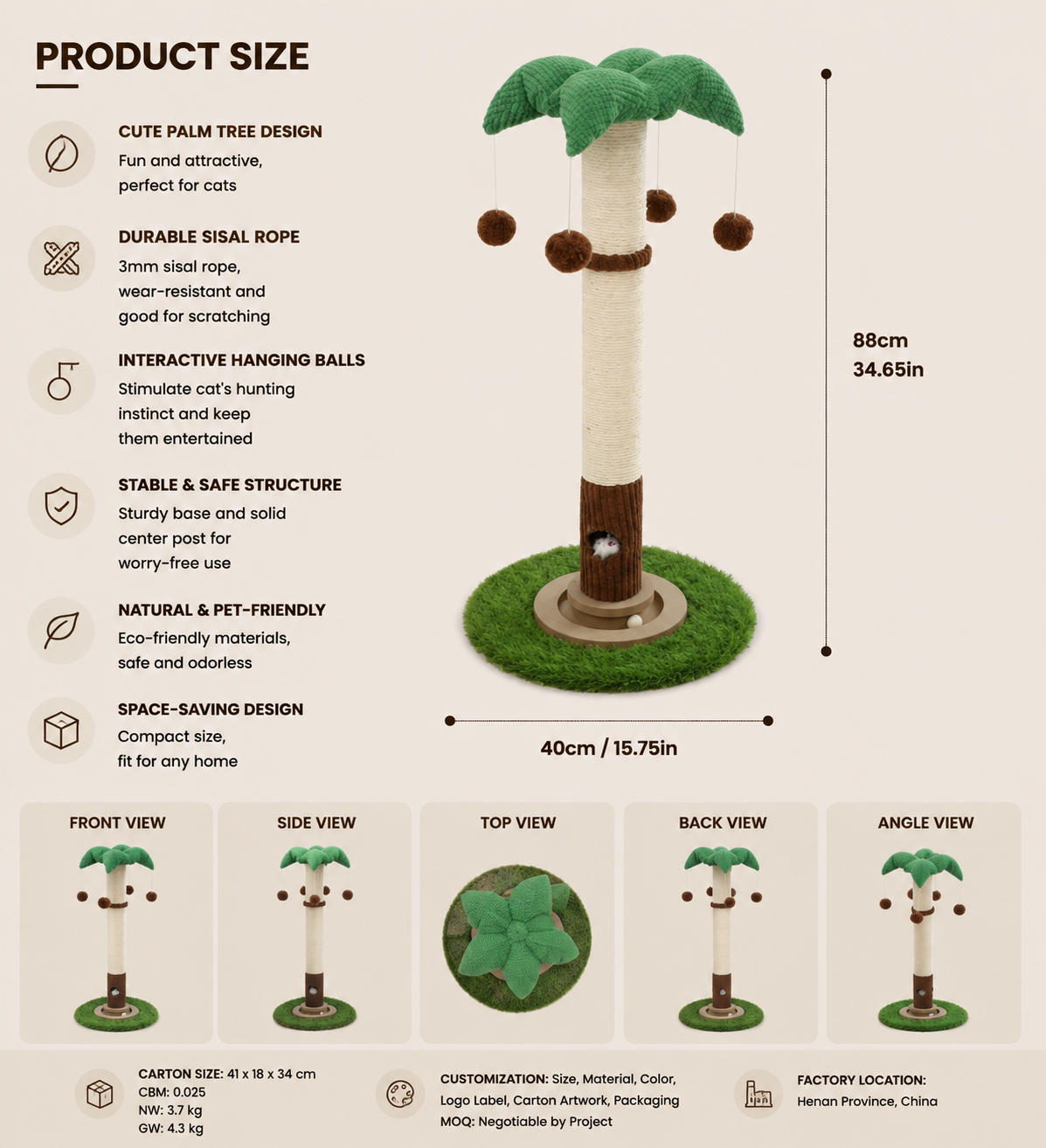
Sisal rope (typically 6–8 mm twisted) and sisal fabric (woven mat stapled or glued to a panel) serve different scratcher geometries: rope wraps posts and columns, fabric covers flat boards and curved surfaces. Rope lasts longer per square centimeter; fabric covers area faster with less labor.
| Wrapping | Suits | Wear mode | Quality marker |
|---|---|---|---|
| Sisal rope, 6–8 mm | Posts, columns | Fails one twist at a time | Tight twist |
| Sisal fabric | Flat boards, curves | Peels in sheets when it fails | Dense weave, heavy backing |
Ask suppliers for the rope twist specification and fabric weight — vague answers mean commodity grade. Good rope is tightly twisted — loose-twist rope flattens within weeks; good fabric is dense-weave with a heavy backing, while thin fabric shreds at the staple line.
The Wrapping Craft: Tension, Glue, and Edge Locking
The wrapping process decides a scratcher post’s service life more than the rope grade does. Three variables matter: winding tension (tight enough that no gap opens when pressed), adhesive coverage (full-length, not spot-glued), and end locking (start and end mechanically secured, not just glued).
- Winding tension — tight enough that no gap opens when pressed; loose rope opens gaps under scratching and claws pull whole loops free.
- Adhesive coverage — full-length, not spot-glued, so every twist stays anchored; non-toxic and low-VOC, since cats chew rope ends.
- End locking — start and end mechanically secured; tuck the final turn into a routed groove or under a cap, because a glued-only end is a pull-tab for a determined cat.
Our workshop check is tactile: press the rope hard with a thumb; if windings separate, tension was wrong. A cheap factory spot-glues rope around a green core and ships it; a specialized manufacturer winds to a tension standard, glues full-length, and locks the ends. This isn’t marketing — it’s the direct math of wear.
The Wooden Core: What the Scratcher Is Built On
Under every wrapped post is a wooden core — usually pine or rubberwood, kiln-dried to 8–12% moisture content — and the core’s stability decides whether the wrap survives. A core that shrinks loosens the entire winding slowly from the inside.
| Core spec | Standard | Why it matters |
|---|---|---|
| Species | Pine or rubberwood | Stable, machines cleanly |
| Moisture content | 8–12%, kiln-dried | Prevents post-wrap shrinkage |
| Board thickness | ≥12 mm | Thinner boards flex, pop staples |
| Turning | CNC-turned | Tighter tolerances, wrap holds |
This is the hidden failure mode of cheap posts. Rope wound tight around a green core feels perfect on the packing line; three months in a heated home, the core shrinks a millimeter and the wrap goes slack. Kiln-dried cores — pin-meter verified at incoming inspection — are the foundation. Composite mounting plates must meet CARB Phase 2 / EPA TSCA Title VI (US EPA).
Wholesale Cat Scratcher Types: Posts, Boards, and Furniture Hybrids
Wholesale cat scratcher formats divide into vertical posts (the classic tower column), horizontal/angled boards (floor scratchers and ramps), and furniture hybrids (scratcher-integrated cat trees, houses, and sofas). Posts suit stretching; boards suit horizontal scratchers; hybrids suit space-constrained homes.
Spec stability, not just height. A tall post with a light base tips during enthusiastic scratching — spec post diameter (9–12 cm suits adult cats), wrap height, base weight. Horizontal boards ship flat but wear in one lane; flippable boards double the service life.
Furniture hybrids put scratchers into cat trees and houses — a scratcher column on a tree, sisal panels inset into a house wall. The challenge is replacement: a hybrid whose scratcher section can’t be refreshed becomes landfill when the sisal dies. Design the scratcher module as a bolt-on part.
Replaceable Design: Planning for the Second Life
The most buyer-friendly scratcher designs treat the wear surface as a consumable: replaceable rope cartridges, flippable boards, or bolt-on sisal panels that refresh the product without replacing your furniture. Replaceability turns a disposable product into a durable one — and keeps your brand in the home.
- Cartridge posts — a pre-wrapped tube slides over the core and locks with a bayonet or screw.
- Flippable boards — the frame must be symmetric so the board turns over for a second life.
- Bolt-on panels — attach with threaded inserts so a worn panel unbolts and a fresh one bolts on.
Each pattern needs the replacement part as a stocked SKU — otherwise the promise is empty. For private label programs, replacement parts are a reorder engine: the consumable brings the customer back (private label pet furniture programs).
Where Scratchers Fail: Honest Limits
First, sisal frays — that is the product working, not failing. Visible wear is proof of function; the defect line is structural — loops pulling free, ends unraveling, staples exposed — not cosmetic fuzz.
Second, no adhesive choice is perfect: water-based glues are safest for chewing but soften slightly in humid climates; hot-melt holds aggressively but can string if applied hot and fast. Ask which the factory uses, and why.
Third, corrugated scratchers are short-lived by design: a month of heavy use is normal, not a defect — the value is attraction, not longevity.
From our factory: A look inside our workshop, where scratching posts are wound to a tension standard, built on kiln-dried cores, and engineered for replaceable wear surfaces.
How Solid Pet Wood Engineers Wholesale Cat Scratchers
Our scratcher capability rests on three pillars: wrapping lines run to a tension and glue-coverage standard, not a speed target; cores kiln-dried and pin-meter verified before the first turn of rope; and a replaceable-parts program keeping consumables available. We treat the wear surface as the product.
Craftsmanship Is the Product
A wholesale cat scratcher has no hidden features — the craft is all on the surface. Developing a scratcher line? Request a quote — tell us your material and format, and we’ll wind a test sample.
FAQ
Sisal, jute, or corrugated — which scratcher material lasts longest?
Sisal rope lasts longest; jute wears faster and pills; corrugated is shortest-lived but most attractive to cats.
Sisal rope or sisal fabric — which is better?
Rope suits posts and wears locally, one twist at a time; fabric covers flat boards faster but peels in sheets.
Why does sisal wrap come loose on some scratcher posts?
Usually low winding tension, spot gluing instead of full-length adhesive, unsecured rope ends — or a green core that shrank after wrapping.
Is the glue on scratching posts safe for cats?
It should be non-toxic, low-VOC water-based or hot-melt adhesive, since cats chew rope ends. Ask which system the supplier uses.
What makes a scratcher design replaceable?
Cartridge tubes sliding over the core, flippable symmetric boards, or bolt-on sisal panels with threaded inserts — with replacements as a stocked SKU.
How are scratcher shipments tested?
Cartons go through ISTA 3A parcel testing, and lots are sampled to an AQL plan at pre-shipment inspection (durability testing protocols).
OEM/ODM Support
Need a custom cat tree production plan?
Send reference photos, target dimensions, material preferences, packaging needs, and market direction. We can review feasibility, sampling, MOQ, and export packaging before production. Request OEM QuoteRelated Product Lines
Explore wooden cat furniture we can manufacture.
Related Buyer Guides