
A buyer once sent us a competitor’s sample: the listing said “solid wood,” but the perch platform rippled and the post joints wobbled. We cut the platform open. The core was low-grade plywood with a void under every screw — the claim was true somewhere in the tower, just not where the structure needed it.
Solid Wood vs Plywood Cat Tree: Which Is Better?
Neither wins outright — horses for courses. On our line, solid sawn lumber goes into load-bearing posts and perch edges, where claws, teeth, and jumping forces concentrate; quality birch plywood serves large flat panels and flat-pack components, where dimensional stability and lighter weight pay off.
Marketing flattened the question: “solid wood” sounds premium, “plywood” cheap — but a cat tree is an assembly of parts under different stresses, and one material for everything is a story, not an engineering answer.
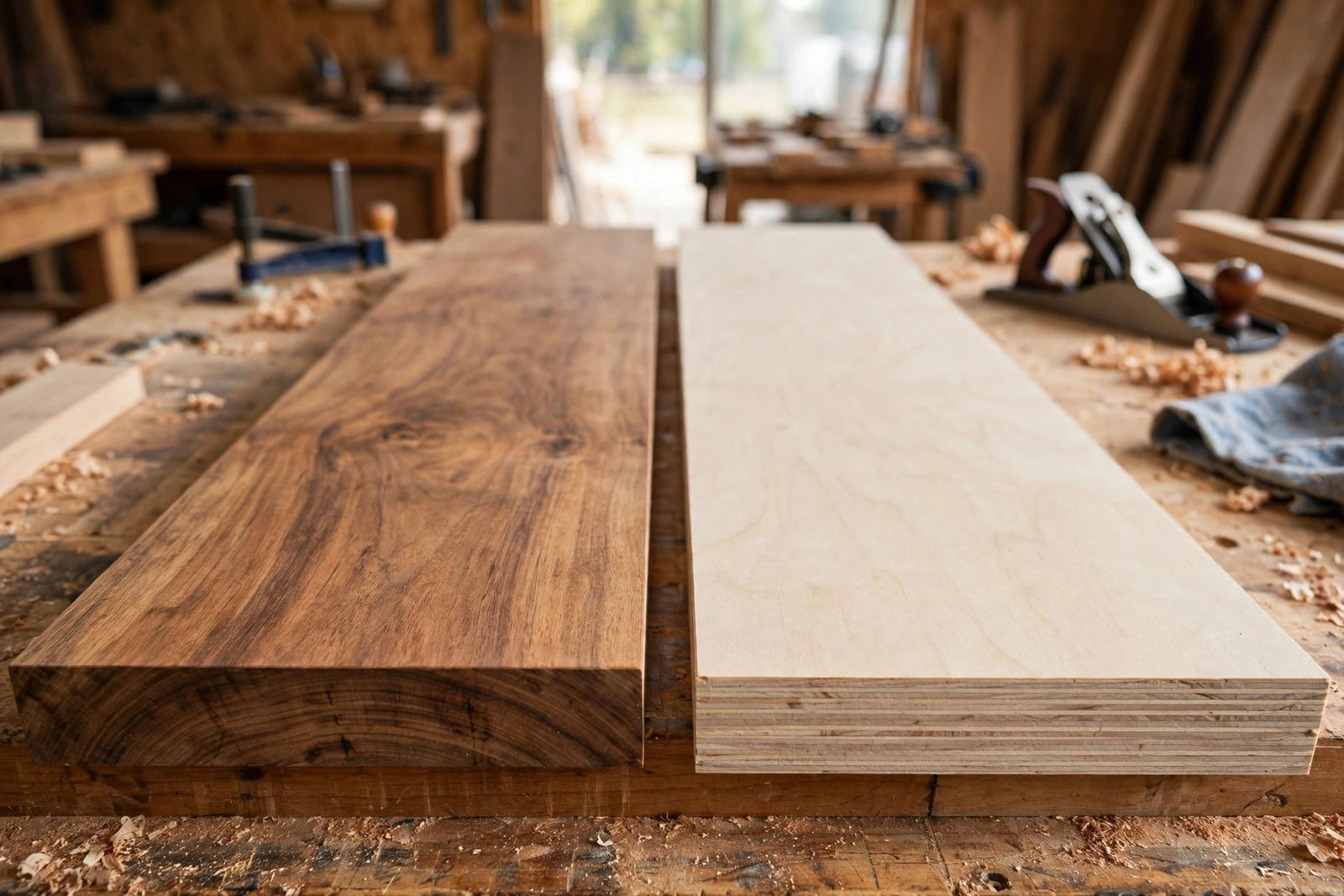
What Solid Wood Brings to a Cat Tree — and Where It Fails
Solid wood brings continuous long grain: a board, or an edge-glued glue-up panel, carries load along its fibers better than anything laminated. Face-grain screw-holding is excellent, and a solid post telegraphs quality the moment a buyer lifts the carton.
Where it fails is movement: seasonal wood movement is physics, not a defect — boards cup, warp, and twist as humidity swings between factory, container, and home. We kiln-dry and meter all solid stock (species detail in our best wood for cat tree guide), but wide panels in a dry apartment still try to cup — one reason flat components are often better as engineered wood.
The second failure point is end-grain: screws driven into the end of a solid board — the classic perch-post joint — hold poorly and back out under cyclic load. We use threaded inserts or through-bolts on every end-grain joint. Third is weight: solid lumber runs heavier, and on tall designs that flows straight into carton specs and freight (tall cat tree wholesale).
What Plywood Brings to a Cat Tree — and Where It Fails
Plywood brings engineered consistency: cross-banded veneer layers laminated under pressure give excellent shear strength — alternating grain resists splitting the way solid lumber cannot — and dimensional stability across large flat parts. A void-free birch plywood panel stays flat through humidity swings that would cup a solid board, and machines cleanly on CNC with minimal tear-out.
Now the honest failures, because cheap plywood gave plywood its bad name. Delamination: when the lamination adhesive fails or moisture enters an exposed edge, plies separate — a delaminated panel is scrap. Void cores: low-grade panels hide gaps that swallow screws whole. Edge chipping: thin face veneer chips at raw edges unless banded or lipped. We reject such panels at incoming with a cut-sample check of every lot.
The dividing line is never “plywood versus solid wood.” It is specified, void-free birch plywood with finished edges versus mystery-core sheets bought on price.
Head-to-Head: Solid Wood vs Plywood for Cat Tree Construction
Our buyer walkthrough — a parts list, not a verdict:
| Property | Solid wood (sawn lumber / glue-up panel) | Quality plywood (void-free birch) |
|---|---|---|
| Bending strength | Excellent along the grain; weak across it | Very good in all directions |
| Shear strength | Lower — splits along the grain | Higher — alternating grain resists splitting |
| Seasonal movement | Moves — expect warp, cup, twist | Minimal — dimensional stability is its signature |
| Weight | Heavier for the same coverage | Lighter panel-for-panel |
| Formaldehyde sources | Adhesive in finger-joint and glue-up lines | Adhesive in every lamination layer |
| CNC machinability | Great detail; tear-out risk across grain | Clean, consistent cuts; edges need banding |
| Screw-holding | Strong in face grain; poor in end-grain | Strong in the face; weak at raw edge |
| Cost comparison | Higher material cost, more waste | Lower cost per panel, efficient nesting |
No row crowns a winner — each points at a part: posts and perch edges want solid wood’s face-grain strength; wide platforms and flat-pack backs want plywood’s stability and weight.
The Formaldehyde Question Applies to Both Materials
Many buyers assume solid wood means zero glue and zero formaldehyde emission. It does not: finger-jointed boards and glue-up panels carry adhesive in every joint line. Ask about the glue in both materials, not just the plywood.
The facts: CARB Phase 2 is California’s formaldehyde emission standard for composite wood products, aligned with the U.S. federal EPA TSCA Title VI rule. E0 and E1 are industry grading labels, E0 the stricter. A plywood cat tree built to CARB Phase 2 or E0-grade panels is a documented low-emission product; a “solid wood” tower from finger-jointed stock with unspecified glue is an unknown (see the Composite Panel Association). Ask every supplier for compliance paperwork on panels and glue-up stock alike.
How Our Factory Actually Decides: A Part-by-Part Framework
When our engineering team specs a new design, the material decision runs through three questions:
1. Does the part carry load, claws, or teeth? Posts, perch edges, and scratching columns get solid sawn lumber — the parts cats attack daily, where face-grain strength earns the cost.
2. Is the part large, flat, or shipping flat-pack? Wide platforms, wall panels, and enclosure backs get void-free birch plywood: stability through container humidity, lighter weight in the carton, minimal CNC nesting waste. We band every exposed edge — usually solid wood lipping — so no customer touches raw plies.
3. What tier is the line? Premium home-decor lines get more solid wood where the eye and hand land; value lines get more plywood where engineering allows. The tier moves the ratio, never the rule: load parts stay solid, flat parts stay engineered.
Behind those questions sits incoming QC: every plywood lot gets a cut-sample check, and every solid bundle is moisture-metered before the saw.
What to Ask Your Factory Before You Choose
Take this checklist to any supplier quoting a wooden cat tree:
- Which parts are solid wood and which are plywood — part by part, not “mostly solid wood.”
- Plywood grade, face-veneer species, and whether the core is genuinely void-free.
- Formaldehyde compliance documentation for panels and finger-jointed or glue-up stock alike.
- How plywood edges are finished — edge-banding, solid lipping, or left raw.
- How screws into end-grain or panel edges are reinforced.
- The moisture-content spec for solid stock — the metered number, not just “kiln-dried” (kiln-dried wood).
- Whether flat-pack panels passed transit drop testing per ISTA — a stable material in a weak carton still arrives broken.
Most telling: ask the factory to explain one part where they chose plywood over solid wood, and why. A real engineering answer means materials chosen on purpose; no answer means chosen on price.
From our factory: Watch our factory wood workshop — how solid lumber and engineered panels each get placed where they perform best in a cat tree.
FAQ
Is a plywood cat tree safe for cats?
Yes, with low-emission panels — ask for CARB Phase 2 or E0-grade documentation on the plywood and its adhesive, and banded or lipped edges, since chewing exposes them.
Which lasts longer, solid wood or plywood?
Construction decides, not the name. A well-engineered plywood panel outlasts a solid board screwed into end-grain without inserts; a properly joined solid post outlasts a void-core plywood one. Judge the joints and the QC.
Why do factories mix solid wood and plywood instead of going all-solid?
Engineering first, cost second. Wide flat parts stay flatter and ship lighter as engineered wood; load-bearing posts hold hardware better as solid lumber. An all-solid tower is a marketing choice that performs worse on wide panels.
Does “solid wood” on a listing guarantee no glue?
No. Finger-jointed boards and glue-up panels contain adhesive in every joint line. If formaldehyde emission matters, ask about the glue in the “solid” parts too.
How can I tell quality plywood from cheap plywood?
Check the edge: uniform plies with no gaps signal a void-free core; visible voids or filler signal trouble. Ask for a cut sample from the actual lot, and confirm face-veneer species and emission grade in writing.
Unsure which parts of your line should be solid? Send your drawings to our engineering team — we will mark up the material spec part by part. Request a quote.
OEM/ODM Support
Need a custom cat tree production plan?
Send reference photos, target dimensions, material preferences, packaging needs, and market direction. We can review feasibility, sampling, MOQ, and export packaging before production. Request OEM QuoteRelated Product Lines
Explore wooden cat furniture we can manufacture.
Related Buyer Guides