
A buyer asked why his wall bridges outsold his shelves, then returned twice as often. Returns photos told the story: shelves failed from bad mounting, but bridges failed at the product level — mid-span sag, brackets pulling from drywall, rope rails fraying at anchors. Wall mounted cat bridge steps live or die on structural engineering, because a bridge is a span and a span is a promise about deflection.
Why Bridges and Steps Behave Differently Than Shelves
Wall mounted cat bridge steps carry loads across open spans, unlike single wall shelves. A shelf is a cantilever with one fixed edge; a bridge is a beam between two supports, multiplying leverage at the anchors. Buyers must evaluate span deflection, anchor pull-out strength, and sequential load transfer.
Shelves forgive mediocre mounting because the load sits close to the wall; a bridge puts the cat’s full weight at mid-span — maximum bending moment, often 60–80 cm from the nearest stud. Steps add landing momentum: each tread takes vertical impact plus shear toward the next step. We treat bridges and steps as structural engineering, not styling.
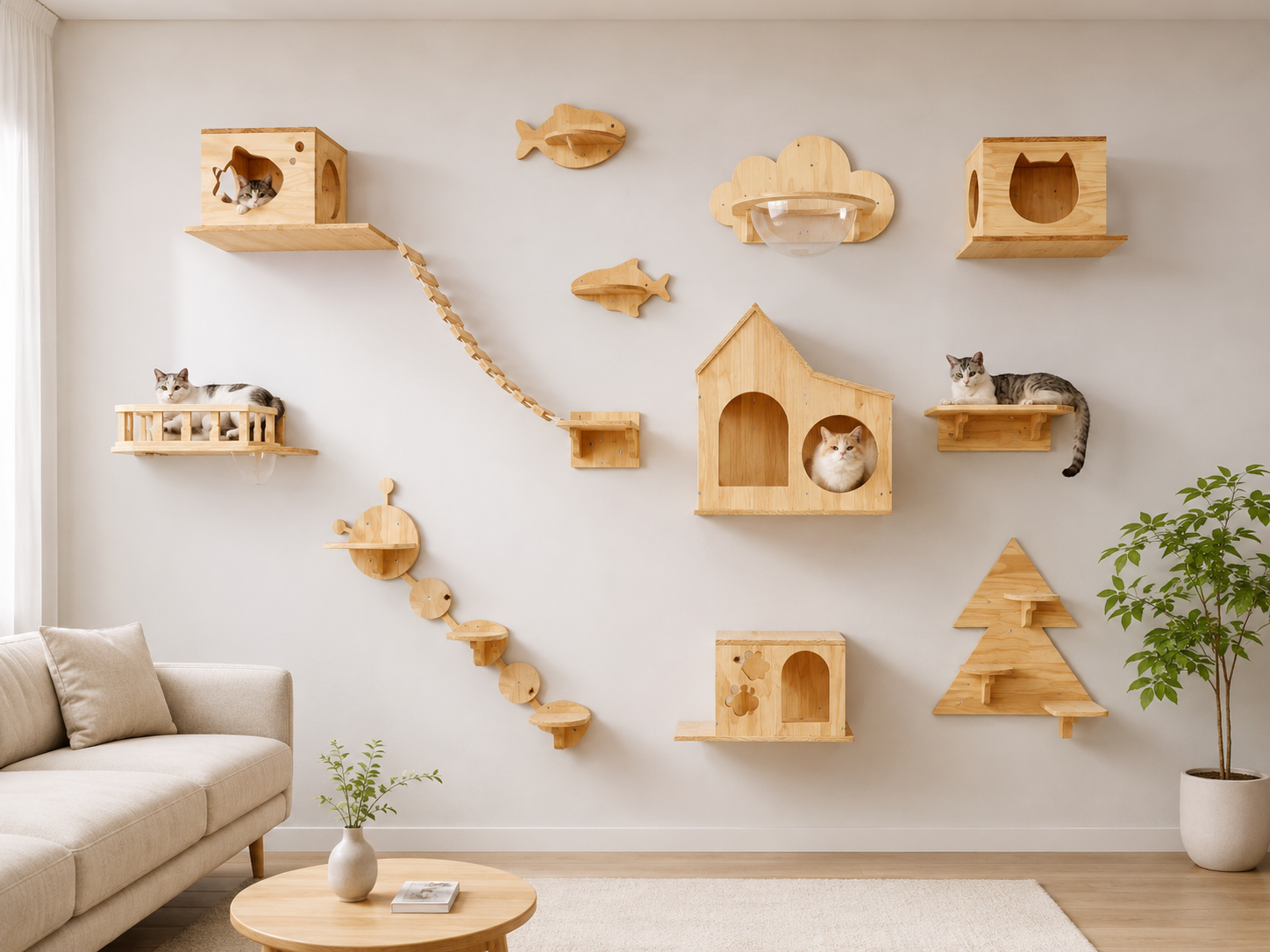
Wall-Mounted Cat Bridge Design: Spanning Without Sagging
A well-built wall-mounted cat bridge holds mid-span deflection to a few millimeters under a large cat, because visible sag destroys customer confidence even when the bridge is technically safe. That stiffness comes from a solid-wood plank thick enough to act as a beam, gusseted end brackets bolted through the plank, and spans matched to plank stiffness.
| Bridge Span | Deck Specification | Deflection Behavior |
|---|---|---|
| Up to 60 cm | 25 mm kiln-dried hardwood | Negligible at mid-span |
| 60–80 cm | 25–30 mm kiln-dried hardwood | A few millimeters under a large cat |
| 80–100 cm | 30 mm + underside rib | Controlled — verify on prototypes |
| 100 cm+ | Avoid single span | Use a center support step |
Thinner stock needs a stiffening rib underneath — a flat thin plank at 90 cm sags visibly within months. End brackets should bolt through the plank, never screws into end grain, and need triangulation: a plain L-bracket twists when a cat walks the bridge edge; a gusseted one does not. Rope or fabric side rails are comfort features, not structure — see our modular cat wall shelves guide.
A cheap factory ships a long, thin plank with plain L-brackets and calls it a bridge; a specialized manufacturer matches span to plank stiffness on paper before cutting wood.
Steps and Stairs: Tread Depth, Riser Height, and Grip
Steps earn their place by giving older or smaller cats a climbable path — but only if tread geometry respects how cats move: tread depth for all four paws (we prototype 18–22 cm), risers a senior cat can step rather than jump (12–15 cm), and a grippy surface.
Grip is where factories cut corners and reviews suffer: bare lacquered wood looks premium in photos and slides under paws. We specify a matte, slightly textured water-based coating for treads, or a replaceable sisal pad inset — both keep formaldehyde and VOC clean per E0/E1 grades and the CARB composite wood products program. Test prototypes with real cats of different ages.
Mounting Hardware: Matching Fasteners to Wall Types
Bridges fail at the wall more often than in the wood, because the same bridge ships to customers with drywall, plaster, brick, and concrete. Ship wall-type-specific anchors — toggle bolts for drywall, frame anchors for plaster, sleeve anchors for masonry — and print a stud-finding step in the instructions.
| Wall Type | Anchor to Specify | Honest Limitation |
|---|---|---|
| Stud-backed drywall | Toggle bolts into studs | Drywall alone pulls out under dynamic load |
| Plaster over sound lath | Frame anchors | Crumbling lath can’t be saved by any anchor |
| Brick or concrete | Sleeve anchors | Needs correct drill depth and hole cleaning |
Include a stud-finding step in the instructions — a bridge anchored only to 12 mm drywall pulls out under dynamic load regardless of anchor quality. Match anchors to rated pull-out values — our furniture hardware selection guide details the logic. At IPQC we weight-count anchors per kit: one missing toggle bolt is a one-star review waiting to happen.
Dynamic Load Testing for Wall-Mounted Cat Bridge Steps
Bridges and steps need dynamic validation at mid-span and each tread — static ratings understate a landing cat. We drop a weighted bag from 30 cm onto the bridge center and individual steps, then check three failure modes:
| Test | Method | Failure Mode |
|---|---|---|
| Mid-span drop test | Weighted bag, 30 cm drop, bridge center | Bracket deformation, plank cracking |
| Tread impact test | Repeated drops on individual steps | Anchor slippage, tread loosening |
| Fatigue cycling | Thousands of mid-span load cycles | Slow loosening over months |
We adapt ASTM F2057 logic to wall-mounted geometry: instead of tip-over, we test whether the mounting system holds under sudden asymmetric load. Surviving one drop but loosening over six months is a warranty claim in slow motion — every design change triggers a fresh fatigue cycle, documented through an engineering change order (ECO). AQL pre-shipment inspection covers bracket welds, finish, and hardware counts; CNC machining keeps hole spacing consistent, and a jig fixture verifies every bracket pattern before packing.
The Limitation: Not Every Wall Can Take a Bridge
The boundary buyers must respect: a wall bridge is only as good as the wall behind it, and many end customers have walls that cannot safely carry a bridge. Thin partition drywall without stud access, old plaster over crumbling lath, and hollow-core panels all fall below the pull-out strength a loaded bridge demands. No product engineering fixes a bad substrate.
Honest brands handle this in the listing, not the returns queue: state minimum wall requirements, require stud mounting beyond a stated span, and print the warning before customers drill. We advise against extra-long spans as a selling point — a 120 cm bridge photographs dramatically and deflects dramatically, pushing carton dimension into awkward freight territory. A two-span layout with a center support step almost always outperforms one heroic span.
From our factory: see our workshop where solid-wood cat furniture is machined and assembled.
How Solid Pet Wood Engineers Wall-Mounted Cat Bridge Steps
Our in-house design team treats every bridge and step as a small structural project: span-to-stiffness calculations first, bracket geometry proven on a jig fixture, then drop testing and fatigue cycling before any production run. Production carries that discipline through CNC-machined mounting plates, IPQC hardware counts per kit, and AQL inspection on welds, finish, and counts.
This isn’t marketing — it’s the direct math of leverage: at 60–80 cm from the nearest stud, landing force multiplies at the anchor — the mounting system either holds under sudden asymmetric load or it doesn’t.
FAQ
How is a wall-mounted cat bridge different from a wall shelf, structurally?
A shelf is a cantilever fixed along one edge; a bridge is a beam between two supports, so mid-span deflection and end-bracket strength dominate. The engineering focus shifts from the wood to the span and the mounting system.
What wall types can safely support wall mounted cat bridge steps?
Stud-backed drywall, sound plaster over lath, brick, and concrete work with the right anchors. Thin partition drywall without stud access and deteriorated plaster generally cannot carry a loaded bridge.
How much deflection is acceptable in a cat bridge?
We prototype for a few millimeters of deflection under a large cat. Visible sag erodes confidence even when the bridge is safe — control stiffness with thicker planks or an underside rib.
Do bridge steps need a special surface finish?
Treads need grip: matte, slightly textured water-based coating or an inset sisal pad. High-gloss finishes photograph well but perform poorly; keep formaldehyde and VOC within E0/E1 and CARB-aligned expectations.
Can bridges and steps match our existing wall shelf line?
Yes — the standard private-label extension. Spans, step counts, finishes, and bracket styles adapt to your shelf line; validated mounting logic stays consistent, and structural changes trigger new prototype iteration.
Wall mounted cat bridge steps are the natural line extension for wall-shelf brands: same mounting story, higher perceived value, a clear upsell to full climbing walls. See our custom cat tree design options, then send your concept through request a quote for an engineering review.
OEM/ODM Support
Need a custom cat tree production plan?
Send reference photos, target dimensions, material preferences, packaging needs, and market direction. We can review feasibility, sampling, MOQ, and export packaging before production. Request OEM QuoteRelated Product Lines
Explore wooden cat furniture we can manufacture.
Related Buyer Guides