
We’ve seen handsome wooden litter box enclosures come back for the same three failures: a leaking interior liner, hinges sagging after months of daily scooping, and an “odor-free” claim meeting reality. This category lives or dies on three engineering details: ventilation, waterproofing, and hinge durability.
What Makes Hidden Litter Box Furniture Wholesale Work as a Category
Hidden litter box furniture wholesale means supplying furniture-grade enclosures — cabinets, benches, side tables — that conceal a cat’s litter box. Retailers sell them as home furniture first; wholesale buyers evaluate joinery, finish, and hardware, not just pet functionality.
The category rewards specialist factories: a pet-goods factory struggles with furniture-grade finish, while a furniture factory misses the daily-use details — an opening wide enough for a large cat to turn around, doors that cycle several times a day without loosening. Our litter cabinet line runs its own tooling and QC checklist.
Bought as furniture, judged as a daily-use tool — it has to pass both audits.
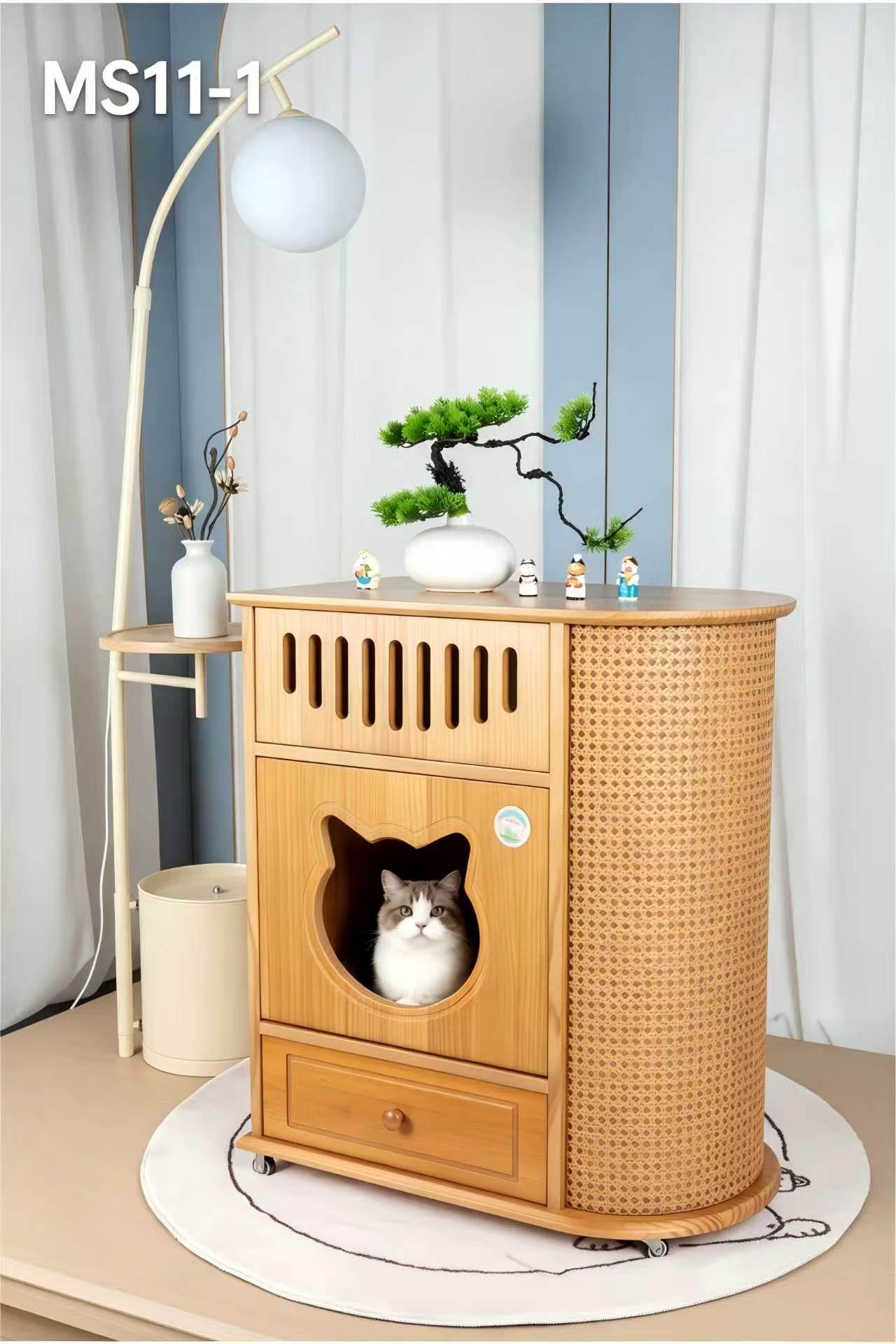
Ventilation and Odor Control: The Engineering That Matters Most
Ventilation in hidden litter box furniture works by creating a controlled airflow path — intake vents low on one side, exhaust vents high on the opposite side — so air moves through instead of stagnating. Litter type, scooping frequency, and the cat’s habits matter more than any cabinet design.
| Vent position | Placement | Purpose |
|---|---|---|
| Intake | Low, one side | Fresh air entry |
| Exhaust | High, opposite wall | Full cross-flow before exit |
| Filter slot | Groove routed at exhaust | Carbon filter accessory |
Intake sits low because ammonia rises; exhaust sits high on the far wall so air crosses the interior instead of short-circuiting. We never seal the cabinet “for odor control” — a sealed box concentrates ammonia and makes cats refuse to enter.
Airflow management, not sealing, is the engineering brief.
Waterproof Interior Liners: Keeping Moisture Out of the Wood
A litter cabinet’s interior faces litter dust, urine misses, and cleaning sprays. Solid wood survives this only if moisture never reaches it — so we use a waterproof liner system rather than relying on the wood finish alone, and the tray’s seam construction is the detail that decides whether the system holds.
| Liner element | Specification | Why it matters |
|---|---|---|
| Tray | Formed, raised edges, removable | Contains spills; lifts out for washing |
| Corners | Continuous/welded seams | Butt joints wick liquid |
| Floor panel | Coated all six faces | End grain absorbs fastest |
Under the tray, the floor panel’s coating covers all six faces including edges — end grain absorbs far faster than face grain, and an unsealed edge is where returned units swelled. The tray needs removal clearance and a finger pull; we test with the largest standard litter boxes on the market, since customers use whatever box they already own.
The liner system, not the wood finish, carries the waterproofing load.
Hidden Litter Box Furniture Wholesale: Doors, Hinges, and Daily-Use Durability
Doors and hinges decide whether hidden litter box furniture survives wholesale expectations: a cabinet door opens three to five times daily for scooping — roughly 1,500 cycles a year. We fatigue-test hinges and mounting plates to multiples of that figure before approving production hardware.
| Hardware decision | Specification | Reason |
|---|---|---|
| Cycle rating | Tested to multiples of lifetime cycles | 3–5 openings/day ≈ 1,500/year |
| Mounting plate | Hardwood block or metal insert | Screws loosen first, not the hinge |
| Catch | Tuned magnetic catch | Holds against dogs, firm-pull release |
Standard furniture hinges are rated for occasional use; a litter cabinet door sees daily cycling plus the occasional yank. Soft-close is worth specifying — a slamming door startles cats, and a startled cat may abandon the box. The opening must clear a large cat’s turning circle, with a low threshold for older cats.
The mounting, not the hinge brand, is what loosens first — specify both.
Materials and Finishes for a High-Humidity Interior
A litter cabinet’s interior faces more moisture than any other pet furniture piece. Structural panels are kiln-dried solid wood or CARB Phase 2 compliant panels verified at 8–12% moisture content; interior faces get a water-based coating selected for moisture resistance, not just appearance.
Formaldehyde compliance matters because the cabinet concentrates air around the cat: composite components carry EPA TSCA Title VI documentation, and interior faces use E0 or E1 graded boards. The honest answer: a well-sealed E0 panel outperforms a poorly finished solid board here. Exterior and interior faces follow separate finish schedules — treating them as one system is how interiors fail.
In this application, the finish system matters more than solid-versus-panel.
QC Checkpoints for Litter Box Cabinets
Litter cabinets get a dedicated QC flow because their failure modes differ from standard cat furniture. In-process quality control (IPQC) verifies the waterproofing steps that disappear under later assembly — liner fit, floor-panel edge sealing, vent-hole placement — before the cabinet is closed up.
At final inspection, the AQL plan adds category checks: each sampled door is cycled for hinge alignment, the liner removed and refitted for clearance, vents checked against the drawing. A sample water test — water sitting in the tray — confirms the corners hold. Packaging is validated against ISTA test procedures before shipping.
Waterproofing steps are verified before the cabinet closes up — never after.
Limitations: What a Litter Box Cabinet Can’t Do
No cabinet eliminates odor — it manages airflow. Brands that print “odor-free” set up returns; brands that print “ventilated design” set up repeat purchases. Not every cat accepts an enclosed box, whatever the ventilation: keep an open-top option in the same line. And the liner adds maintenance the customer must perform — a tray that isn’t cleaned lets liquid sit at the seams, and even the best seam yields to standing liquid.
Sell airflow management, not odor elimination — the honest claim repeats.
From our factory: see our workshop where solid-wood pet furniture is built and checked.
How Solid Pet Wood Engineers Hidden Litter Box Furniture
We engineer hidden litter box furniture on a dedicated line: vent routing is cut during milling, liner trays are fit-tested before assembly, hinges are fatigue-tested to multiples of lifetime cycles, and each cabinet passes a water test before packing. This category’s failure modes — liner leaks, hinge fatigue, moisture damage — need tooling and checks that standard cat furniture doesn’t have.
If your line lives or dies on those three details, it should be built by a factory that audits them as its own. Auditing a litter cabinet supplier — or developing an enclosure line from scratch? Request a quote for hidden litter box furniture. Related engineering references: durability testing protocols, quality inspection standard, hardware selection guide, solid wood factory overview.
FAQ
How many litter boxes fit inside a standard enclosure?
Most wholesale enclosures fit a single standard litter box, checked against the largest common boxes. Double-box designs need more ventilation and a wider opening; we prototype those as separate models.
Are carbon filters necessary, or just a marketing add-on?
They help at the margins. A carbon filter at the exhaust vent reduces odor on the way out, but cannot compensate for poor ventilation layout or infrequent scooping. We route a filter slot into the design because it costs little and gives brands an accessory.
What hinge specification should wholesale buyers ask about?
Ask for the cycle rating and the mounting method, not just the brand name. The rating should exceed lifetime cycles by a comfortable margin, and the plate should mount into hardwood or a metal insert rather than bare composite.
Can the interior be cleaned with standard pet-safe sprays?
Yes. The water-based interior coating tolerates routine pet-safe sprays, and the removable tray takes the brunt of direct contact. Avoid abrasive cleaners and prolonged soaking — both are called out in the care card.
Do enclosed litter cabinets suit multi-cat households?
They can, with sizing discipline. The opening and interior turning space must fit the largest cat, and ventilation scales with use — a two-cat cabinet needs more vent area. Some households run one enclosed and one open box side by side.
OEM/ODM Support
Need a custom cat tree production plan?
Send reference photos, target dimensions, material preferences, packaging needs, and market direction. We can review feasibility, sampling, MOQ, and export packaging before production. Request OEM QuoteRelated Product Lines
Explore wooden cat furniture we can manufacture.
Related Buyer Guides