
Consider two visually identical cat trees with very different lifespans. Same beech, same finish, same height — but one hides mortise-and-tenon joints at every column connection while the other holds columns with short screws in end grain. Months of jumping work the screws loose. Joinery is the invisible half of wooden cat furniture: it decides whether a piece survives the household or slowly rattles apart.
Which Joinery Is Strongest for Cat Furniture?
For load-bearing connections in wooden cat furniture, mortise-and-tenon is the strongest joinery, followed by glued dowel joints; screws alone are weakest, especially into end grain. A landing cat multiplies its body weight several times over, and only joints with real mechanical interlock plus glue survive that cyclic loading for years.
Joinery choice predicts warranty claims better than visible features: finish scratches are cosmetic, a failed column joint is structural.
| Joinery | Mechanical interlock | Glue dependence | Best structural role | Flat-pack fit |
|---|---|---|---|---|
| Mortise-and-tenon | Full — shaped tongue locked in socket | Bond across full tenon cheek | Column-to-base, column-to-platform | Poor — permanent |
| Glued dowels | Partial — pins align parts | Total — the glue is the strength | Secondary frames, hideaway boxes | Good with fasteners |
| Screws alone | None — threads only | None | Trim, cushions, replaceable parts | Good |
Judge the joint map, not the joint marketing — every load-bearing node needs mechanical interlock plus glue.
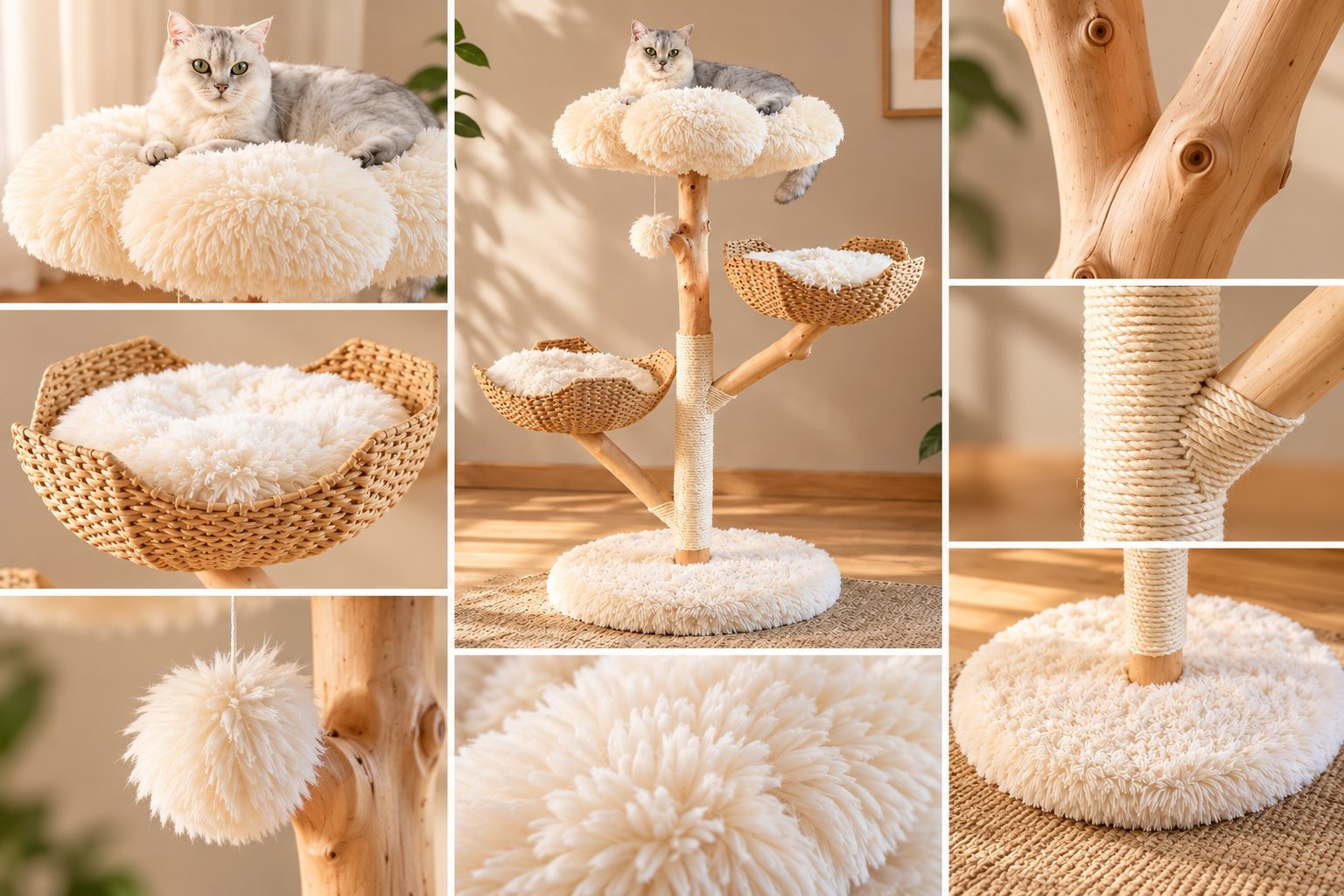
Mortise-and-Tenon: The Load-Bearing Standard
A mortise-and-tenon joint locks a shaped wooden tongue into a matching socket, glued under clamp pressure. It resists pull-out, shear, and twisting in every direction — exactly the forces a climbing cat generates. We specify it for every primary load path: column-to-base, column-to-platform, wall-bracket anchor blocks.
Strength comes from wood-to-wood contact area: glue bonds across the full tenon cheek, spreading stress instead of concentrating it on a screw thread. A mortise-and-tenon column joint comes through thousands of load repetitions silent and tight, while a screw-only comparison develops visible play.
A cheap factory will cut mortises loose and flood the gap with glue; a specialized manufacturer machines each mortise to a friction fit — a sloppy mortise is weaker than a good dowel joint. Ask to see the jig fixtures keeping every mortise identical across the production run.
Dowels and Glue: The Quiet Workhorse
Dowel joints — hardwood pins glued into matching holes — are the workhorse of wooden cat furniture: near mortise-and-tenon shear strength, fast on CNC equipment, self-aligning in assembly.
The failure mode is glue starvation. A dry dowel hole is a future wobble: tight at packing, loose within a year. IPQC checks during the production run should verify dowel fit and glue coverage. In our workshop, operators check dowel seating depth on the first piece of every batch — a thirty-second check that prevents a container of future wobbles.
For knock-down home assembly, dowels pair with confirmat-style screws — dowels for alignment, fasteners for clamping force. Our pet furniture hardware guide details which fastener types belong in knock-down cat furniture.
Screws: Fast, Familiar, and Frequently Misused
Screws are not villains — they are the most misapplied joinery in cat furniture. A screw excels at clamping parts in side grain: the right choice for cushion retainers, decorative trim, replaceable scratch pads, access panels.
The misuse is structural — screws driven into end grain, screws as the sole connection at a column base, screws holding a cantilevered platform. Screws are clamps, not structure: never accept them as the sole connection at a load-bearing node. End grain grips threads poorly, and climbing forces work screws loose the way a shaken nail works out of a board.
One structural role is legitimate: screws complementing glued joints. Driven through a glued mortise-and-tenon, a screw acts as a permanent clamp — holding the joint tight while the glue cures, adding insurance decades later.
How Joinery Choices Survive the Factory Floor
Three controls protect joint quality on our floor: jig fixtures for every drilling and routing operation; IPQC sampling at the machining stage — tenon thickness, dowel hole depth, mortise cleanliness; trial assembly of first articles, stressed by hand, before the line continues.
Paper joinery is a promise; first-article trial assembly is the proof. Our in-house design team builds, breaks, and revises each new design’s joints before tooling is finalized. We’ve seen the alternative on incoming buyer samples: joints that photographed beautifully and rattled after a week of test climbs. Ask what changed between the first prototype and the final joint map — a factory with nothing to show probably skipped the breaking step.
Where Each Joinery Belongs: A Buyer’s Joint Map
Check every connection on the factory’s structural drawing against this map:
| Structural node | Recommended joint | Why |
|---|---|---|
| Column-to-base | Mortise-and-tenon, glued | Full cyclic-load path |
| Column-to-platform | Mortise-and-tenon, glued | Cantilever stress |
| Secondary frames, hideaway boxes | Dowels, full glue coverage, IPQC-verified | Alignment plus shear strength |
| Wall-mount brackets | Mortise-and-tenon anchor blocks + through-bolts | Pull-out resistance |
| Trim, cushions, replaceable parts | Screws, clearly marked | Customer-serviceable |
Then confirm the testing behind the map: fatigue cycles on the connections and tip-over testing of the finished structure, per the logic of ASTM F2057 (official standard page). A joint map without test records is a promise; with records, it is engineering. See our pet furniture durability testing guide.
The Honest Trade-off: Why We Don’t Use Mortise-and-Tenon Everywhere
We put mortise-and-tenon at every primary load node and dowels-plus-fasteners everywhere else — three honest reasons. Tooling: each unique profile needs dedicated cutters and fixtures. Repairability: glued mortise-and-tenon is permanent. Flat-pack logic: knock-down joints must assemble with an Allen key.
The right question is never “strongest joint?” but “right joint for this connection, this assembly method, this customer’s tools?” This isn’t marketing — it’s the direct math of knock-down design: the strongest joint you can’t ship flat is worth less than the right joint a customer assembles correctly.
Wooden Cat Furniture Joinery: Specify Like an Engineer
Wooden cat furniture joinery decides product lifespan more than any visible feature. Demand the joint map, verify the load-bearing nodes, and confirm the testing behind it. Want our engineering team to review a factory’s joint map? Send it through our request-quote page or via our contact page.
How Solid Pet Wood Engineers Joinery for Cat Furniture
Joinery is where our two strengths meet: design engineering and production discipline. Our in-house design team draws a joint map for every new design, then proves it through prototype iteration — build, break, revise until the joints survive test climbs. On the floor, jig fixtures lock every mortise and dowel hole in position, IPQC sampling catches tool wear at the machining stage, and first articles are trial-assembled and hand-stressed before the run continues. Finished structures face fatigue and tip-over testing in the spirit of ASTM F2057, with records in the product file — so the answer to “what holds your cat tree together” is documentation, not adjectives.
From our factory: Watch our craftsmen build and stress-test the mortise-and-tenon joints that keep our solid wood cat trees rock-solid for years.
FAQ
How can I tell which joinery a cat tree uses without cutting it open?
Ask for a joint map and close-up photos of joints taken before upholstery or finishing. Reputable manufacturers photograph load-bearing joints during production as IPQC records.
Are dowel joints strong enough for large cats?
Yes, when properly glued — multiple dowels distribute load and resist shear well. The risk is glue starvation: verify via the factory’s IPQC records that dowel fit and glue coverage are checked during the production run.
Why do some factories use only screws in cat furniture?
Speed and tooling simplicity — screws need no special cutters or fixtures. The trade-off is lifespan at load-bearing nodes, where cyclic loading loosens them over time.
Can joinery be repaired if a joint loosens?
Dowel and screw joints can be re-glued or re-tightened by the customer; glued mortise-and-tenon is permanent — replace the part, not the joint. State this in product manuals.
Does joinery affect shipping damage rates?
Directly. Joints that survive ISTA 3A drop-test sequences arrive intact; weak joints crack inside the carton. Ask whether the finished product — not just the carton — passed parcel-simulation testing (ISTA 3A procedures).
OEM/ODM Support
Need a custom cat tree production plan?
Send reference photos, target dimensions, material preferences, packaging needs, and market direction. We can review feasibility, sampling, MOQ, and export packaging before production. Request OEM QuoteRelated Product Lines
Explore wooden cat furniture we can manufacture.
Related Buyer Guides