
Two cat trees can look identical in a product photo and differ completely in construction quality: one has reinforced joints and a weighted base, the other hides shallow screws and a hollow-core column behind upholstery. Buyers judging by photos mistake the second for the first — until returns correct them. Here are eight details that decide whether a cat tree lasts — all invisible in a render.
What Defines Cat Tree Construction Quality?
Cat tree construction quality rests on eight details: reinforced column-to-base joints, base weight matched to tower height, a solid-wood frame beneath upholstery, adequate platform thickness, no exposed fasteners in rest areas, anti-tip provisions, disciplined glue lines, and finish sealed on every face. Verify with drawings and test records — not photos.
Color and styling sell the first unit; these eight details decide whether the customer ever buys a second.
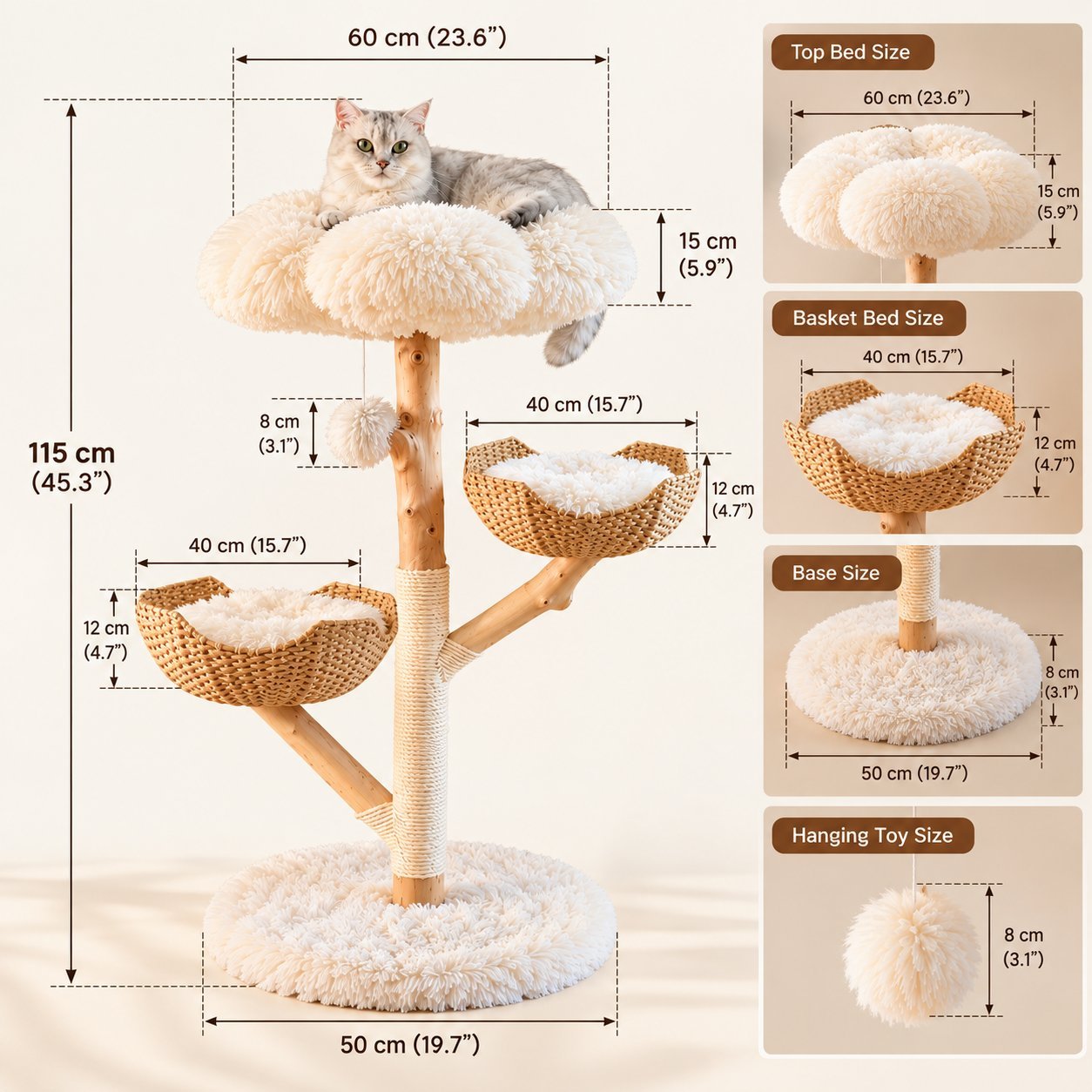
1. Column-to-Base Joints: Where Towers Live or Die
The column-to-base joint carries the highest cyclic load on a cat tree: every jump funnels force down the column into the base. Demand mortise-and-tenon or reinforced dowel joinery, glued and pinned — never screws alone into end grain. Ask for a close-up showing wood-to-wood contact, not a bracket hiding weakness.
A properly glued column-base joint survives thousands of load cycles silently; a screw-only joint develops the “wobble” customers report eighteen months in — and no tightening fixes wood that threads have wallowed out.
| Column-to-Base Joint | Behavior Under Cyclic Load | Factory Verdict |
|---|---|---|
| Screws into end grain | Threads wallow; visible play within ~18 months | Reject |
| Dowel joint, glued and pinned | Silent through thousands of fatigue cycles | Accept |
| Mortise-and-tenon, glued and pinned | Joint outlasts the upholstery | Specify for tall towers |
A cheap factory hides a screw-only joint under a decorative bracket; a specialized manufacturer shows you the joint before upholstery goes on.
2. Base Weight Proportion: The Physics of Not Tipping
A tall tree on a light base is a lever waiting for a cat. Good construction means solid wood mass — plus concealed ballast where needed — proportioned to tower height. The verification is standard: tip-over testing following ASTM F2057 logic — see the official standard page.
Ask for the test record, not the claim — a factory that ballasts bases keeps the ballast specification (material, mass, placement) on file and hands it over without hesitation.
3. The Frame Under the Plush: What Upholstery Hides
Plush is where construction quality goes to hide. Beneath the fabric of a well-built tree sits a solid-wood frame: real boards wrapped and stapled — not cardboard or thin fiberboard. The cheap alternative — fabric over hollow cores — feels identical in the showroom and collapses under a heavy cat within a year.
You cannot see through upholstery, so verify by documentation: demand a photo of the bare frame before covering, confirming solid-wood platform boards. In our workshop, frame photos are standard IPQC records — taken before fabric goes on, because no buyer can check afterward.
4. Platform Edges and Thickness You Can’t See
Platform thickness decides whether a platform resists landings without flexing and whether fasteners grip in solid wood. Thin platforms force fasteners to the edge, where they split the wood or pull through under load.
| Platform Thickness | Typical Use | Fastener Grip Margin |
|---|---|---|
| 12–15 mm | Light perches, small condos | Tight — splitting risk at edges |
| 18 mm | Standard platforms | Full seating with margin |
| 25 mm+ | Heavy landings, hideaway bases | Maximum — bolt-through capable |
Well-built trees use platforms thick enough that screws and dowels seat in solid material with margin. Edges get their own check: sealed and finished even where nobody looks, since raw edges absorb moisture, swell, and telegraph bumps through the upholstery.
5. Fastener Maps: No Exposed Metal Where Cats Sleep
Cats knead and sleep against every surface, so exposed fastener heads in rest areas are a comfort failure and a liability — good construction means countersunk fasteners with filled holes, or fasteners where paws never reach.
Ask for the fastener map: a drawing showing every mechanical fastener’s position. A factory that cannot produce one assembles by habit, not engineering.
6. Anti-Tip Provisions: Anchors, Straps, and Wall Options
Every tall cat tree should ship with anti-tip provisions: pre-drilled anchor points with hardware included, a wall-strap kit in the carton, or clear wall-mounting instructions. These are the furniture equivalent of a seatbelt — standard on responsible tall structures, not an admission of instability.
Check what ships in the carton, not what the manual suggests buying separately. An included kit signals a factory that engineered for the real home; fine-print mentions signal one that engineered for the photo.
7. Hidden Glue Lines and Why They Matter
Most structural joints are glued as well as fastened, with glue lines hidden inside — easy to neglect, impossible to inspect later. Verify by process: controlled glue application — spread rate, open time, clamping pressure, cure time — and IPQC joint-fit checks before glue-up?
Starved glue lines are the classic invisible defect: the joint looks perfect at packing and opens a year later as cyclic loading works the dry joint apart. At pre-shipment inspection we pull-test sampled joints destructively — a few broken parts that vouch for the thousands we don’t break.
8. Finish on Unseen Surfaces: Moisture’s Back Door
The last detail is the least visible: finish on platform undersides, hideaway interiors, and base bottoms. Unfinished wood exchanges moisture freely, so a platform finished on top but raw underneath cups. Where composite panels appear, sealed edges also slow emissions from CARB Phase 2 or EPA TSCA Title VI compliant boards.
Quality construction seals all faces, balancing the board. If the factory finishes surfaces nobody sees, it finishes the visible ones with care.
The Visibility Problem: Why Drawings Beat Photos
The honest limitation: every detail above is hard to verify from photos, and several stay invisible until upholstery comes off. Online sourcing rewards factories that photograph well; these eight details reward factories that build well. The practical answer is structural documentation: joint drawings, the fastener map, ballast specs, pre-upholstery frame photos, and fatigue plus tip-over records.
A factory producing these routinely as inspection records has nothing to hide; one that stalls has told you everything. See our pet furniture durability testing and pet furniture quality inspection guides for how the records should read.
From our factory: Watch how solid wood cat trees take shape in our workshop — from timber selection to the finished frame.
How Solid Pet Wood Verifies Cat Tree Construction Quality
Our in-house design team reads structural drawings like a lender reads a balance sheet — joints, fastener maps, ballast specs, test records, not renderings. That review pairs with IPQC checkpoints at load-bearing joints, glue-up discipline, and destructive pull-testing before packing. No design enters a production run unproven — on paper and on the jig fixture. For a drawing review, reach us through our contact page.
This isn’t marketing — it’s the direct math of leverage: every jump multiplies force at the column base, and the joint either survives or it doesn’t.
FAQ
Can I judge construction quality from online product photos?
Only partially — photos show styling, never structure. Use them as a first filter, then request joint drawings, pre-upholstery close-ups, and the fastener map.
Which single detail matters most?
The column-to-base joint: highest cyclic load, and progressive loosening is why tall trees wobble. Verify mortise-and-tenon or pinned dowel joinery, and ask for fatigue test records.
Should I worry about the frame under plush upholstery?
Yes — it’s the most common hiding place. Confirm a solid-wood frame via pre-upholstery photos, not hollow cores.
What testing validates these structural details?
Three levels: fatigue cycles on joints, tip-over testing per ASTM F2057 logic, ISTA 3A drop sequences on the packed product — see the ISTA test procedures page.
Do anti-tip kits mean the tree is unstable?
No — they’re standard engineering on tall furniture, a seatbelt rather than an admission of failure. What matters: does the kit ship in the carton with pre-drilled anchors, or only appear in the manual?
Cat tree construction quality lives in eight details buyers overlook — joints, base, frame, platforms, fasteners, anti-tip kits, glue lines, finishing. Want our engineers to review a factory’s drawings? Send them through our request-quote page.
OEM/ODM Support
Need a custom cat tree production plan?
Send reference photos, target dimensions, material preferences, packaging needs, and market direction. We can review feasibility, sampling, MOQ, and export packaging before production. Request OEM QuoteRelated Product Lines
Explore wooden cat furniture we can manufacture.
Related Buyer Guides